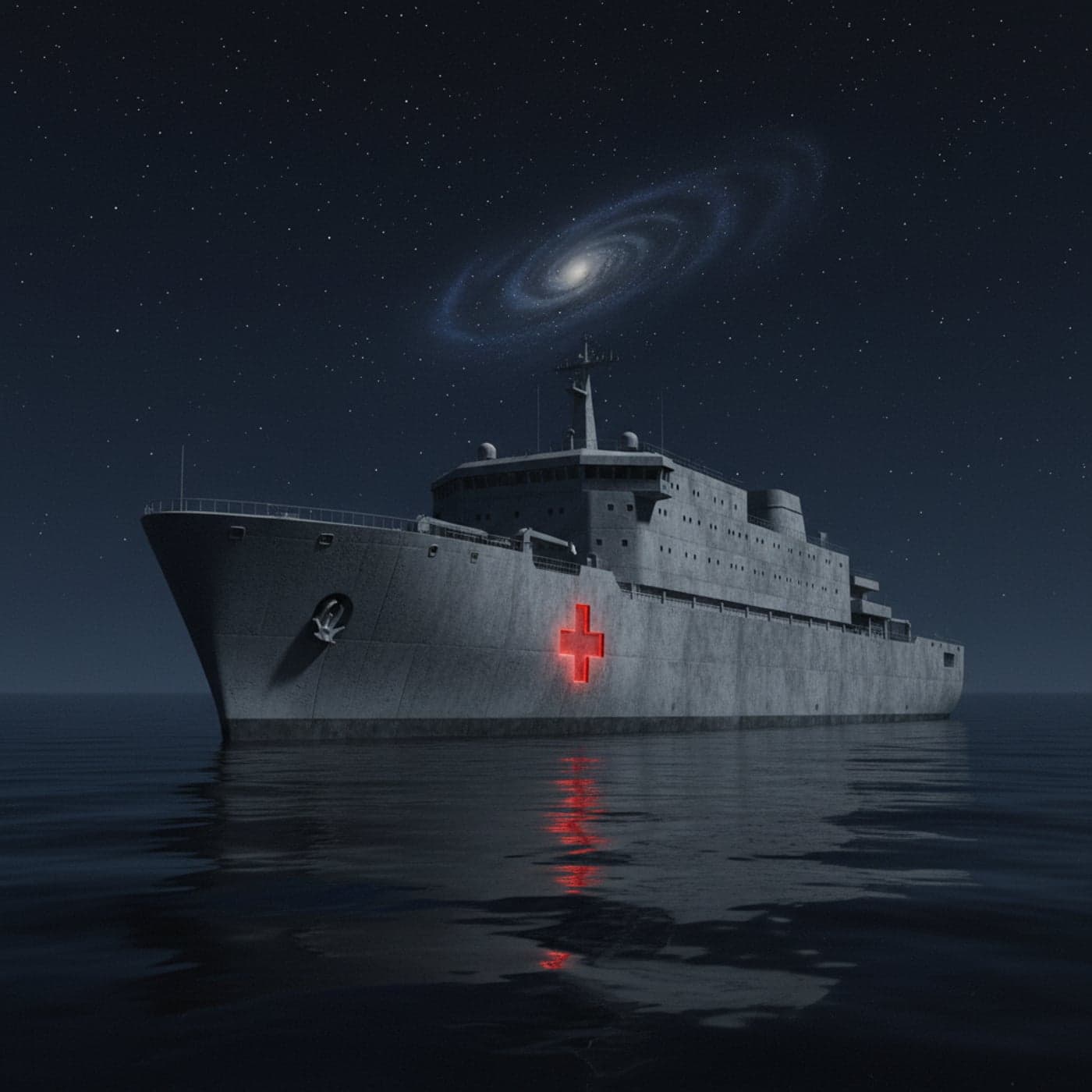
A ship built for luxury and commerce became a phantom vessel dodging submarines, only to find its final calling as a sanctuary for the wounded.
From the USS Refuge Wikipedia page. The hosts are synthetic voices.
Read the script
A ship built for luxury and commerce became a phantom vessel dodging submarines, only to find its final calling as a sanctuary for the wounded. This is the story of the USS Refuge, a vessel whose life spanned decades of peace and war, a journey from the world of passenger liners to the front lines of healing. Her life began in 1921, launched as the SS Blue Hen State. She was a product of the Emergency Fleet Corporation's '502' design, intended for troop transport but completed as a civilian passenger and cargo ship. New York Shipbuilding built her, one of seven of her kind, designed for 12,000 tons deadweight, carrying passengers and cargo, with a crew of 115. She was named after a nickname for Delaware, a state with a maritime tradition. Her name changed, a common fate for ships in those days. In 1922, she was renamed President Garfield, part of a mass renaming of 'State'-named ships. She transferred to the Dollar Line in 1923. Her early years were not without incident. In August 1925, she ran aground off Nantucket, Massachusetts, but was refloated the next day. A more serious event occurred in June 1928, when she rammed the American cargo ship SS Kershaw in the Atlantic Ocean. The Kershaw sank, tragically, with the loss of seven crew members. President Garfield, however, rescued thirty survivors. Another grounding happened in January 1929, this time on Matanilla Reef in the Bahamas. Her passengers were safely transferred to another ship, the SS Pan America, and she was refloated a few days later. She continued her service, eventually being transferred to American President Lines in 1938 and renamed President Madison in 1940. As World War II loomed, the President Madison was delivered to the U.S. Government in September 1941, operating under American President Lines. Then, war came to the Pacific. The ship had just sailed from Manila when hostilities erupted. Arriving in Surabaya, unaware of the war, she sailed with lights blazing, a stark contrast to the blacked-out port. Upon being told to extinguish her lights and informed of the war, passengers and crew scrambled to paint the ship grey. A carpenter even fashioned an imitation wooden gun, a desperate hope to deter submarines. Thus began her transformation into the 'Phantom Ship'. Under strict radio silence, she began a perilous journey to New York, dodging Japanese submarines. Her evasion was so successful that she was presumed sunk by the enemy. Ninety-two days later, she arrived safely in New York, a testament to her crew's skill and perhaps a bit of luck. The Navy acquired the President Madison in April 1942. Her civilian life was over. She was converted into a troop transport, renamed USS Kenmore, and commissioned in August 1942 as AP-62. As the Kenmore, she sailed to the Pacific, carrying Marines and naval construction battalions. She participated in operations around Guadalcanal in late 1942 and early 1943. After a period of troop transport between San Francisco and Hawaii, she returned to the Pacific, ferrying troops and cargo to Nouméa, New Caledonia, and Guadalcanal. Her service as a troop transport concluded in September 1943. She then decommissioned at Baltimore for a significant conversion, this time to a hospital ship. She was renamed USS Refuge and redesignated AH-11, recommissioning in February 1944. Now, her mission shifted from carrying troops to caring for the wounded. As USS Refuge, she began transporting casualties from war zones back to the United States. She made voyages to the Mediterranean, embarking patients from Algeria and the British Isles, returning them to American shores. Later, she sailed to the South Pacific. After stopping in Dutch New Guinea, she arrived in the Philippines on Christmas Eve, 1944. From Leyte, she began ferrying wounded soldiers and sailors to hospitals in New Guinea and the Admiralties. Through the end of August 1945, she continued this vital work, receiving patients from fleet units. Her duties extended to evacuating personnel. She sailed to Korea, embarked evacuees in China, and made voyages between Okinawa and China. Finally, she embarked patients and troops for the journey home to the United States, arriving in San Francisco in November 1944. Her service continued, taking Army troops from Japan to Seattle in early 1946. For her wartime service, USS Refuge earned one battle star. In April 1946, USS Refuge was decommissioned at Seattle. Her name was struck from the Navy list, and she was delivered to the War Shipping Administration. Placed in the Reserve Fleet, her final chapter was written in February 1948 when she was sold for scrap. From a luxury liner to a phantom evader, and finally to a ship of mercy, the USS Refuge, formerly the SS Blue Hen State, President Garfield, President Madison, and USS Kenmore, completed a remarkable journey. Her story, of adaptation and service, is based on the Wikipedia article titled USS Refuge, available under Creative Commons. The hosts are synthetic voices.