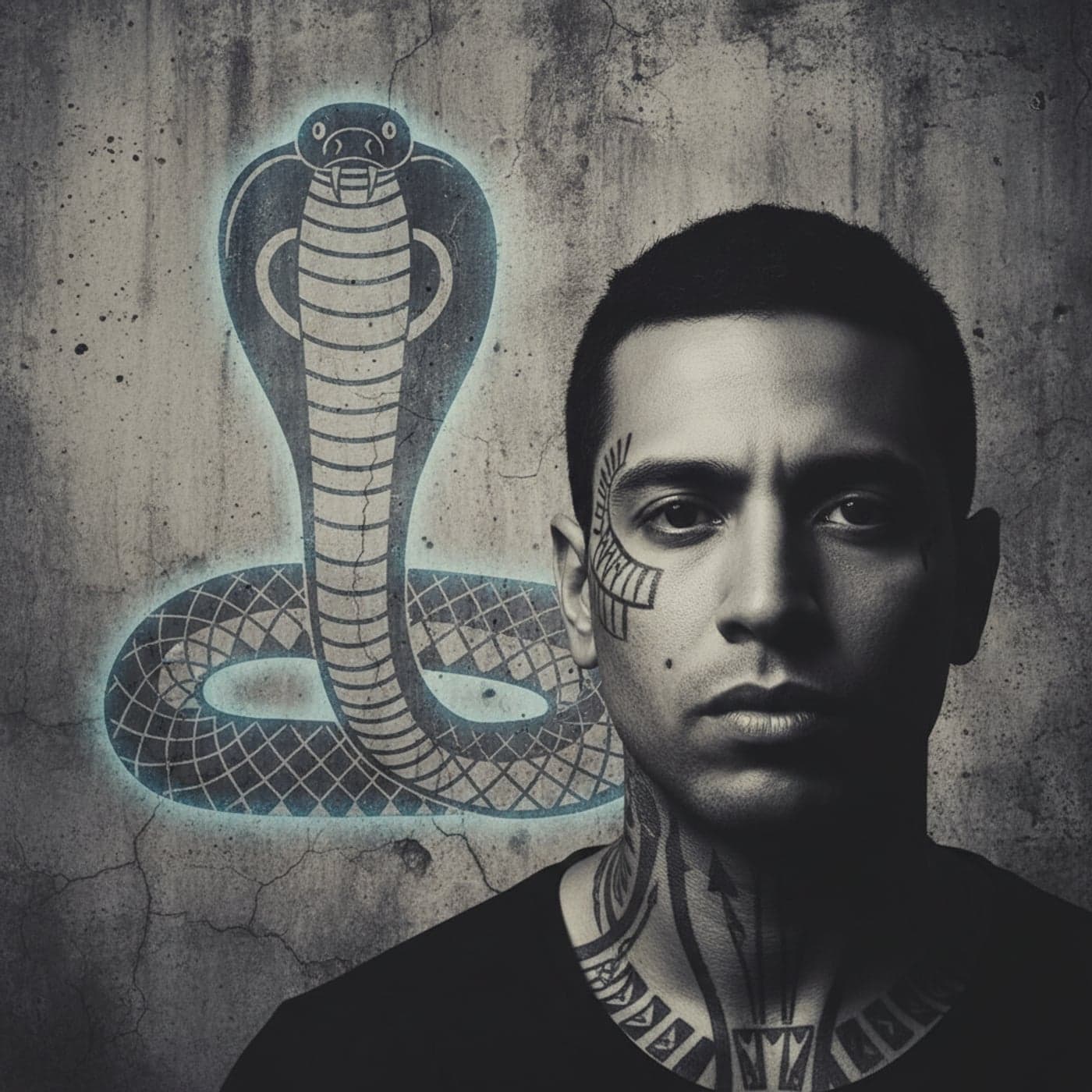
He emerged from prison after serving a decade, only to embark on a ten-day killing spree, claiming his actions were dictated by an ancient serpent god.
From the Nikko Jenkins Wikipedia page. The hosts are synthetic voices.
Read the script
He walked out of prison after serving a decade, only to unleash a ten-day killing spree. His chilling justification? That his actions were dictated by an ancient serpent god. This is the story of Nikko Jenkins. Jenkins' life was a consistent, disturbing pattern of violence and alleged mental instability. It began in childhood with shocking incidents involving weapons, and it culminated in his repeated claims of hearing divine commands from Egyptian deities. These delusions led him to commit four murders, which he attributed to the god Apophis. On July 30, 2013, Nikko Jenkins was released from an 18-year sentence for carjacking and assaults. He had served just over ten years. Within two weeks, a new wave of terror began in Omaha, Nebraska. From August 11th, a ten-day period of bloodshed commenced. Four lives were extinguished. Two individuals were lured to a meeting for sex and then murdered. Another victim was a former acquaintance from Jenkins' prison days. The final victim was a mother of three. Jenkins confessed to the killings. He was aided by family members, who also faced charges. His confession was bizarre, claiming the murders were sacrifices to Apophis, an ancient Egyptian serpent god. This delusion persisted throughout his trial. He exhibited erratic behavior, even engaging in self-harm. Psychiatrists debated his competency and the nature of his alleged psychosis. Despite his claims of mental illness and hearing divine commands, he was ultimately found competent. He was convicted of the four murders and, in May 2017, sentenced to death. Jenkins' early life was marked by significant challenges. Born in Denver, Colorado, his parents never married and had a history of domestic disputes and protective orders against each other. His mother, Lori, had a child at 16. His father, David, had a prior manslaughter conviction. Jenkins was of Omaha and African American descent through his maternal family. From a young age, Jenkins displayed a lengthy history of mental health and behavioral issues. At just seven years old, in 1993, he was temporarily removed from his mother's custody after bringing a loaded .25 caliber handgun to elementary school. By age eleven, he was accused of theft on three occasions and began skipping school, leading to placement in a group home. His behavior there was aggressive; in February 1998, he was forced to leave after whipping another child with a clothes hanger. His teenage years saw him move between his parents and a state-run youth detention center. This began after, at age 12, he attacked someone with a knife. After a series of escapes, his probation was revoked, and in August 2001, he was sent to a youth rehabilitation center. He returned to his family in 2002, but his father soon reported him for threatening him with a shotgun. That same year, Jenkins committed two armed carjackings. In 2003, at the age of 16, he received an 18-year prison sentence. His first incarceration, from 2004 to 2012, was filled with disciplinary actions. He was cited 71 times for violations including assaults on inmates, property destruction, drug use, prison tattooing, gang activity, and possessing contraband. He even fashioned a shiv from a toilet brush and was charged for participating in a prison riot. While imprisoned, his father died in 2009. That same year, Nikko and his sister Erica, who was also incarcerated, were granted furlough for their grandmother's funeral. During the funeral, Jenkins and his sister attacked a guard when one of Jenkins's hands was uncuffed. Both were restrained. In 2010, after attacking a correctional officer, Jenkins first made claims of mental illness, attempting an insanity plea. He told a psychiatrist he heard voices from Egyptian gods and blamed childhood abuse. He claimed the voices stopped with medication but later refused it, alleging prison staff were poisoning him. The psychiatrist diagnosed him with antisocial personality disorder and believed he was feigning psychosis, noting Jenkins would exaggerate his symptoms when questioned. A different psychiatrist, testifying later at his murder trial, believed Jenkins's claims of psychosis, as he had revealed plans to kill people in 2011. In 2011, based on self-reported symptoms, Jenkins was diagnosed with a nonspecific psychosis, antisocial and narcissistic personality traits. Possibilities included bipolar affective disorder with psychotic features or delusional disorder. PTSD and substance dependence were also noted. By 2012, however, staff at another correctional institution, considering his self-reported symptoms and family interactions, ruled out psychotic disorders. They supported a diagnosis of antisocial personality disorder. They observed that during family visits, Jenkins appeared clear-minded and goal-oriented, even instructing his fiancée and mother on filing complaints and monitoring staff. He referred to his presentation of mental illness as a 'skit,' indicating he was aware of his manipulation. He was released on July 30, 2013. The murders began shortly after. On August 11, 2013, two bodies were found in a pickup truck near a city swimming pool. Juan Uribe-Pena and Jorge C. Cajiga-Ruiz had been shot in the head. They had been lured there for a sexual encounter. On August 19, the body of Curtis Bradford was discovered outside a garage. Bradford and Jenkins had met in prison and even posed for a Facebook photo together within 24 hours of Bradford’s murder. It's believed Jenkins and his sister Erica lured Bradford out for a robbery, then shot him. Erica may have wanted him dead because his friends had previously shot at her house. Jenkins's final victim was Andrea Kruger, a mother of three. She was found on August 21, shot multiple times. She had been returning home from a bartending shift. Her SUV was later found abandoned miles away, with a feeble attempt to set its interior ablaze. On August 29, 2013, Jenkins was arrested on unrelated terroristic threat charges. By then, evidence was mounting. Investigators had surveillance footage of an associate buying the distinctive ammunition used in the killings. Additional footage tracked the route to Kruger's abandoned SUV. On September 3, Jenkins confessed to all four murders during an eight-hour interview. He reiterated his claim that the acts were sacrifices to Apophis. He was charged with four counts of murder. During his trial, Jenkins maintained his delusion, stating he wished to plead guilty and would protect Apophis's kingdom. He filed a lawsuit claiming his concerns about hearing voices were ignored and that his problems stemmed from mental illness. Psychiatrists remained divided on his competency, but a consensus emerged that he could stand trial. Jenkins requested to represent himself, with advisory attorneys. His courtroom behavior was erratic: speaking in tongues, howling, and laughing as details of the murders were recounted. Judge Peter Bataillon found him guilty of all four murders on April 16, 2014. Throughout this period, Jenkins also engaged in repeated self-mutilation. His sentencing was delayed as his competency to understand the death penalty proceedings was assessed. He was housed at a psychiatric hospital, but officials refused due to security concerns. Doctors agreed to treat him at a prison, where he continued self-harm, including an attempted hanging and swallowing keys. In May 2017, a three-judge panel sentenced Jenkins to death, imposing four consecutive death sentences. He received an additional 450 years for weapons charges. An appeal to the US Supreme Court based on competency and mental status was refused in 2020, upholding the conviction and sentence. Six of Jenkins's family members were arrested in connection with the killings. His sister, Erica, was sentenced to life in prison for her role, including shooting Curtis Bradford. She later changed her name to Elluminati Egoddess Enikko Prestige and received additional sentences for assaults. His mother, Lori, received a ten-year sentence for illegally purchasing ammunition. A cousin, Christine Bordeaux, was sentenced to 20 years for robbery and conspiracy. His uncle, Warren Levering, received 40 years for his involvement in Andrea Kruger's murder. Even after his conviction and sentencing, Jenkins has continued to engage in self-harm, cutting his neck to remove a non-existent tumor, leading his legal team to file for a new trial based on a claimed mental decline. His lawyers argued he had poor legal defense and did not advise him on an insanity plea or his low IQ. However, victim families criticized these requests, calling Jenkins an attention seeker. In March 2025, Jenkins asked Nebraska to set an execution date, only to retract the request weeks later, wanting to continue appeals. The court has continued to reassess his mental state and intellectual capacity. This is based on the Wikipedia article titled Nikko Jenkins, available under Creative Commons. The hosts are synthetic voices.