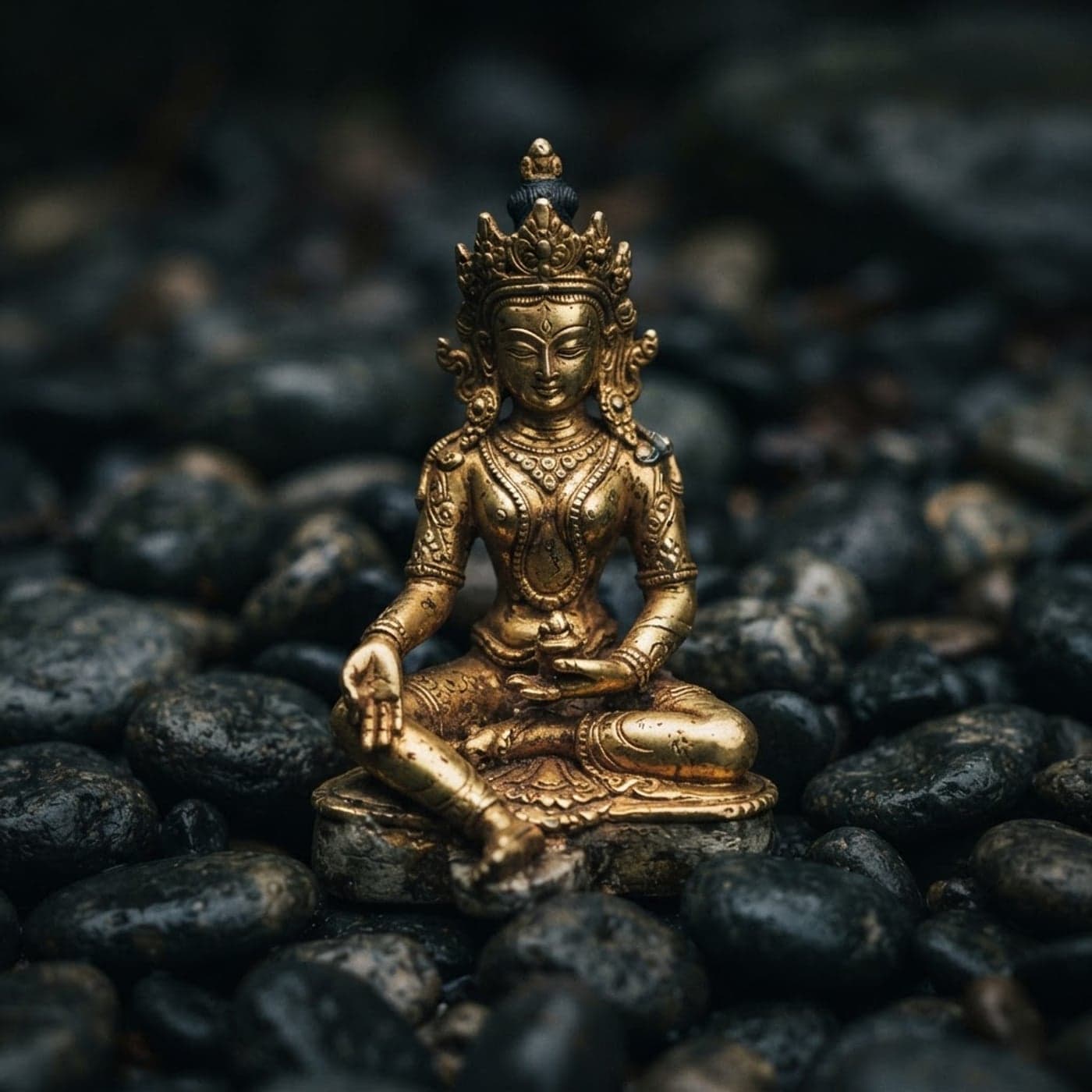
A 2kg golden goddess, unearthed by a Manobo woman, sparked a century-long debate about ancient Philippine spirituality and its place in the world.
From the Agusan image Wikipedia page. The hosts are synthetic voices.
Read the script
In 1917, along the banks of the Wawa River in Mindanao, a woman from the Manobo people was going about her day. And she found something. Something gleaming in the riverbed. A statuette, about seven inches tall, weighing four and a half pounds, made of 21-karat gold. She kept it. As a doll. A little golden figure of a woman, seated cross-legged, adorned with a headdress and jewels. It was a beautiful thing. But eventually, the statuette found its way into the hands of a local official, and then, into the wider world. And from the moment it did, this golden figure, now known as the Agusan image, has been a puzzle. A source of debate, a symbol of ancient spirituality, and a focal point for the complex history of the Philippines. Its age was determined to be somewhere between the 9th and 10th centuries. But who was she? And what did she represent? Early anthropologists, like H. Otley Beyer, suggested she was a Hindu Shaivite goddess. A goddess from a tradition that had spread through Southeast Asia, possibly through the Majapahit Empire, influencing the Philippines long before the arrival of Ferdinand Magellan. Beyer thought that local craftsmen, while skilled, might have imperfectly copied the intricate hand gestures of Hindu deities, adapting them to their own indigenous animist beliefs. This idea was supported by the discovery of other supposedly Shaivite images, though some of those were later lost in a museum fire, and their identities, too, became part of the debate. But then, other scholars looked closer. F.D.K. Bosch, in 1920, suggested the image was made by local artisans, copying a style from the Nganjuk region of Java, a region known for its gold mining. He saw a connection to Javanese miners who were active in the Agusan-Surigao area in the 14th century. He, too, leaned towards a Shaivite goddess. However, Juan R. Francisco, a Filipino scholar, questioned these assumptions. He revisited the statuette and proposed a different identity: a Buddhist Tara. He argued that the figure fit better within the Buddhist pantheon, specifically the Mahayana group, which often featured female bodhisattvas and Taras, the consorts of Buddhist gods. The debate continued, shifting and evolving with new insights. More recent scholarship has focused on an even more specific identity: Vajralāsyā. An offering goddess from the Tantric Buddhist tradition. Vajralāsyā is one of four female deities found in the inner circle of a mandala, specifically the Diamond Realm mandala. Mandalas, in Tantric Buddhism, are elaborate diagrams representing the cosmos. They can be two-dimensional, painted or drawn, or three-dimensional, like sculptural tableaux. The Diamond Realm mandala, for example, features the Buddha Vairocana at its center, surrounded by various deities, including four offering goddesses at its corners. Vajralāsyā, whose name means “amorous dance,” is always depicted with her hands on her hips. This detail, along with stylistic similarities to other statuettes from three-dimensional Diamond Realm mandalas found in Nganjuk, Java, strengthened the argument for the Agusan image being Vajralāsyā. This identification suggests something profound: that the Agusan image was likely part of a larger set of offering deities. A set that would have formed a complete Diamond Realm mandala, now lost to time, but hinting at a rich and complex Tantric Buddhist practice in the ancient Philippines. The Agusan image’s journey didn’t end with its scholarly identification. After its discovery, it was acquired by Blas Baklagon, then by the Agusan Coconut Company, to whom Baklagon owed a debt. Word of the golden figure reached Louise Wood, the wife of the American Governor-General in the Philippines. Fearing the beautiful statuette would be melted down for its gold, Mrs. Wood launched a fundraising campaign. With the help of Fay-Cooper Cole, a curator at the Field Museum in Chicago, and Shaler Matthews from the University of Chicago, enough funds were raised. In 1922, the Agusan image was purchased for 4,000 pesos and shipped to the United States. It has been on display at the Field Museum of Natural History in Chicago ever since. Its presence there has sparked another, more contemporary, debate: the call for its repatriation. Filipinos, from scholars to former senators, have advocated for its return, seeing it as a national treasure. They argue that the image was acquired during a time when the Philippines was under American colonial rule and facing financial hardship, making it impossible for the government to purchase it. The Field Museum has stated that it might return the golden image if “strongly requested” by the Philippine government. Today, the site in Agusan where the image was found has become a pilgrimage site, for both Buddhists and animists. A testament to the enduring spiritual power of this small, golden figure. This is based on the Wikipedia article titled Agusan image, available under Creative Commons. The hosts are synthetic voices.