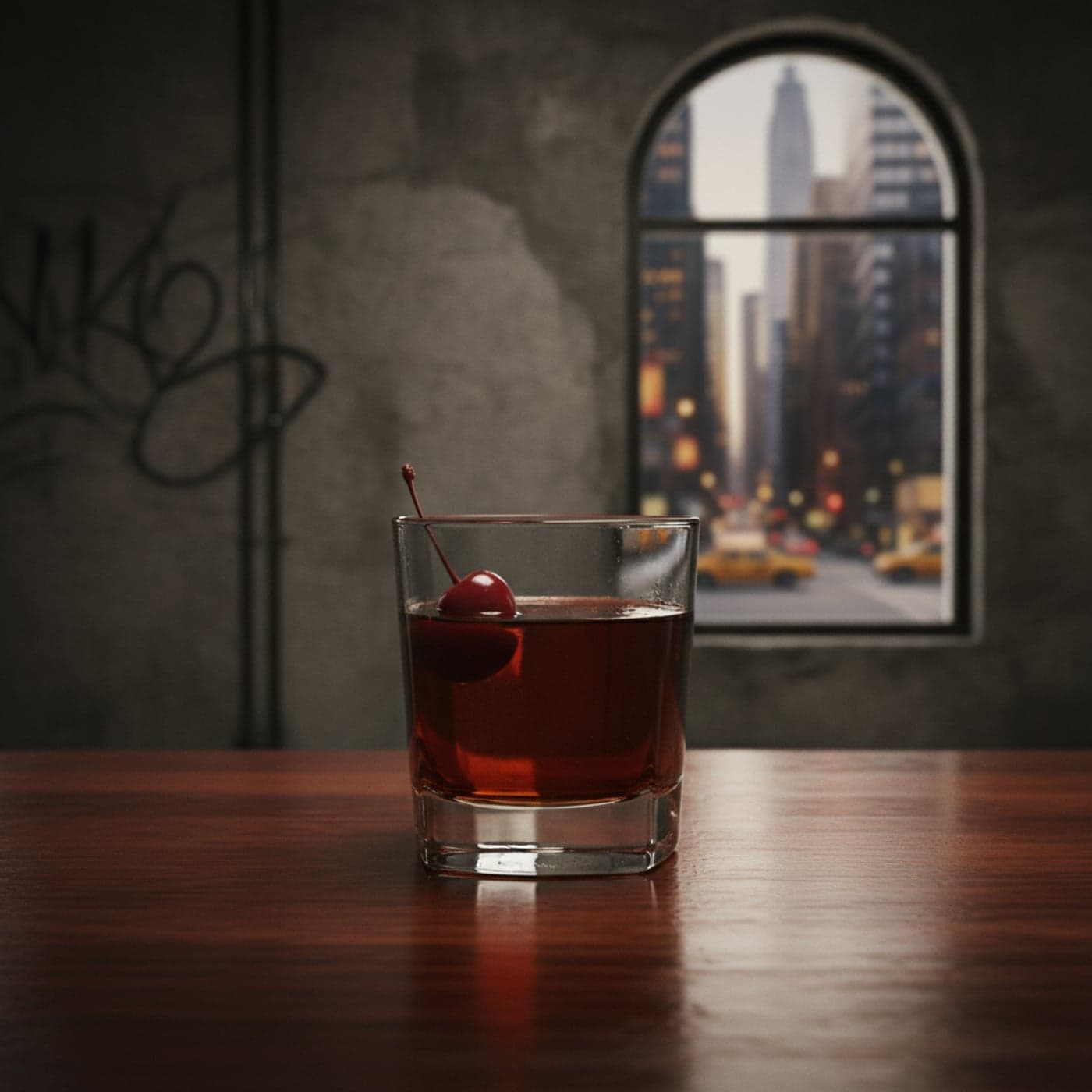
Forget the official histories; the Manhattan cocktail's true origin story is as murky and beguiling as the drink itself.
From the Manhattan (cocktail) Wikipedia page. The hosts are synthetic voices.
Read the script
Forget the official histories; the Manhattan cocktail’s true origin story is as murky and beguiling as the drink itself. This isn't a simple tale of a specific date and a celebrated inventor. Instead, it’s a story whispered through time, evolving with each sip, each bartender's unique touch. The classic Manhattan, a sophisticated blend of whiskey, sweet vermouth, and bitters, sits comfortably among the pantheon of great cocktails. Rye is the traditional choice for the whiskey, though bourbon, Canadian whisky, or even Tennessee whiskey have all found their way into the mix. Stirred with ice, strained into a chilled cocktail glass, and often crowned with a maraschino cherry, it's a drink that speaks of elegance and a certain timeless appeal. Like so many enduring legends, the most popular origin story for the Manhattan is almost certainly a charming fabrication. The tale goes that it was invented at the Manhattan Club in New York City in the mid-1870s. The occasion? A grand banquet hosted by Jennie Jerome – better known as Lady Randolph Churchill, mother of Winston – in honor of a presidential candidate. The success of this gathering, so the story claims, propelled the drink into fashion, with patrons soon asking for “the Manhattan cocktail.” It’s a lovely narrative, but one quickly unravels when you consider that Lady Randolph was, at that precise time, in France and heavily pregnant. Not exactly the ideal conditions for hosting a lavish New York banquet. The real genesis, it seems, is far more humble and, frankly, a bit blurry. Earlier references point to a bartender named Black, working at a bar on Broadway near Houston Street in the 1860s, as the likely creator. By 1884, the drink had already made its way into print, appearing in bartending guides like Charlie Paul’s *American and other Drinks* and O.H. Byron’s *The Modern Bartender’s Guide*. These early recipes show variations, from Scotch whiskey with a dash of plain syrup and lemon, to versions using French or Italian vermouth. It even appeared under a different name, the “Tennessee Cocktail,” in a 1930s guide. What’s clear is that the Manhattan emerged from the vibrant, innovative bar scene of New York City, becoming one of five cocktails named for a New York City borough. It’s a close relative to the Brooklyn cocktail, which swaps out sweet vermouth for dry, and changes the bitters, but the kinship is undeniable. During the Prohibition era, from 1920 to 1933, when alcohol was driven underground, Canadian whisky became a popular choice for the Manhattan, simply because it was more readily available. This adaptability is one of the cocktail’s hallmarks. Bartenders today continue to experiment, using different types of bitters, creating their own syrups, or substituting other digestifs for vermouth. Some even shake it rather than stir, creating a frothy top. The garnish, too, can vary from the classic cherry to a lemon peel. But perhaps the most charming chapter in the Manhattan’s journey takes us far from the bustling streets of New York, to a small, remote island in the North Sea. On Föhr, one of Germany’s North Frisian islands, the Manhattan cocktail is not just a drink; it's a staple, found in almost every cafe, restaurant, and local gathering. The story here is that many islanders, traditionally deep-sea fishermen, would travel to Manhattan, fall in love with the drink, and bring the recipe back home. On Föhr, it’s typically mixed as one part vermouth to two parts whiskey, with a dash of bitters, served ice cold in an ice-cold glass, often with ice and a cherry. It’s a testament to the drink’s universal appeal, finding an unexpected second home thousands of miles from its supposed birthplace. From a contested birth in the bustling taverns of Broadway to a beloved tradition on a windswept German island, the Manhattan cocktail has proven its enduring allure. It’s a drink that, much like the city it’s named after, is always evolving, always welcoming new interpretations, yet always remaining distinctly itself. This portrait is based on the Wikipedia article titled Manhattan (cocktail), available under Creative Commons. The hosts are synthetic voices.