He was a diplomat who befriended Sun Yat-sen, survived a tiger hunt, and advised presidents on China.
From the Ernest B. Price Wikipedia page. The hosts are synthetic voices.
Read the script
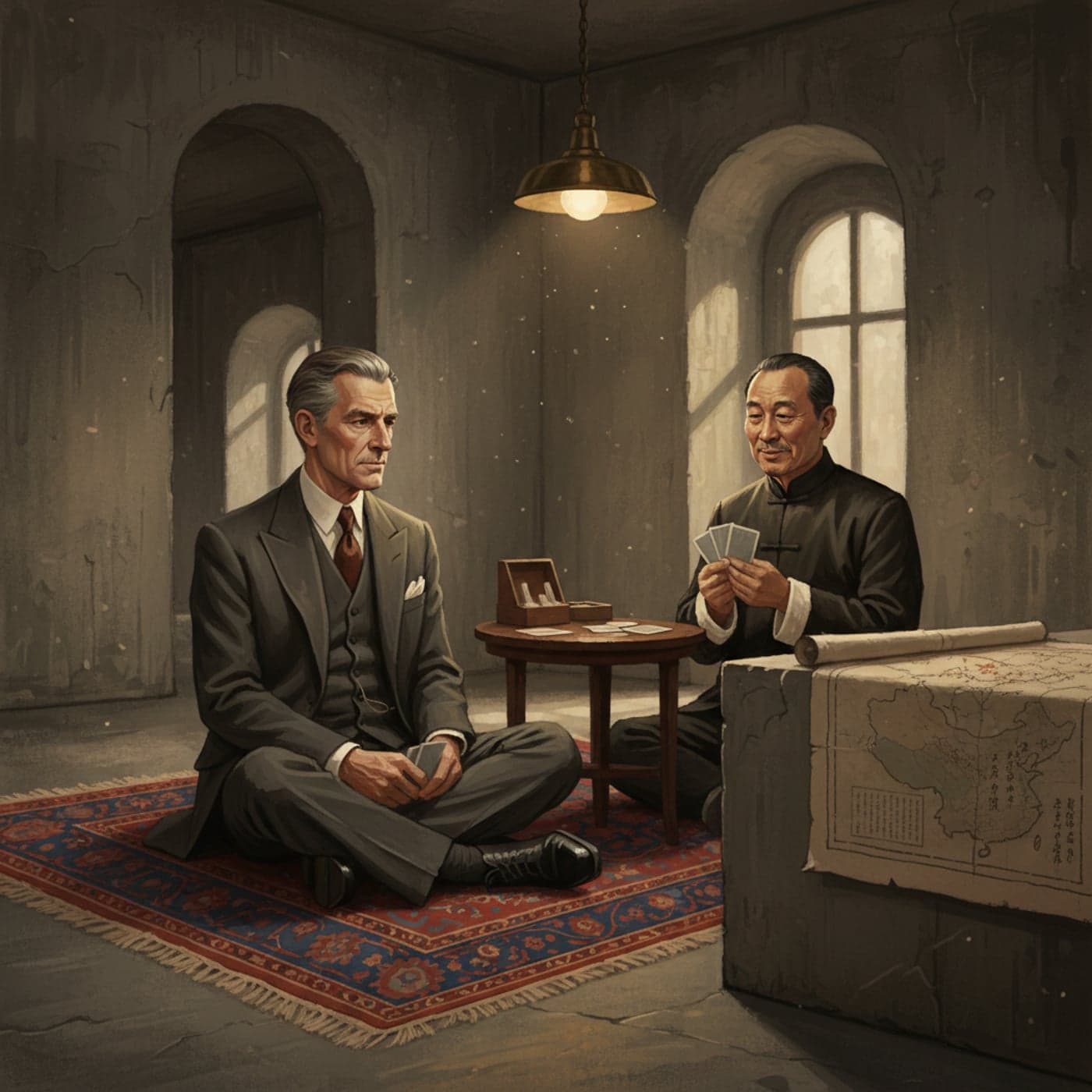
Ernest B. Price lived a life that was, in many ways, a bridge. A bridge between continents, between cultures, between eras. He was a man who understood China not just from policy papers, but from the ground up, forging friendships and navigating its tumultuous landscape for decades. It’s a life that began far from the centers of power, born to missionary parents in Burma in 1890. His early years instilled in him a global perspective, and after his father’s death, he found himself back in the United States, learning German in a small North Dakota school. This linguistic talent, coupled with his studies at the University of Rochester, set him on an extraordinary path. His fluency in German, unexpectedly, helped him enter the special China branch of the U.S. Foreign Service. Once in China, he plunged into Mandarin, mastering it in less than two years. This wasn't just about language; it was about immersion. He met his future wife, Florence, in Yokohama, where they married, and together they spent the next fifteen years in China. All five of their children were born there, truly rooting their family in the country that would define so much of Ernest’s career. In China, personal relationships were everything, and Ernest cultivated them with remarkable skill. He befriended warlords, not taking sides in their power struggles, but trying to expand American trade. He saw the growing influence of Imperial Japan and the Comintern agents, and he understood the crucial role that these personal connections played. Perhaps his most significant friendship was with Dr. Sun Yat-sen, the man who would become the first President of the Republic of China. They played bridge together, discussing politics, and their bond was so strong that Sun Yat-sen invited Ernest and Florence to his inauguration. The U.S. didn't officially recognize the Nationalist government then, so Ernest couldn't attend in his diplomatic capacity. But Florence went, and her detailed report became a formal dispatch to the State Department – a testament to the unique position Ernest and his family held. Ernest’s diplomatic life was anything but sedentary. In 1920, as Assistant Chinese Secretary in Peking, he was tasked with escorting an American trading company’s caravan of Model-T Fords across the vast Gobi Desert to Mongolia. This wasn't just a trade mission; it was also a secret intelligence assignment to check on a U.S. consul in Russia, whose fate was uncertain amidst the chaos of the Bolshevik revolution. He succeeded in both, returning with the renowned archaeologist and adventurer Roy Chapman Andrews, often cited as an inspiration for Indiana Jones. Andrews recounted their journey, including a memorable moment when their car ran out of oil in the Gobi, only to be saved by a camel caravan and a pot of mutton fat. Andrews even incorporated another of Ernest’s real-life adventures – hunting a man-eating tiger in southern China – into one of his own novels. After serving in various diplomatic posts, Ernest left the Foreign Service in 1929 to become President of China Airways. He then returned to the U.S. to pursue a doctorate, earning his PhD in political science from Johns Hopkins in 1933. His book, “The Russo-Japanese Treaties,” chronicled the relentless efforts of Japan and Russia to carve up Northeast Asia. He visited Japan’s puppet state of Manchukuo, even meeting the last Manchu emperor, Pu Yi. His writings in the 1930s warned of Japan’s aggressive policies, highlighting the threat of international conflict – warnings that proved to be both prophetic and timely. He taught Chinese studies at the University of Chicago, where his mastery of multiple languages made him a natural host for distinguished international visitors. When World War II broke out, Ernest’s deep understanding of China became invaluable. He advised President Franklin D. Roosevelt through the Office of Strategic Services, the precursor to the CIA. In 1944, he was commissioned as a Marine Corps Captain, planning for an Allied invasion of Japanese-occupied China. After the atomic bomb, he was immediately dispatched to China with the first wave of American occupation troops, present for the formal Japanese surrender. He even made the first Chinese-language radio announcement of the surrender. His “sound advice based on a thorough understanding of the Chinese people” earned him a Bronze Star. After the war, he supported U.S. ambassadors, including General George C. Marshall, in their attempts to negotiate a coalition government and prevent civil war between Nationalist and Communist forces. Though these efforts ultimately failed, Ernest’s “keen sense of judgment” earned him a second Bronze Star. He later joined Standard Vacuum Oil Company, hoping to expand their operations into China. He worked in Hong Kong and Shanghai until the Communist revolution forced their withdrawal. He retired in 1960 and passed away in 1973 in California. Ernest B. Price’s life was a testament to the power of personal connection and deep understanding in an often-impersonal world. His diplomatic dispatches, journals, and correspondence are now preserved in the Hoover Institute archives at Stanford University, a rich legacy of a man who truly understood China. This has been a spoken life portrait based on the Wikipedia article titled Ernest B. Price, available under Creative Commons. The hosts are synthetic voices.