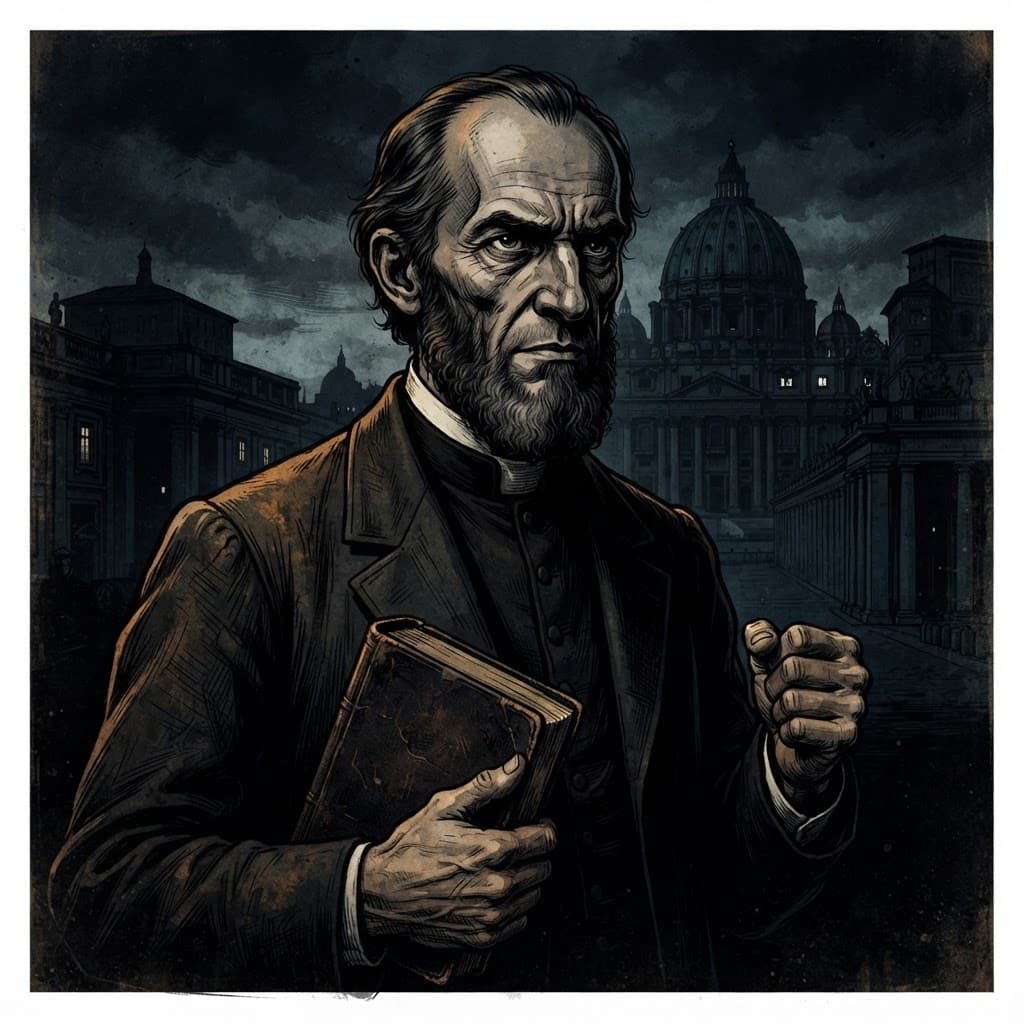
A Catholic priest turned Presbyterian minister accused the Vatican of orchestrating Abraham Lincoln's assassination.
From the Charles Chiniquy Wikipedia page. The hosts are synthetic voices.
Read the script
You think you know the story of Abraham Lincoln. A man of humble beginnings, a lawyer, a president who saved the Union. But what if I told you that the very fabric of that story, the tragic end, was woven with threads of conspiracy, threads reaching all the way to the Vatican? It sounds like something out of a pulp novel, doesn't it? A Catholic priest, excommunicated and enraged, pointing a finger at the Pope himself as the mastermind behind Lincoln's assassination. This isn't fiction. This is the life and legacy of Charles Chiniquy. Chiniquy. Say the name. It’s a name you might not recognize, but the claims he made are astonishing. He was a man who lived a life of dramatic reversals. Born in Quebec in 1809, he began as a fervent Catholic priest. He was also a passionate crusader against alcohol, a man who saw drink as a plague on his community. He immigrated to Illinois, where he founded a colony. He even hired a young, ambitious lawyer named Abraham Lincoln to defend him in a libel suit. A promising start, right? A man of God, a community builder, a friend of the future president. But then, the path diverged. Chiniquy clashed with his bishop. The details are murky, a dispute over church governance, a disagreement about how Catholics in Chicago were being treated. The bishop threatened him with excommunication. Chiniquy refused to move, to accept his bishop’s authority. And so, in 1856, he was excommunicated. A formal, public severing from the Catholic Church. He disputed the decision, of course. He felt wronged, misunderstood. This excommunication was the pivot. It was the moment Charles Chiniquy stopped being a Catholic priest and started becoming something else entirely. He left the church, converted to Protestantism, and became a Presbyterian minister. And with this conversion came a new mission: to denounce the Catholic Church with every fiber of his being. His life’s work, for the remaining forty years, was a relentless assault on Catholicism. He wrote books, gave lectures, and crisscrossed the continent, warning anyone who would listen that the Church was pagan, that its followers worshipped Mary, that its theology was fundamentally anti-Christian. He spoke of Vatican plots to seize control of the United States, fueled by waves of Catholic immigrants from Ireland, Germany, and France. This was a time of great social upheaval, of famine and revolution in Europe, and Chiniquy painted a picture of a sinister, coordinated effort to undermine American democracy. His autobiography, 'Fifty Years in the Church of Rome,' became a sensation. It was a bestseller, a gripping account of his spiritual journey, but also a powerful piece of anti-Catholic propaganda. And within its pages, he laid out his most explosive claim: that the Vatican was behind the assassination of Abraham Lincoln. He asserted that Lincoln’s assassins were faithful Catholics, acting on orders from the Pope himself. Think about that. A man who had once hired Lincoln as his lawyer, a man who had walked among the very people he was now accusing, was now weaving them into a grand conspiracy theory that implicated the highest levels of the Catholic Church. Did he provide concrete proof? The article doesn't go into that. What it does show is the sheer force of his conviction, and the impact he had. He joined the Orange Order, a Protestant fraternal society with a history of anti-Catholic sentiment, and found a willing audience. His lectures sometimes led to riots. In New Zealand, his tour was cut short due to opposition from Catholics. He was a controversial figure, to say the least. But the story doesn't end with Chiniquy. His influence, insidious and persistent, lingered. His books, particularly 'Fifty Years in the Church of Rome,' continued to be promoted among Protestant Christians, among those who held a fundamentalist view of faith. The article even points to Jack Chick, the creator of those ubiquitous, often shocking, 'Chick tracts,' as a modern-day follower who adapted Chiniquy’s autobiography for his own anti-Catholic comics. So, what do we make of Charles Chiniquy? Was he a man driven by genuine spiritual conviction, or a bitter ex-priest seeking revenge? Was he a prophet warning of genuine threats, or a demagogue exploiting fear and prejudice? The historical record, as presented in the Wikipedia article titled 'Charles Chiniquy,' available under Creative Commons, doesn't offer easy answers. It presents a life lived in extremes, a man who started with a mission to save souls from alcohol and ended by accusing the Pope of murder. It’s a reminder that history is rarely as simple as we’d like it to be. Sometimes, the most compelling stories are the ones that leave us with more questions than answers.