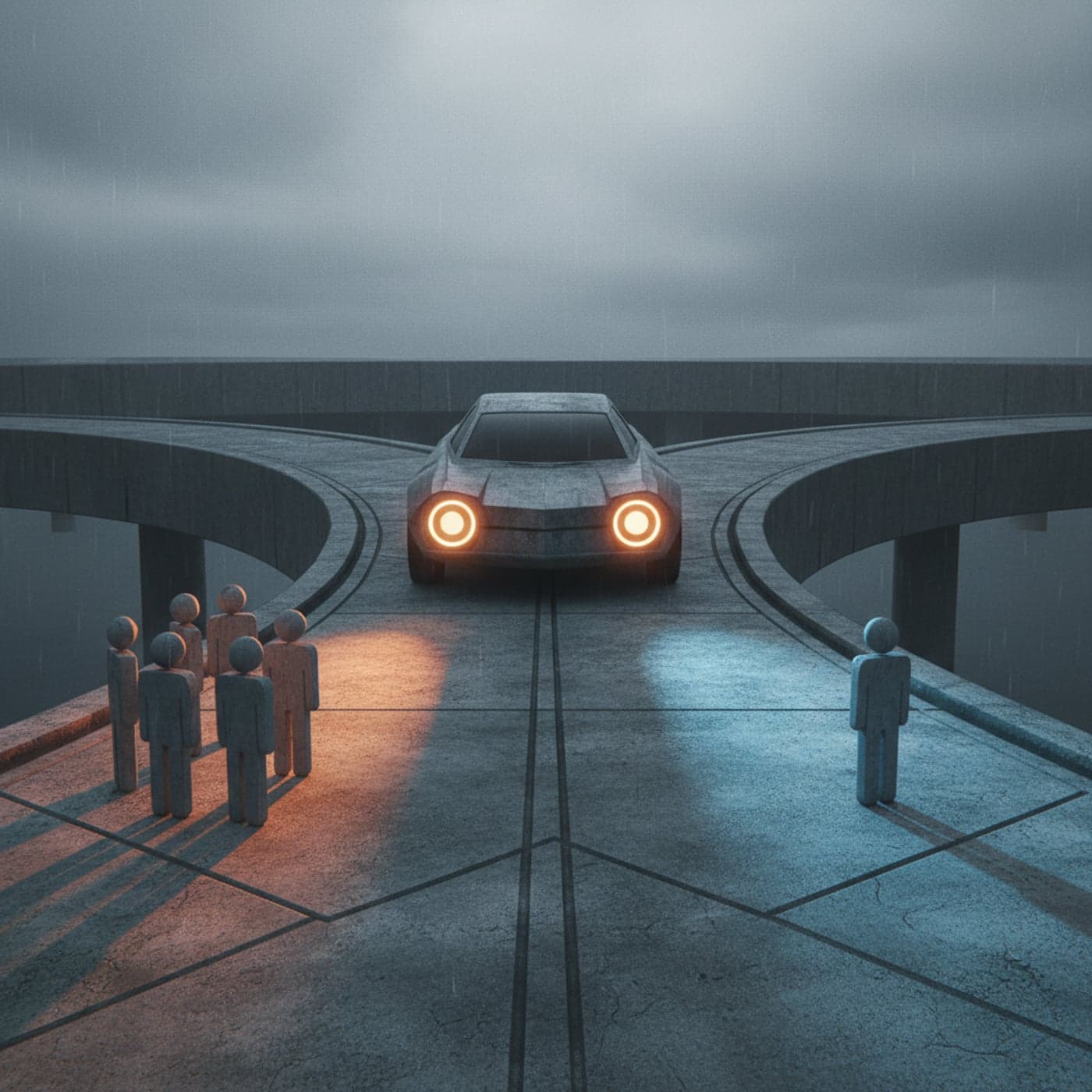
Wait, so you're telling me philosophers spent decades thinking about whether to push a fat guy off a bridge to save five people, and now self-driving cars might have to make that exact call?
From the Trolley problem Wikipedia page. The hosts are synthetic voices.
Read the script
Host A: Okay, so I was deep-diving on Wikipedia last night, you know, how I do. And I stumbled across something that honestly blew my mind. It's called the trolley problem. Host B: The trolley problem? Is that like, a new ride at Six Flags? Host A: No, no, no. It's this classic philosophical thought experiment. So imagine, there's a runaway trolley, right? And it's barreling down the tracks towards five people who are tied up. You're standing by a lever, and if you pull that lever, the trolley will switch to a different track. But, uh oh, there's one person tied to that other track. Host B: Oh no. So you either let five people die, or you actively pull a lever that kills one person? Host A: Exactly! That's the core dilemma. And get this – philosophers have been wrestling with this for decades. They've come up with all these variations, like the 'fat man' dilemma, where you're on a bridge and the only way to stop the trolley from hitting the five people is to push a really large stranger off the bridge onto the tracks. Which is... a lot. Host B: Yeah, that's significantly more visceral. So, what's the philosophical consensus? Kill the one, save the five? Or is it better to do nothing and let the five die? Host A: Well, that's the thing. There isn't really a consensus. Utilitarians, the ones who think the best action is the one that maximizes overall happiness or well-being, they'd say you absolutely have to pull the lever. It's the greater good, right? One life versus five. Host B: Makes sense. From a purely numbers perspective. Host A: But then you have other viewpoints, like deontology, which focuses on duties and rules. They might say that actively causing someone's death, even to save others, is inherently wrong. You can't just use a person as a means to an end, even a good end. Host B: So, it's like, the intent matters more than the outcome? Host A: In some philosophies, yes. And then it gets even messier. People's intuitions change depending on the details. Most people would pull the lever in the original scenario, but fewer people are willing to push the fat man off the bridge, even though the outcome is the same – one death to save five. Host B: I can see that. Pushing someone feels a lot more… direct. Like you're the one committing the act. Flipping a switch feels more like redirecting a disaster. Host A: Right? And here's where it gets really wild and why I was so fascinated. This isn't just an abstract puzzle anymore. This is becoming a real-world problem for self-driving cars. Host B: Wait, seriously? So, like, when a self-driving car is in an unavoidable accident, it has to make a decision like this? Host A: Apparently, yes. Engineers are literally trying to program ethics into these vehicles. They have to decide, in a split second, who the car should hit if it can't avoid a collision. Does it swerve to hit a pedestrian to save the occupants? Or does it protect the pedestrian even if it means endangering the people inside the car? Host B: That's… terrifying. And also, incredibly complex. How do you even begin to program that? Host A: Exactly! MIT even created this thing called the 'Moral Machine' online game, where they asked millions of people how they'd want autonomous vehicles to behave in these scenarios. They wanted to see if there were cultural differences in these ethical judgments. Host B: So, they're crowdsourcing morality for robots? That sounds like a recipe for disaster. Host A: It does, doesn't it? And the article pointed out that some critics say these trolley problems are too abstract, too divorced from reality to be useful for programming. They argue that real-life accidents are chaotic and unpredictable, not neat little dilemmas with clear choices. Host B: That makes sense. In a real crash, it's probably not as clean as 'one person here, five people there.' There's a lot more uncertainty. Host A: And then there's the legal side. The article mentioned how this comes up in law too. Traditionally, the law has a hard time with the idea of intentionally causing harm, even to prevent greater harm. Like that old case of shipwrecked sailors who killed one of their own to survive – they were still convicted of murder. Host B: Because the law doesn't want to endorse 'ends justify the means' when it comes to taking a life. Host A: Precisely. But then you see utilitarian thinking creeping into other areas, like cost-benefit analyses for safety regulations. It's like this philosophical debate is constantly bubbling up in different forms. Host B: It’s mind-boggling to think that something that started as a hypothetical thought experiment in a philosophy class is now directly influencing how we design the technology of the future. And who gets to decide what's 'right' for these algorithms? Host A: Right? Is it the engineers? The car manufacturers? The government? Or should individual car owners be able to set their own car's 'ethical settings'? Imagine a world where you can buy a car that's programmed to prioritize your life above all else, or one that’s programmed to be a selfless altruist. Host B: That sounds like a dystopian nightmare. People would be choosing cars based on whether they want their car to be a bodyguard or a martyr. Host A: It’s a lot to process. This is all based on the Wikipedia article titled "Trolley problem," available under Creative Commons. Host B: Well, you've definitely given me a lot to think about. My brain hurts. I might need to go lie down. Host A: [laughs] Me too. But it’s fascinating, isn't it? How these age-old questions are suddenly becoming incredibly urgent.