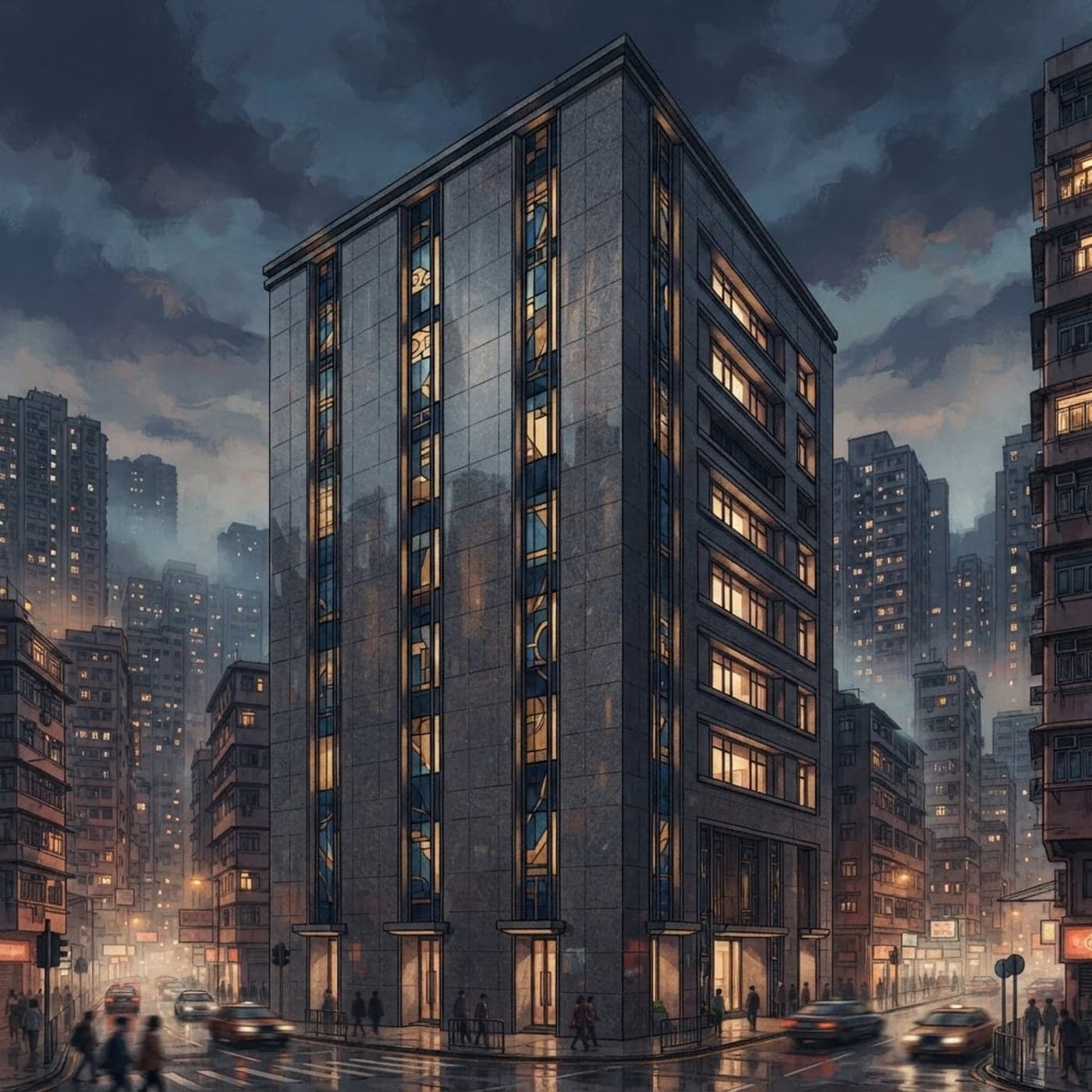
In a city defined by its relentless pace, a sanctuary of peace was meticulously crafted, blending ancient Chinese motifs with the spiritual aspirations of a growing faith.
From the Hong Kong China Temple Wikipedia page. The hosts are synthetic voices.
Read the script
In the vibrant, ceaseless energy of Hong Kong, a city that never truly sleeps, there stands a place designed for profound peace. It is a sanctuary, meticulously crafted, where ancient Chinese motifs meet the spiritual aspirations of a growing faith. This is the story of the Hong Kong China Temple. Its existence is a testament to persistent spiritual outreach, a journey spanning decades, overcoming geographical and political hurdles to establish a sacred space. It’s a building that harmonizes East and West, symbolizing deep roots and continued growth for The Church of Jesus Christ of Latter-day Saints in Asia. The Hong Kong China Temple, originally known simply as the Hong Kong Temple, holds a significant place as the 48th operating temple of the Church. Its story begins long before its physical construction, with the first missionaries arriving in Hong Kong in 1853. Their initial efforts were brief, hampered by the internal turmoil of China at the time, leading them to return home after just a few weeks. The seed was replanted in 1921, when David O. McKay, then of the Quorum of the Twelve Apostles, dedicated China for missionary work with a prayer in Beijing’s Forbidden City. Official missionary work in Hong Kong then began in earnest on July 14, 1949, marked by another prayer, this time by apostle Matthew Cowley. The early days saw about 30 people attending weekly meetings by 1951. This small gathering blossomed, growing to 1,700 members by 1960 and a remarkable 10,000 by 1975. This growth was also supported by significant efforts like the translation of the Book of Mormon into Chinese, completed in 1965. By the early 1990s, the need for a dedicated temple in the region became clear. In October 1992, Gordon B. Hinckley, then first counselor in the First Presidency, announced the intention to build a temple in Hong Kong. But finding a suitable, affordable site in Hong Kong’s incredibly dense urban landscape was a monumental challenge. Real estate in the city is notoriously expensive and scarce. The solution was ingenious and uniquely suited to Hong Kong: a vertical design. Instead of spreading out, the temple would rise up. It was decided that the new temple would be built on the site of an existing mission home and chapel, becoming a multi-purpose facility. The groundbreaking ceremony took place on January 22, 1994, presided over by John K. Carmack. This scarcity of space led to the temple’s distinctive architecture. The six-story building was designed to house not only the temple itself, but also a chapel, mission offices, and even living quarters for the temple president and several missionaries. It was a compact, efficient, and deeply integrated structure, reflecting the pragmatic spirit of Hong Kong itself. Construction proceeded steadily over the next four years. When it was completed, a public open house was held from May 7 to May 21, 1996, drawing over 13,000 visitors. This included 25 interfaith leaders and 500 VIP guests, highlighting the temple’s presence as a significant landmark in the community. The temple was officially dedicated on May 26 and 27, 1996, in seven sessions led by Gordon B. Hinckley, who by then had become the Church president. He was joined by other prominent Church leaders, and over 5,000 members participated in the dedication, many traveling from Taiwan, Thailand, Singapore, and mainland China. Hinckley remarked on the Church’s remarkable growth in Asia, noting that the dedication of the temple marked a moment of “full maturity” for the faith in the region. At that time, Hong Kong was home to 20,000 Church members across five stakes. The temple’s exterior is polished granite, with Giallo Ornamental and Sunset Gold stone sourced from Xiamen, China, reflecting Hong Kong’s colonial architectural influences. Its design incorporates traditional Chinese elements, such as vertical columns of art glass and ornamental walls. Inside, traditional Chinese motifs are woven throughout, including the thunder pattern symbolizing life-giving rain, and decorative stencils inspired by ancient Chinese ceramics. The Yulan magnolia, symbolizing purity, is a prominent feature in the art glass of the celestial room. Even the furniture and lighting fixtures echo Chinese craftsmanship, with fretwork, asymmetrical wood grain patterns, and hexagonal chandeliers reminiscent of traditional lanterns. In 2019, the temple closed for significant renovations. These updates included structural reinforcement, changes to the exterior, and interior reconfigurations. Notably, the original spire and Angel Moroni statue were removed, replaced by a smaller tower designed to create a more understated and culturally harmonious aesthetic. Following these renovations, the temple was rededicated on June 19, 2022, by Gerrit W. Gong, the Church’s first ethnically Chinese apostle. The Hong Kong China Temple serves as a vital spiritual hub for Church members across a wide swath of Asia, including parts of India, Pakistan, Thailand, Sri Lanka, Singapore, Mongolia, Malaysia, Cambodia, and Indonesia. It holds particular significance for Filipino domestic workers, who often work six days a week. To accommodate their schedules, the temple uniquely opens quarterly on Sundays, a testament to its commitment to serving its diverse congregation. Gordon B. Hinckley once described the temple as a “sanctuary of peace amid the rush and roar” of Hong Kong’s bustling metropolis. It stands as a symbol of faith’s enduring journey, a place where spiritual aspirations find a home in a city of constant motion, beautifully blending cultural heritage with sacred purpose. This portrait is based on the Wikipedia article titled "Hong Kong China Temple," available under Creative Commons. The hosts are synthetic voices.