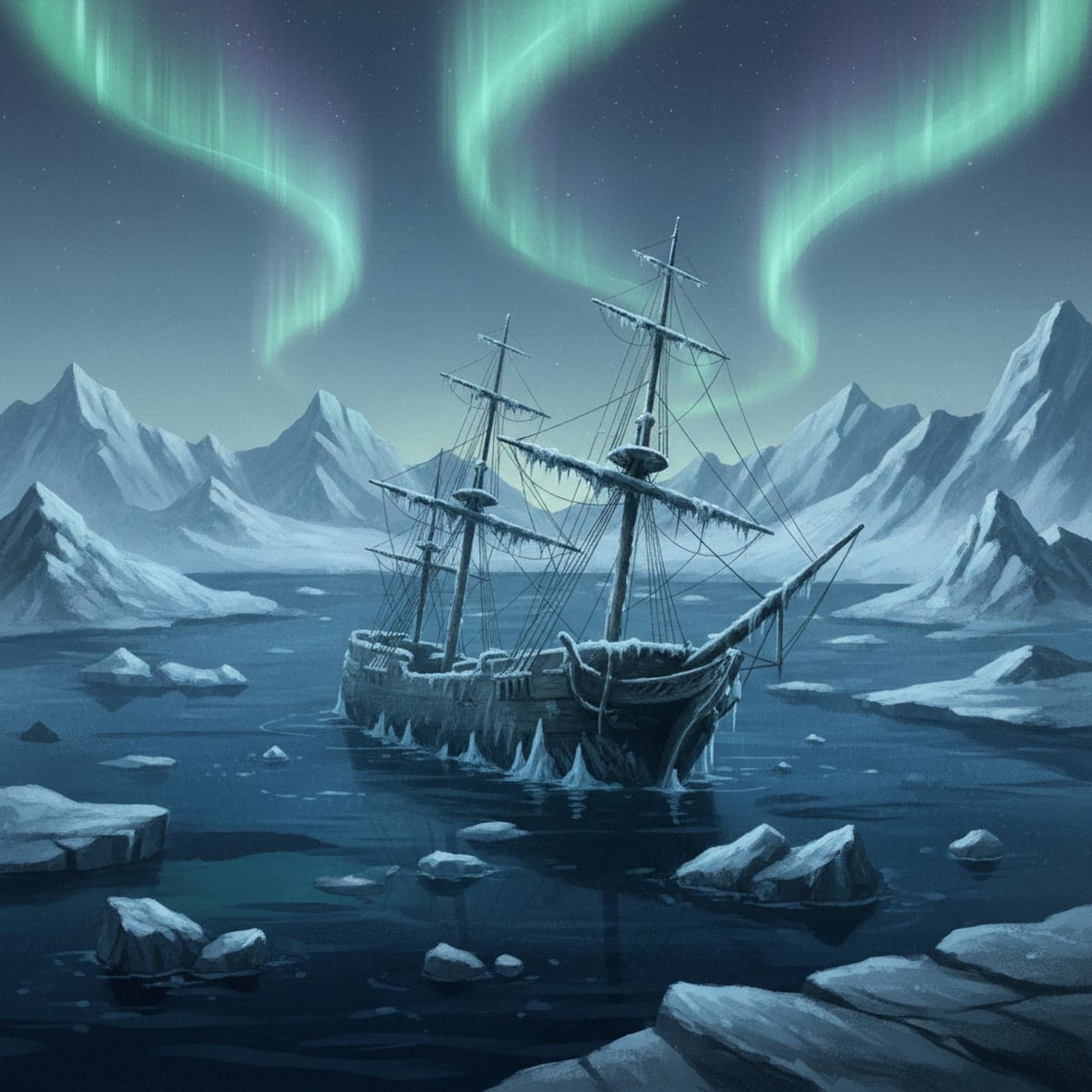
A bomb vessel built for war became a symbol of exploration's ultimate peril, its discovery centuries later still shrouded in mystery.
From the HMS Erebus (1826) Wikipedia page. The hosts are synthetic voices.
Read the script
A bomb vessel, built for the grim business of naval warfare, ended up becoming a symbol of exploration's ultimate peril. Its discovery, centuries after its disappearance, still holds a deep and compelling mystery. This is the story of HMS Erebus. Erebus began its life in 1826, a sturdy Hecla-class bomb vessel constructed in Pembroke dockyard in Wales. Its name, taken from the Greek personification of darkness, seemed fitting for a ship armed with powerful mortars and guns, designed to bombard enemy fortifications. For a time, it served its intended purpose, including a stint in the Mediterranean Sea. But the destiny of HMS Erebus shifted, pivoting towards the unknown. It was refitted for exploration, and its first major voyage took it to the vast, icy expanse of Antarctica. As part of the Ross expedition from 1839 to 1843, Erebus, alongside its sister ship HMS Terror, played a crucial role in charting unfamiliar waters and landscapes. The crews landed on Victoria Land, naming features like Mount Erebus after the ship itself, and Mount Terror after its companion. They also discovered the immense Ross Ice Shelf, a barrier of ice they couldn't penetrate, which they followed eastward for hundreds of miles. The expedition returned with valuable scientific data, including studies in magnetism and collections of botanical and ornithological specimens. The scientific output was significant, leading to publications like 'The Botany of the Antarctic Voyage of H.M. Discovery Ships Erebus and Terror'. A young Joseph Dalton Hooker, who would later become a renowned botanist, served as assistant-surgeon on this voyage. After its Antarctic adventure, Erebus was again refitted, this time with steam engines and iron plating. Its purpose was once more set to exploration, but with a far more ambitious and ultimately tragic goal: to navigate the Northwest Passage. In May 1845, HMS Erebus, captained by the experienced Sir John Franklin, and HMS Terror set sail from Greenhithe, England. Their mission was to complete the charting of the Northwest Passage, a legendary sea route connecting the Atlantic and Pacific oceans, which had only been partly mapped from either end. The two ships, equipped with steam power for maneuvering through ice, carried a crew of around 130 men. They were last seen by Europeans in August 1845, entering Baffin Bay. After that, they vanished. The disappearance of Sir John Franklin's expedition triggered a massive and prolonged search effort. For years, the fate of Erebus and Terror remained one of the Arctic's most enduring mysteries. The first clues to their tragic end began to emerge in 1853, when Dr. John Rae of the Hudson's Bay Company collected artefacts and gathered testimony from local Inuit. Later expeditions confirmed the grim reality. Both ships had become irrevocably ice-bound and were eventually abandoned by their crews. All approximately 130 men perished, succumbing to a brutal combination of hypothermia, scurvy, and starvation as they attempted to trek overland to safety. Further investigations, including autopsies of crew members found in the late 20th century, suggested that the ships' canned rations may have been contaminated with lead and botulism, adding another layer of horror to their ordeal. Disturbingly, forensic evidence of cut marks on skeletal remains also offered a grim corroboration of Inuit oral reports that some of the crew had resorted to cannibalism. For over a century and a half, the wrecks themselves remained elusive, hidden beneath the Arctic ice and waters. Then, in 2014, a significant breakthrough occurred. Parks Canada, an agency of the Canadian government, launched a renewed search effort. On September 2nd, 2014, the wreckage of one of Franklin's ships was discovered. It was later announced that these were the remains of HMS Erebus. Two years later, in September 2016, the wreck of HMS Terror was also found. The discovery of these iconic vessels, after so many years lost, was a monumental event, bringing a tangible end to the long search and opening a new chapter of underwater archaeology. The wrecks are now a designated National Historic Site of Canada. Ownership of the ships has been transferred from the United Kingdom to Canada, with provisions for shared stewardship with the Inuit and the retention of certain relics. Ongoing archaeological work continues to uncover artifacts and shed light on the final days of the expedition. In 2019, a leather-bound folio was recovered from Erebus, and there is hope that its contents might reveal more written accounts from the lost crew. The challenge of preserving these fragile relics in the harsh Arctic environment, and the ongoing scientific investigations, ensure that the story of Erebus is still being written. From a tool of naval bombardment to a pioneer of polar exploration, HMS Erebus was ultimately defined by its final, ill-fated voyage into the Arctic. Its discovery centuries later is a testament to enduring mysteries and the resilience of oral history, a poignant reminder of the perilous allure of the polar unknown. This spoken life portrait is based on the Wikipedia article titled HMS Erebus (1826), available under Creative Commons. The hosts are synthetic voices.