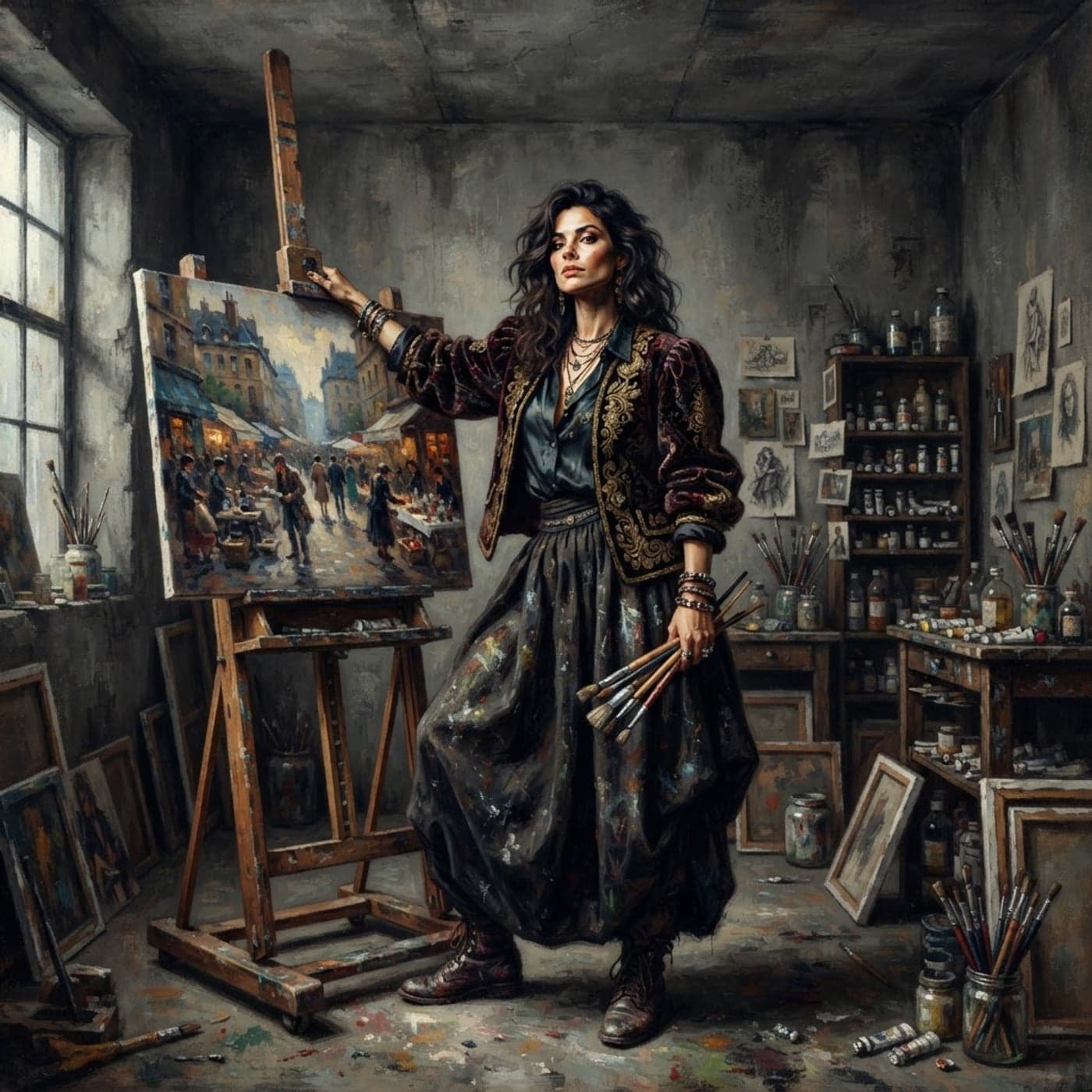
For centuries, this masterpiece was misattributed to a man, obscuring the brilliance of its true creator.
From the Self-portrait by Judith Leyster Wikipedia page. The hosts are synthetic voices.
Read the script
For centuries, this masterpiece hung in galleries, admired, analyzed, but crucially, misattributed. It was thought to be the work of a man, a celebrated artist of the Dutch Golden Age. Yet, the truth was far more remarkable. This painting is a self-portrait by Judith Leyster, a woman who dared to carve out a career in a world that largely excluded her. And this painting, far from being a simple self-reflection, was her audacious declaration of professional equality and artistic mastery. Painted in 1633, this oil on canvas was Leyster's submission as a masterpiece to the Haarlem Guild of St. Luke. For ages, it was assumed to be by Frans Hals, another prominent Haarlem artist, and its true creator only came to light upon its acquisition by the National Gallery of Art in 1949. This misattribution speaks volumes about the challenges faced by women artists in the Dutch Golden Age, a period of incredible artistic flourishing, but one where women's contributions were often overlooked or credited to their male contemporaries. Judith Leyster was a trailblazer. By the age of eighteen, she was already a working artist, and she went on to become one of the first successful women painters in the Netherlands. She ran her own workshop, taught students, and specialized in genre scenes, portraits, and still lifes. Her signature was a star, a clever nod to her surname which translates to 'leading star'. She was also the first woman to be admitted to the male-dominated Haarlem painters' guild, a significant achievement in itself. This self-portrait, however, is more than just a painting; it's a strategic performance. Leyster presents herself not in the practical, paint-splattered attire one might expect of an artist at work, but in her finest clothes – a rich silk sleeve, a magnificent lace collar. These were not garments for the messy business of applying oil paint. Instead, they were a deliberate choice to showcase her success, her wealth, and her status. The painting is an artificial confection, designed to impress. Look closely at the composition. There's a sense of 'Baroque closeness', as critics have described it. The artist and the viewer are brought into intimate proximity. Elements are foreshortened, reaching out, as if to draw you into her studio, into her world. She holds eighteen brushes between her hands, a display of her advanced skill, and notably, no mahlstick, that prop used by less confident painters. Her pose is relaxed, arm propped up, exuding a casual confidence. Her lips are parted, her teeth visible in a rare, upturned smile, as if she's about to speak, to engage you directly. What she's working on, the subject on the easel, is also telling. It's a genre scene, a 'laughing fiddler', a subject Leyster excelled at. This wasn't just a portrait of an artist; it was an advertisement for her versatility. X-ray analysis has revealed that the figure on the easel was initially a portrait of a young girl, but Leyster changed it to this lively genre scene. This wasn't just about showing she could paint portraits; it was about demonstrating her mastery of popular genre subjects, proving she could handle theatrical poses and complex compositions. There's another fascinating aspect related to gender roles. While other women artists of the time, like Catharina van Hemessen and Sofonisba Anguissola, depicted themselves at their easels, they typically placed themselves on the right side of the composition, the so-called 'heraldic left', considered appropriate for female figures. Leyster, however, places herself on the left, the 'heraldic right', traditionally reserved for male figures. This was a bold statement, a visual commentary on her professional standing, a claim to a space and status usually denied to women in both society and the art world. This self-portrait, submitted as her masterpiece, was her way of saying: 'I am a master artist. I am your equal.' It was a calculated move in a competitive art world, a bid for recognition that was unfortunately undone by historical biases and the subsequent misattribution to Frans Hals. Yet, through diligent scholarship and the work of institutions like the National Gallery of Art, Judith Leyster’s brilliance is finally being recognized. Her legacy is being reclaimed, star by star. This portrait is based on the Wikipedia article titled Self-portrait by Judith Leyster, available under Creative Commons. The hosts are synthetic voices.