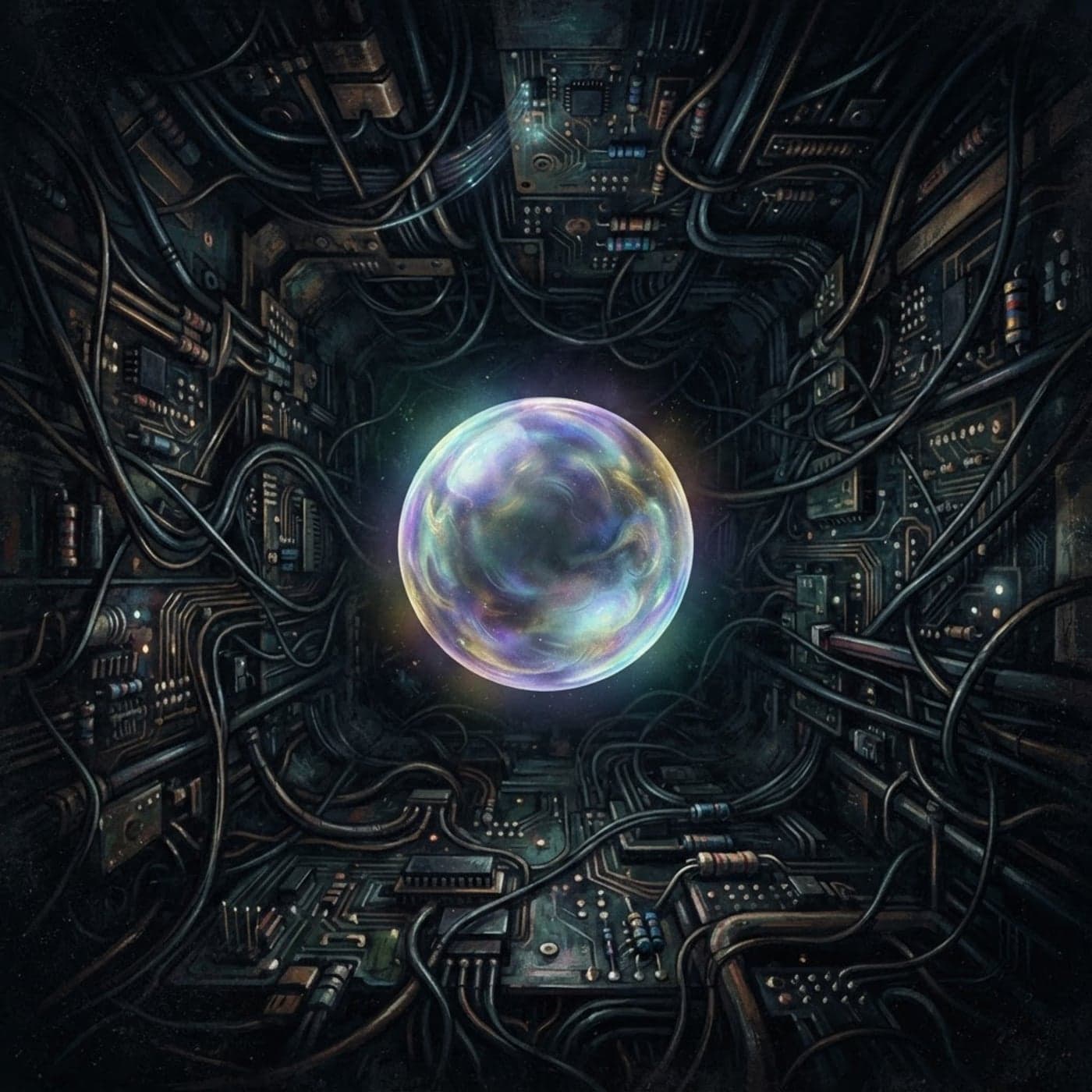
Even if we perfectly map every neuron and synapse in the brain, we still might not understand why it *feels* like something to be alive.
From the Hard problem of consciousness Wikipedia page. The hosts are synthetic voices.
Read the script
We tend to think that if we just knew enough, if our science were advanced enough, we could understand everything. Imagine a future where we could map every single neuron in the brain, every synapse, every chemical reaction – a perfect, complete picture of the brain’s physical workings. Surely, then, we would understand consciousness, right? We’d know how thoughts form, how memories are stored, how emotions arise. It seems intuitive that with enough data, the mystery would simply dissolve. But what if it wouldn’t? What if, even with that perfect map, we’d still be missing something fundamental? This is the core of what’s been called the ‘hard problem of consciousness.’ It’s a concept that challenges our most basic assumptions about reality and our place within it. The philosopher David Chalmers coined the terms ‘easy problems’ and the ‘hard problem’ of consciousness in the mid-1990s. And the irony is, the so-called ‘easy problems’ aren’t easy at all in the colloquial sense. Steven Pinker, the cognitive psychologist, famously quipped that they’re about as easy as going to Mars or curing cancer. These are the problems neuroscientists are actively tackling: how the brain processes sensory information, how it integrates data, how it controls behavior, how we discriminate between different stimuli, or how we generate speech. These are functional problems, mechanistic puzzles. And scientists generally agree that with enough research, brainpower, and funding, we can probably crack them. But Chalmers argued that even if we solve all these ‘easy problems,’ we’re left with a deeper, more stubborn mystery: why does any of it *feel* like something? Why is the humming of neurons accompanied by the subjective experience of seeing the color red, or feeling the pang of hunger, or the sharp ache of pain? This subjective, qualitative aspect of experience – what philosophers call ‘qualia’ – is what makes up the ‘hard problem.’ Think about it this way: we can explain the physics of light, how it hits the retina, how signals travel to the visual cortex, how the brain interprets those signals to identify an apple. That’s an ‘easy problem.’ But why does that process result in the *experience* of redness? Why does it *feel* a certain way to see red, as opposed to, say, hearing a sound, or nothing at all? The hard problem isn't about *what* the brain does, but *why* there's an inner, felt quality to those doings. To illustrate this, philosophers often use thought experiments. One is the concept of a ‘philosophical zombie.’ Imagine a being that is physically identical to a human in every single way – every neuron, every synapse, every behavior, every verbal report. If you pinched it, it would say ‘ouch.’ But it would have no inner, subjective experience of pain. It would be a perfect functional replica, but utterly devoid of consciousness. Chalmers argues that such a zombie is logically conceivable, even if it might not be naturally possible. If it is logically conceivable, then consciousness isn’t simply reducible to physical functions. Another famous thought experiment is ‘Mary’s Room.’ Mary is a brilliant neuroscientist who lives in a black-and-white room and has never seen color. She knows absolutely everything there is to know about the physics of color, the biology of the eye, and the neural processes in the brain that give rise to color perception. She knows every physical fact. But then, one day, she steps out of her room and sees a red rose for the very first time. Chalmers argues that Mary gains new knowledge – the knowledge of ‘what it’s like’ to see red. This new knowledge, he contends, isn't a physical fact, implying that subjective experience goes beyond purely physical descriptions. The hard problem directly challenges physicalism, the dominant view in science and philosophy that everything in the universe, including consciousness, is ultimately reducible to physical matter and its interactions. If the hard problem is real, if consciousness isn't just a byproduct of physical processes but something distinct, then physicalism, in its current form, might be incomplete or even false. It suggests that consciousness might be a fundamental property of the universe, like mass or charge, or that we need an entirely new framework to understand it. It’s important to note that the existence of the hard problem is hotly debated. Many prominent philosophers and cognitive scientists reject it, arguing that consciousness *is* just a collection of ‘easy problems’ that will eventually yield to scientific explanation. They believe that the sense of a ‘gap’ is merely an illusion, a result of our current lack of understanding, or even a conceptual confusion. But a 2020 survey of philosophers found that a majority – over 62% – believe the hard problem is a genuine, significant challenge. Whether it’s a genuine problem, a conceptual illusion, or something human minds are simply not equipped to solve, the hard problem of consciousness forces us to confront the deepest questions about who we are and what reality itself entails. It makes us wonder if there’s more to the universe than what our physical models can currently describe. This script is based on the Wikipedia article titled 'Hard problem of consciousness,' available under Creative Commons. The hosts are synthetic voices.