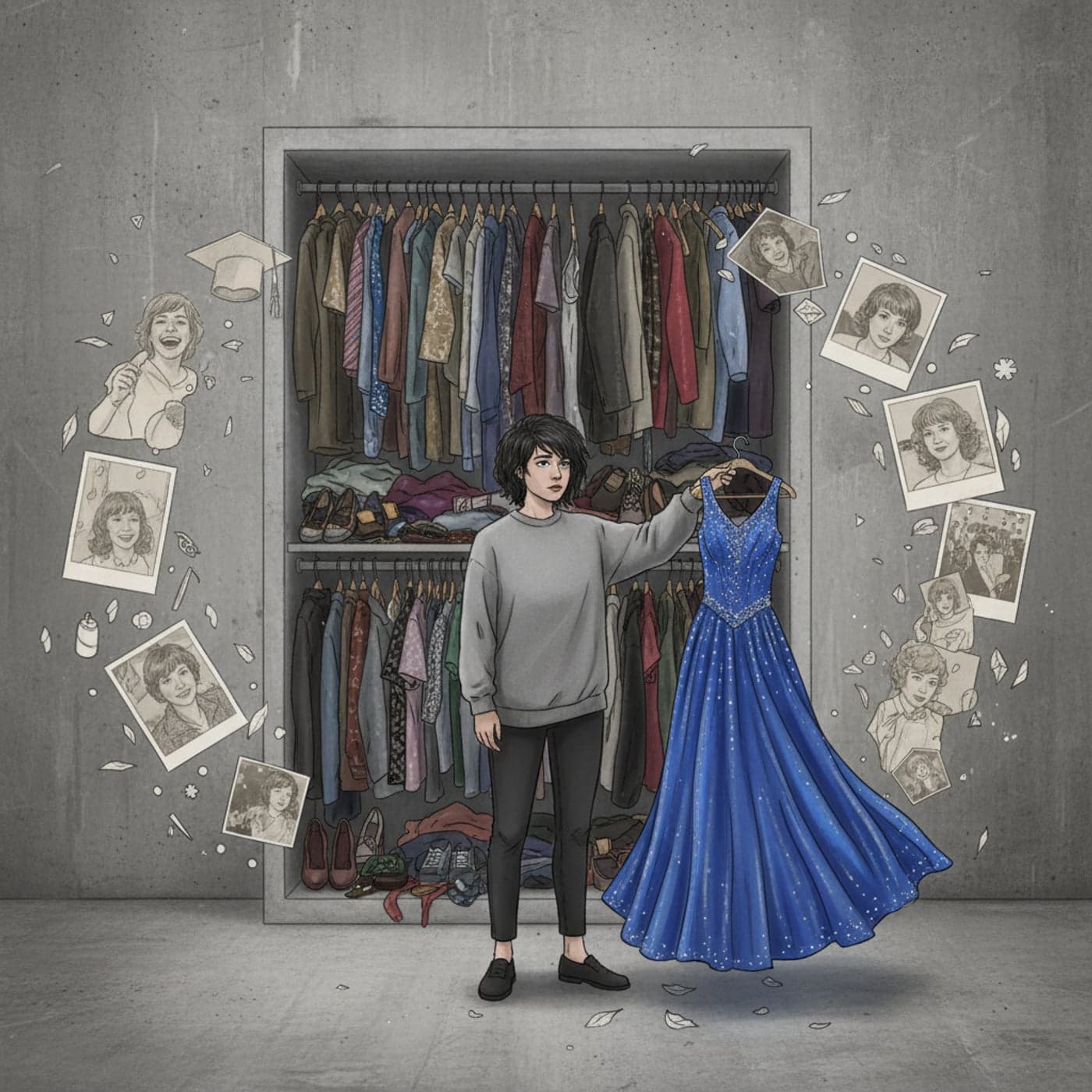
What you wear isn't just fabric; it's a time capsule of your life, holding memories of love, loss, and every significant moment in between.
From the Love, Loss, and What I Wore Wikipedia page. The hosts are synthetic voices.
Read the script
What you wear. It’s more than just fabric stitched together. It’s a time capsule. It holds memories of love, of loss, of every significant moment in between. And the surprising through-line, the thread that stitches it all together, is how the seemingly superficial world of women’s wardrobes – the dresses, the shoes, the purses – becomes a profound, and often humorous, lens through which we examine the deepest, most resonant experiences of life. From heartbreak and motherhood to the sometimes messy search for identity. This is the essence of a remarkable stage production, a play called *Love, Loss, and What I Wore*. It was conceived by Nora and Delia Ephron, based on a book by Ilene Beckerman. And it transforms a woman's closet, that most intimate of spaces, into a landscape for storytelling. Through a series of monologues, delivered by a rotating cast of five actresses, the play uses clothing as a powerful metaphor for life's pivotal moments. Think about it. A childhood Brownie uniform. The agonizing anxieties of prom dresses. Wedding attire. Each garment, each accessory, unlocks a flood of memories. Memories about relationships, about personal growth, about who we are and who we’re trying to become. The show explores themes of love and loss, often with a disarming blend of humor and poignancy. It touches on experiences like motherhood, body image, and even the profound sadness of trauma, all filtered through that uniquely intimate connection women have with their attire. Nora Ephron, you’ll remember, was a legendary writer, director, and producer. She gave us films like *When Harry Met Sally…* and *Sleepless in Seattle*. She received three Academy Award nominations for her screenplays. She also wrote best-selling books, and sometimes collaborated with her sister, Delia, on screenplays like *You’ve Got Mail*. Nora Ephron wrote the introduction to Ilene Beckerman's 1995 book, *Love, Loss, and What I Wore*. She immediately saw its dramatic potential. She felt the book wasn’t about fashion, but about what clothes truly mean to us. How we constantly try to find our identity through them. Soon after the book's publication, Nora gave it to eight friends for Christmas. She became interested in adapting it herself. And once she decided to turn it into a play, she and Delia emailed over a hundred women, asking for their stories. The monologues in the play are drawn largely from Beckerman's book. The Ephrons wove these together with recollections from friends, including Rosie O'Donnell. One standout monologue was based on Nora Ephron's own best-selling book, *I Feel Bad About My Neck*. The play itself is structured around a narrator, a character called “Gingy.” She opens the show sketching parts of her wardrobe that hold the most poignant memories. She weaves her own life story through the other tales, describing her three marriages, her experiences with motherhood, and the death of a child. Each turning point, she explains, is marked by a particular item of clothing. Her life story, as told through her wardrobe, begins with a Brownies uniform and extends through her entire life. Other characters represent different facets of experience. There’s the “vixen,” a “vulnerable gang member,” a “brave cancer patient,” and a “mature woman pierced by vivid memories.” One character, Heather, initially chooses conservative “think” shoes over high heels, but later in life, develops a preference for the latter. The gang member character, for instance, is drawn to the prominent insignias on sweaters. Among the 28 stories told, others delve into the undeniable influence of Madonna – “any American woman under 40 who says she's never dressed as Madonna is either lying or Amish.” There are tales of dressing room anxiety – “I’m an 8. I’ve always been an 8.” And musings on mothers’ tastes in clothes – “I don’t understand, you could look so good if you tried.” Three characters might work as a trio at times, and all of them deliver monologues. The *Los Angeles Times* highlighted a vignette about two high school prom dresses. The junior prom dress, a conservative powder blue gown, was for a nerdy date. The senior prom dress, a sexy black mini, was for a much more desirable date. These dresses presented an identity crisis: “Here’s the thing,” one character recalls, “I’ve never really known for sure which of those two people I am – the girl who almost doesn’t get asked to the prom at all or the girl who gets to go with the really cute guy. Every time I thought I knew which one I was, I turned out to be the other. Which is one reason I think I got married, to, like, end the confusion.” The *New York Times* pointed to three particularly emotional stories: one about a woman who removed miniskirts from her college wardrobe after being raped, but kept her favorite boots; another about wedding attire anxieties; and a third about the choice of adorning a newly reconstructed breast with a tattoo. The paper also noted a humorous ode to the color black as a wardrobe staple: “Sometimes I buy something that isn’t black, and I put it on and I am so sorry.” Other stories include the dress bought for a date with a guy who later married someone else. The foibles of spandex bras. The ubiquitous Juicy Couture tracksuit. Wardrobe choices made on the wrong day of the month. And the story of an incarcerated lover, and a strategically placed hole in a pair of pants. *Love, Loss, and What I Wore* began its life in 2008 at Guild Hall in East Hampton, New York, as a benefit performance. It then moved to a series of benefit performances in New York in early 2009. Later that year, it opened Off-Broadway at the Westside Theatre. There, it became the second-longest running show in that theatre's history. The production was celebrated for its unique theatrical experience and its relatable exploration of the female psyche. It won the Drama Desk Award for Unique Theatrical Experience and a Broadway.com Audience Award for Favorite New Off-Broadway Play. The show has since been produced on six continents, in more than eight countries, and even embarked on a national tour across the United States. What makes it so resonant? As Charles Isherwood of *The New York Times* put it, it’s a “show about matters of the heart and matters of the closet.” Marilyn Stasio in *Variety* called it “a bittersweet meditation on the joys and tribulations of women’s lives, reflected through the prism of their clothes.” Critics noted the playwrights’ skill at mixing the sentimental and the satirical, turning out something truly poignant. The clothing and accessories often dominate the memories, with the men in the stories sometimes feeling like mere “extras.” One particular highlight, consistently praised, was Rosie O'Donnell’s portrayal of a purse in the scene “I Hate My Purse!” It was described as an “aria,” a defiant denunciation of the tyranny of the pocketbook. The show, in essence, points out that if there’s one thing females have in common, it’s a deep, abiding love-hate relationship with their wardrobe. And this wonderfully witty show illustrates that what one wears to the party is sometimes more memorable than the party itself. This portrait is based on the Wikipedia article titled *Love, Loss, and What I Wore*, available under Creative Commons.