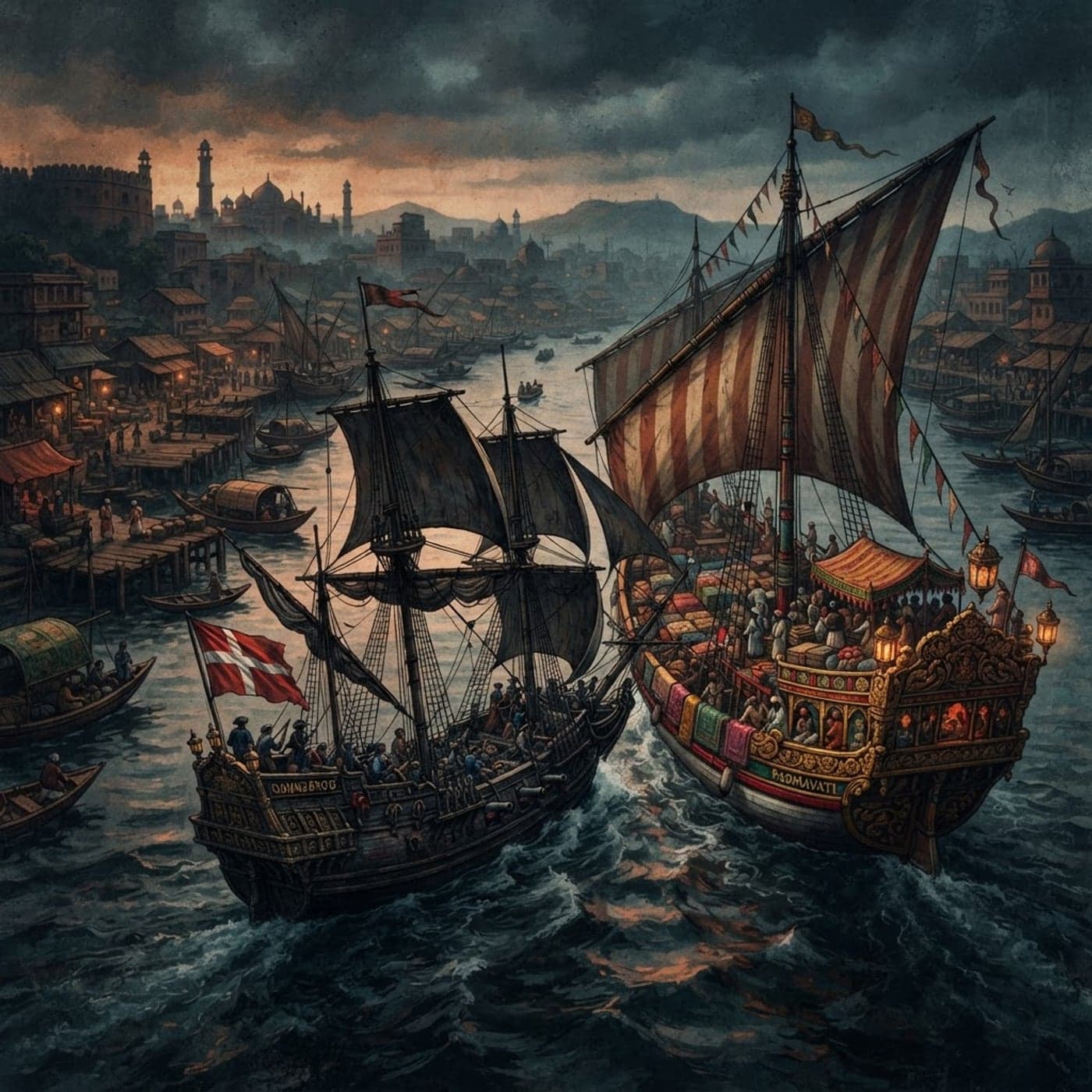
In a world where empires cast long shadows, a small European kingdom declared war on a giant, not for land, but for profit.
From the Dano-Mughal War Wikipedia page. The hosts are synthetic voices.
Read the script
In a world where empires cast long shadows, a small European kingdom declared war on a giant. Not for land, not for glory, but for profit. This was the Dano-Mughal War, a conflict that stretched for over half a century, from 1642 to 1698. It was a colonial and maritime skirmish, pitting the vast Mughal Empire against the Danish East India Company. The Danes, a declining European power, found themselves facing an empire with an army perhaps fifty times its size. Yet, they declared war. The reason lay in the ruthless logic of mercantilism, the dominant economic theory of the time. It held that a nation's strength was tied to its economic dominance, and competition was not just encouraged, it was essential. For European charter companies like the Danish East India Company, this meant using any means necessary to secure their commercial interests. In 1640, a Danish ship, the St. Jacob, was seized and wrecked by Bengali authorities. The Danes couldn't negotiate the release of its cargo. Dutch records suggest it was due to Danish debts, but the Danes saw it as a tyrannous act. In 1642, they formally declared war. Lacking the naval might for a direct confrontation with the Mughals, the Danish strategy was simple, and brutal: prey on Bengali merchant ships. Their targets were particularly those vessels returning from Southeast Asia, laden with valuable goods. This campaign of piracy was, for the Danes, a vital source of revenue, especially during a period when their company faced dissolution and resurrection back home, with no reinforcements from Denmark. They were not interested in conquest, but in maximizing profits. Danish seizures became alarmingly frequent. A letter from Willem Leyel, a Danish colonial figure, states they were doing their best to cause the Bengalis as much harm as possible. The repercussions were severe. Bengali merchants lived in fear, their businesses crippled, discouraged from venturing to sea. Resistance was scarce. According to Danish colonial historian Gunnar Olsen, the Bengalis seemed to have given up in advance on any form of resistance. Yet, resistance was not entirely absent. In 1644, off the Gingeli coast, a Danish yacht intercepted two Bengali ships carrying elephants. A skirmish ensued, and tragically, some of the elephants perished. The overall lack of effective resistance, however, can be attributed to the stark contrast in naval capabilities. Land skirmishes were rare, and often bizarre. In the early 1640s, before the official declaration of war, Danish factors at Pipli had financial troubles with a Persian merchant who refused to pay his debts. The Danes imprisoned him, then seized his slave and goods. The Mughals responded by dispatching 300 men to burn down the Danish trading station and imprison the Danish factors. Another incident occurred mid-war, when a wrecked Danish vessel led to the crew being detained by locals. A Danish rescue mission, led by Poul Nielsen, stormed the governor's residence and later the town hall, finding the castaways in iron chains. The mission was successful, with minimal casualties. To justify their actions, the Danes drafted a Portuguese-written manifesto in 1644. It outlined grievances, including the loss of the vessel Jupiter, the imprisonment of its crew, and the abduction of a Danish boy who was forcibly converted to Islam. They blamed the Mughal governor for these incidents, and cited them as reasons for stopping trade, alongside other alleged aggressions like obstruction of commerce and the poisoning of shipwrecked servants. Some of these claims are disputed by scholars. The manifesto aimed to portray the enemy as immoral, while highlighting the Danes' continued willingness to negotiate. The Mughals, lacking naval power, tried to negotiate. In 1645, they offered 80,000 rupees for peace, but the Danish governor, Willem Leyel, rejected it, hoping for a much larger sum. He intensified the fighting. The Mughals tried again in 1647 or early 1648, but no lasting peace was achieved. Danish conditions for peace included a substantial cash payment, equal trading privileges to the Dutch, and forgiveness of certain debts. Frustrated by their inability to negotiate with the Danes, the Mughals attempted to pressure other European powers. They issued an ultimatum to the Dutch East India Company: either stop Danish aggression or leave Bengal. However, the Dutch were persuaded against it. Later, local authorities refused favorable trading terms from the Dutch unless they could guarantee protection for their merchants against the Danes. The Dutch found this ridiculous. The complexity was further fueled by the loyalty of Danish company servants. King Christian IV had a strong bond with the company, refusing to dissolve it even when unprofitable, to protect his reputation. It was eventually dissolved after his death, but the Danish factors in Asia continued operating as the settlements were Crown property. Relations were re-established in 1669 after a successful Danish expedition. In 1672, Christian V wrote to the Mughals seeking compensation for Danish vessels, but it was never fulfilled. The Danes continued to chase and destroy Bengali vessels, their harassment lasting until the late seventeenth century. They wished to regain their influence and re-establish their presence. They tried to negotiate again, and this time, they succeeded. In 1698, Danish delegates arrived with ships, settlers, and goods to establish a trading presence. They successfully negotiated a peace agreement with the Bengali governor. Both parties agreed to set aside claims over previously confiscated ships. The Danes were granted a lease for land near the French settlement of Chandernagore. This area became known as Dannemarksnagore, where the Danes established a trading post, the foundation for their operations in Bengal. This story is based on the Wikipedia article titled Dano-Mughal War, available under Creative Commons. The hosts are synthetic voices.