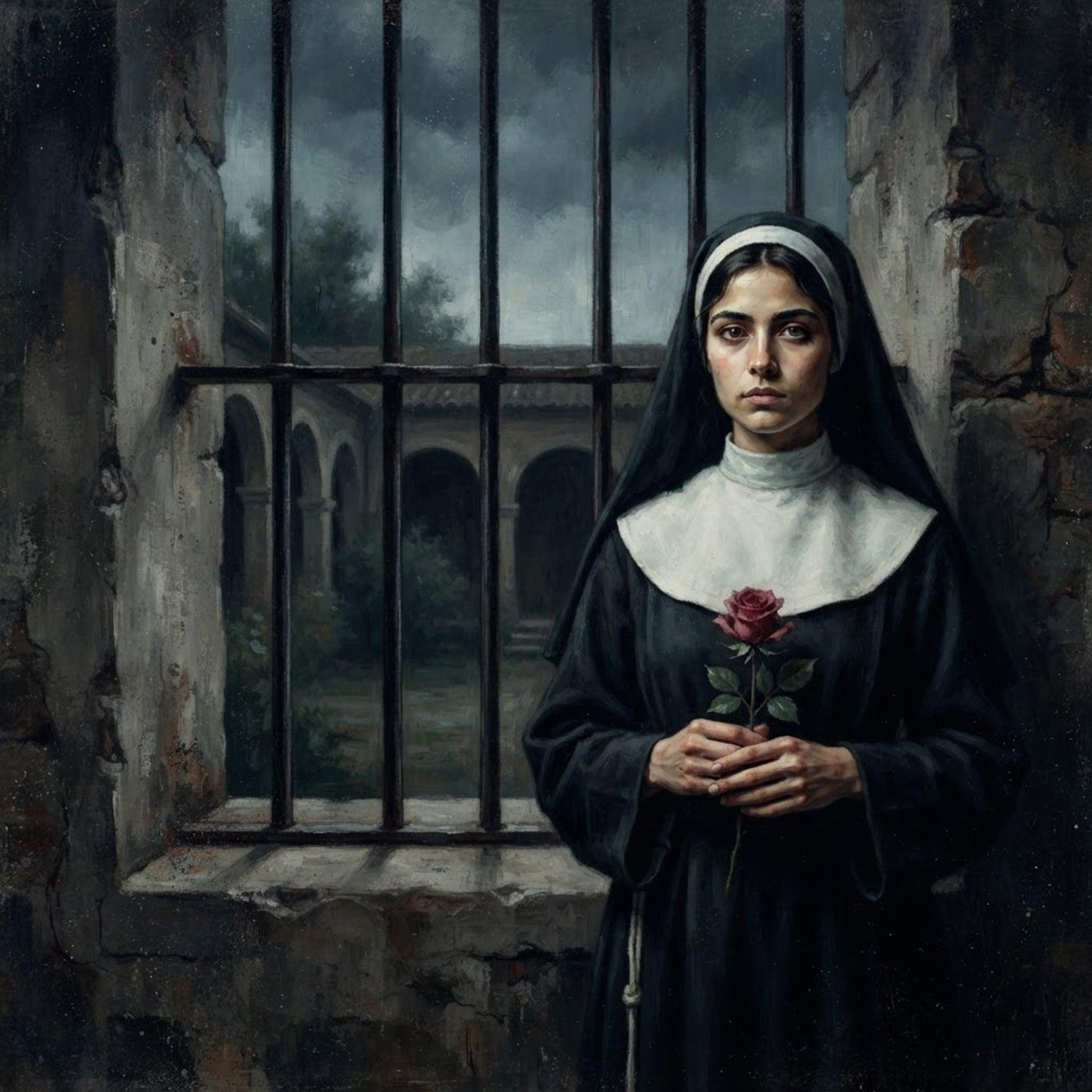
Despite being declared the "greatest saint of modern times," Thérèse of Lisieux spent her final eighteen months in a tormenting 'night of faith.'
From the Thérèse of Lisieux Wikipedia page. The hosts are synthetic voices.
Read the script
She is known as the 'greatest saint of modern times.' Yet, for the last eighteen months of her short life, Thérèse of Lisieux endured a profound torment – a 'night of faith,' a period of doubt and perceived absence of God. It’s a stark contrast to the image of unwavering spiritual certainty we might expect from someone so revered. Thérèse's life was, in many ways, a relentless pursuit of God. From a young age, she possessed an intense, almost precocious spiritual sensitivity. This sensitivity, amplified by the loss of her mother and difficult school experiences, eventually led her to embrace the cloistered Carmelite life. She saw herself as a 'little queen,' destined, as she put it, for a 'more fertile soil' – a life dedicated entirely to divine love. Born Marie Françoise-Thérèse Martin in 1873, she came from a devout family. Her parents, Louis and Zélie Martin, would themselves later be canonized as saints, a testament to their faith. Five of their nine children became nuns. From her earliest years, Thérèse was immersed in a deeply Catholic environment. Mass at dawn, strict fasting, and constant prayer were the rhythm of her childhood. But she was also a sensitive child, prone to anxiety, and her temper could flare. Her mother, Zélie, died of cancer when Thérèse was just four and a half. This loss profoundly affected the young girl. She wrote that her once lively disposition changed, becoming diffident and oversensitive. The family moved from Alençon to Lisieux, and Thérèse's sister Pauline took on a maternal role. Her childhood, she later described, was the most painful period of her life, a time when she rediscovered a more serious side to herself. School proved difficult. Despite being intelligent, she was bullied by older children, finding solace only in the presence of her younger sister, Céline, who joined her in the same class. The tension of managing her inner life and the daily challenges of school became increasingly strained. Things shifted again when her sister Pauline entered the Carmelite convent in Lisieux at the age of 20. Thérèse was devastated, feeling Pauline was 'lost' to her forever. Around this time, Thérèse also suffered from a mysterious illness, characterized by nervous tremors. Doctors were baffled, diagnosing emotional frustration and neurotic attacks. Her recovery, she later attributed to a vision of the Virgin Mary smiling at her. But when she recounted this to the nuns, their questioning made her doubt her own experience, leading to a period of intense self-reproach. Then came a turning point. On Christmas Eve of 1886, when she was just 14, Thérèse experienced what she called her 'complete conversion.' Her father remarked that it would be the last Christmas she'd expect gifts from the 'Child Jesus.' Overcome with sadness, Thérèse began to cry, but then, in an instant, she pulled herself together. She ran downstairs, unwrapped her gifts with feigned joy, and felt a profound shift. She later wrote that 'charity entered my soul, and the need to forget myself and to please others.' This moment of self-forgetfulness, of overcoming her own sensitivity, marked a profound change, a grace that freed her. This newfound strength propelled her. She felt a strong call to Carmel, but faced obstacles due to her youth. Even her father, recovering from a stroke, was hesitant. Yet, she persisted. In 1887, she joined her father and Céline on a pilgrimage to Rome. There, she famously approached Pope Leo XIII, asking permission to enter the convent. The Pope, perhaps sensing her determination, advised her to follow her superiors' decisions. This trip also offered her a broader perspective. She saw priests not just as figures of ministry, but as human beings with weaknesses. This experience solidified her understanding of her vocation: to pray and offer her life for the conversion of sinners, and for the very priests who, despite their dignity, were still human. She realized she needed to leave the 'poisonous breath of the world' and enter Carmel. In April 1888, at the age of 15, Thérèse finally entered the Carmelite convent in Lisieux. It was an old community, with many elderly nuns, some ill, some seemingly lukewarm. Thérèse embraced the Carmelite life with her 'Little Way' – a path of spiritual childhood, finding God in the ordinary, in small acts of love and self-forgetfulness. She fulfilled various roles within the convent, including sacristan and assistant to the novice mistress. But her final eighteen months were marked by that intense spiritual struggle, the 'night of faith.' She experienced doubts about God's existence, a profound sense of His absence. It was a torment that shadowed her final days. Thérèse died of tuberculosis on September 30, 1897, at the age of 24. During her lifetime, she remained relatively obscure. However, after her death, her spiritual memoir, 'The Story of a Soul,' was published. It revealed her profound insights, her 'Little Way,' to the world. Her immense popularity and reputation for holiness led to her swift beatification and canonization by Pope Pius XI, just 28 years after her death. In 1997, Pope John Paul II declared her a Doctor of the Church. Today, the Basilica of Lisieux is the second most popular pilgrimage site in France. Thérèse of Lisieux, the 'Little Flower,' continues to inspire millions with her simple yet profound message of love and trust in God, even amidst the deepest spiritual darkness. This portrait is based on the Wikipedia article titled Thérèse of Lisieux, available under Creative Commons. The hosts are synthetic voices.