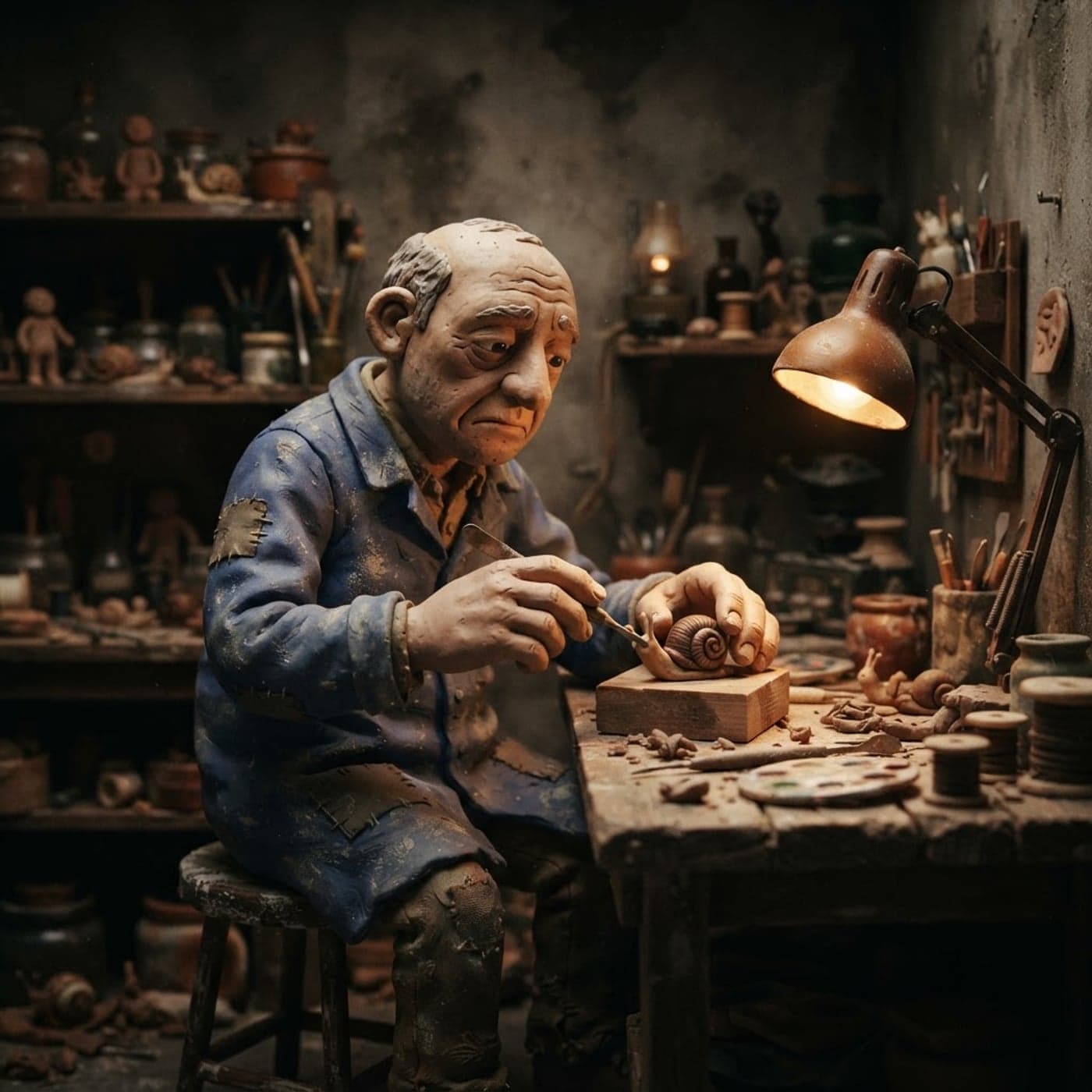
An Australian animator, born with a hereditary tremor, transformed his disability into a unique visual style, crafting heartbreakingly funny clay-animated biographies of his own family and friends.
From the Adam Elliot Wikipedia page. The hosts are synthetic voices.
Read the script
He was born in the Australian outback, on a prawn farm. His father, a retired acrobatic clown. His mother, a hairdresser. And Adam, one of four siblings, arrived with a tremor. A hereditary tremor that would, years later, become a signature. He’s Adam Elliot, an Australian animator. And his films are called 'Clayographies'. A word he coined himself. A blend of clay animation and biography. His own family, his friends, their lives, their struggles, their quiet comedies. These are the stories he tells. Born with a tremor, a persistent shaking in his hands, Elliot could have fought it. He could have sought the smooth, unblemished perfection of digital art. But he didn't. Instead, he embraced the uneven lines, the organic feel, the beautiful imperfections that tremor brought to his clay figures. His early life was marked by hardship. The prawn farm went bankrupt. The family moved to Melbourne. He tried to become a veterinarian. He didn’t get the grades. He spent five years hand-painting t-shirts at a craft market. Then, he found animation. At the Victorian College of the Arts, he made his first film, 'Uncle'. A six-minute short, shot on 16mm film, edited on an obsolete system. It won awards. It showcased his unique style. A style born from necessity, from a physical reality. He refuses to use digital enhancements. His films are entirely handcrafted. Each prop, each set, a real, miniature object. 'Uncle' was semi-biographical. About an anonymous uncle, narrated by an anonymous nephew. A balance of comedy and tragedy. Humour and pathos. It set the tone for what was to come. Then came 'Cousin'. Funded professionally, it explored a childhood relationship with a cousin who had cerebral palsy. Still minimalist, still featuring the distinct, uneven lines. And 'Brother'. The conclusion to what became known as a trilogy. Made in a friend's spare bedroom, above a falafel shop. Strictly analog. No digital tools. He edited it, again, on a Steenbeck. These early shorts, 'Uncle', 'Cousin', 'Brother', they established his voice. A voice that draws directly from personal experience. From the lives of those closest to him. The world took notice. In 2003, 'Harvie Krumpet'. Narrated by Geoffrey Rush. This film won an Academy Award for Best Animated Short. A profound, bittersweet story of a man who lives his life with a series of misfortunes, but finds joy and meaning nonetheless. It was a triumph. His first feature film, 'Mary and Max', premiered at Sundance. The first animated film, the first Australian film, to open the festival. A poignant story about an unlikely pen-pal relationship between a lonely young girl and an elderly, overweight man with Asperger's syndrome. It explored themes of loneliness, friendship, and the complexities of human connection. Then, 'Ernie Biscuit'. A black-and-white short about a deaf Parisian taxidermist. It explored stronger themes of love. It was dynamic, fast-paced, yet still carried that signature bittersweet tone. And most recently, 'Memoir of a Snail'. His second feature. A story about a lonely hoarder of ornamental snails. It premiered at Annecy and, once again, received an Academy Award nomination. Elliot's work is a testament to the power of the handcrafted. To the beauty found in imperfection. To the profound stories that can be told when we embrace our own vulnerabilities, our own histories. His tremor, once a potential obstacle, became a gift. A unique visual language that speaks to the heart. This is based on the Wikipedia article titled Adam Elliot, available under Creative Commons. The hosts are synthetic voices.