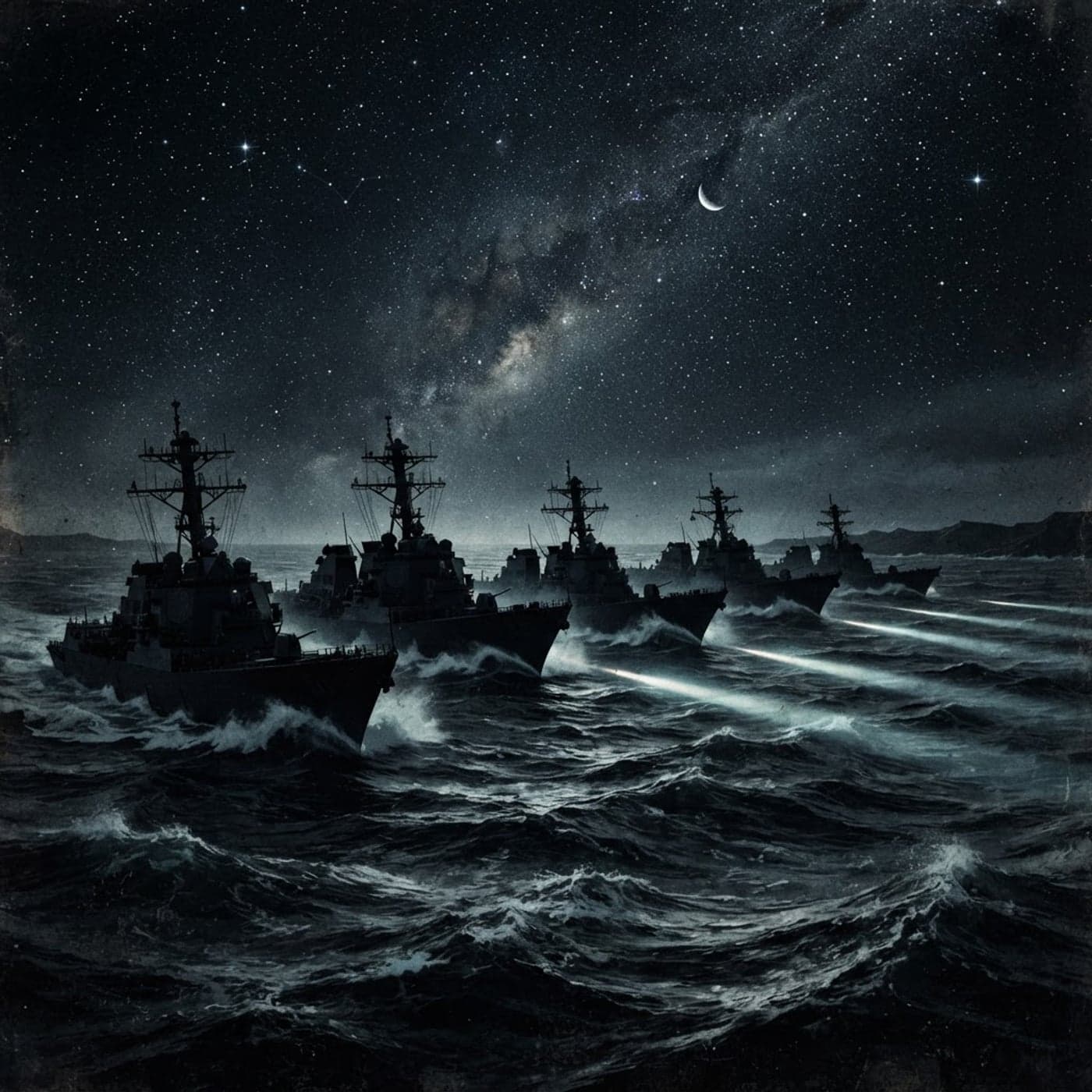
In the dead of night, amidst the Solomon Islands, a deadly game of radar cat and mouse unfolded, becoming the last dance of surface ships in a campaign.
From the Battle of Cape St. George Wikipedia page. The hosts are synthetic voices.
Read the script
The Solomon Islands campaign, a brutal, grinding series of battles, was drawing to a close. For months, the night seas around these islands had been a deadly chessboard, with American and Japanese destroyers locked in a desperate game of cat and mouse. But on a moonless night in November 1943, near Cape St. George, a new kind of game was played, one that would mark the end of an era for surface ship engagements in the Pacific. American forces had recently landed Marines on Bougainville Island. The Japanese, believing the real target was the airfields on Buka Island to the north, decided to reinforce Buka. So, on November 25th, three Japanese destroyers, acting as transports, set out to deliver troops and supplies to Buka. They were escorted by two other destroyers, commanded by Captain Kiyoto Kagawa. But American reconnaissance aircraft spotted the Japanese convoy. The US Navy dispatched Destroyer Squadron 23, a force of five destroyers, under the command of Captain Arleigh Burke, to intercept them. Burke's squadron was divided into two divisions, ready for a new tactical maneuver: one division would launch a torpedo attack, while the other held back, ready to open fire once the torpedoes struck. Meanwhile, the Japanese destroyers successfully landed their troops and picked up 700 Navy aviation personnel, withdrawing from a Buka airfield that Allied bombing had rendered useless. As they headed back towards Rabaul, just after midnight, American PT boats detected four of the Japanese ships on their radar. But the PT boats mistook the Japanese vessels for friendly forces and moved closer to shore. Two of the Japanese ships attacked the PT boats, firing and attempting to ram one, but missed. One PT boat fired a torpedo, which also missed its target. The Japanese destroyers then steamed west, towards Cape St. George. Around 1:41 AM, Burke's destroyers, positioned between Cape St. George and Buka, picked up Kagawa's two escort destroyers on their radar. The American ships had superior radar, allowing them to see the Japanese, while the poor visibility of the moonless night prevented the Japanese from seeing their American counterparts. Burke decided his own division would launch the torpedo attack. At about 1:55 AM, the American ships, undetected, closed to within 5,500 yards and launched their torpedoes. The Japanese destroyer Onami was hit by several torpedoes and sank immediately, taking Captain Kagawa and all hands with her. The destroyer Makinami was hit by one torpedo and disabled. Burke’s force then picked up the rest of the Japanese force on radar, 13,000 yards away. Yamashiro's three transport destroyers, now without their escorts, fled north. Burke's division pursued them, while the other American destroyers finished off the disabled Makinami with torpedoes and gunfire. During the chase, Japanese destroyers fired torpedoes, which exploded harmlessly in the wakes of the American ships. Burke's three destroyers steadily gained on the heavily laden Japanese transports. Around 2:22 AM, the Americans opened fire, scoring several hits. One Japanese destroyer, Uzuki, was hit by a dud shell and escaped without significant damage. Amagiri escaped untouched. Around 2:25 AM, the Japanese ships split up and fled in different directions. Burke chose to pursue Yugiri with his entire force and, after a fierce engagement, sank her at about 3:28 AM. By 3:45 AM, Burke’s and Austin's divisions had linked up. They continued to push north, pursuing the remaining Japanese ships, but Burke called off the chase at 4:04 AM. They were low on fuel and ammunition and needed to withdraw before daylight, when Japanese aircraft would likely begin operations. The only aircraft spotted that morning were friendly American planes. The Battle of Cape St. George was a swift and decisive American victory. Three Japanese destroyers were sunk and one was damaged, with no losses for the US forces. This almost perfect action, as it was later described, earned Arleigh Burke a Navy Cross. It was the final surface engagement of the Solomon Islands campaign and a testament to the tactical brilliance of commanders like Burke, and the critical advantage of radar in night warfare. This is based on the Wikipedia article titled Battle of Cape St. George, available under Creative Commons. The hosts are synthetic voices.