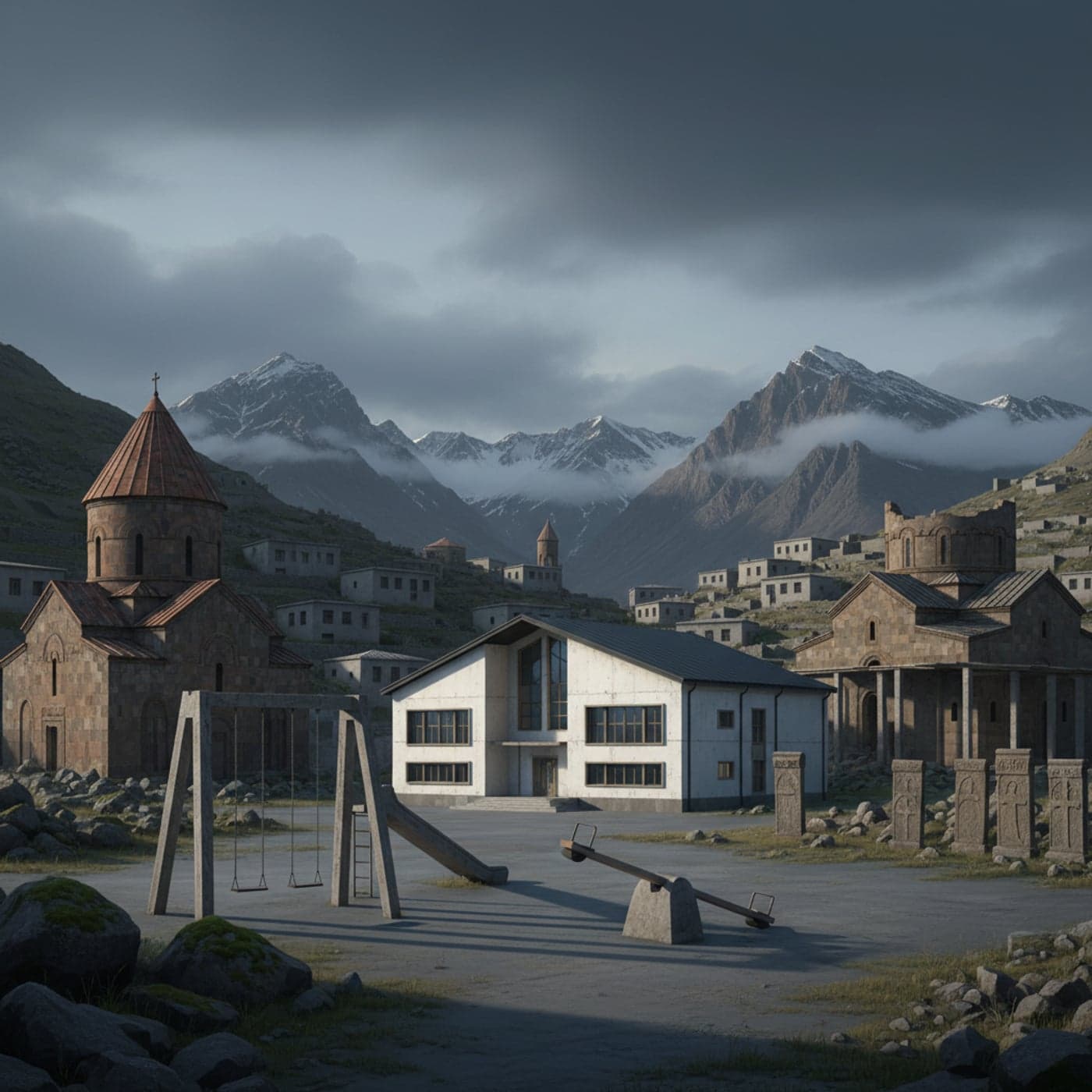
A school in this village was destroyed by war, rebuilt, and then expanded—only for the entire Armenian population it served to vanish before the renovation was finished.
From the Chldran Wikipedia page. The hosts are synthetic voices.
Read the script
Imagine driving through the rolling hills of Nagorno-Karabakh, the landscape dotted with stone churches and farmland, and coming upon a village called Chldran. The name itself carries layers of history – Armenian spelling Чլդ란, Azerbaijani Çıldıran. Today it lies in the Aghdara District of Azerbaijan, but for most of the twentieth century it was part of the Nagorno-Karabakh Autonomous Oblast, a region with a shifting mosaic of peoples. Chldran’s story begins in 1905, when settlers from the nearby hamlet of Arajadzor laid out the first homes. They were farmers and herders, drawn to the fertile valleys and the promise of a new start. Over the decades the village grew slowly but steadily. By 1970 there were 87 houses and 366 inhabitants; twenty years later, in 1987, the count had risen to 173 homes and 476 people. The 2005 census recorded 467 residents, and a decade later, in 2015, the village reached its peak of 528 souls. For most of that time the population was overwhelmingly Armenian. The village’s economy rested on agriculture and animal husbandry – families tended fields of wheat and barley, kept flocks of sheep and goats, and sold their produce at local markets. A modest municipal building stood alongside a secondary school, nine shops, and a small medical centre, providing the basics of daily life. The village is made up of six neighborhoods: Vrtskaler, Kyurkoreg, Perin Gomer, Khor Dzor, Pokr Chldran and Ghalunts Tagh. Each quarter has its own character, shaped by the layout of fields, the orientation of homes, and the paths that connect them to the surrounding countryside. Scattered around the settlement are three spiritual landmarks that have watched over Chldran for centuries. About three hundred meters to the north stands the Karmir Yeghtsi church, dating from the sixteenth or seventeenth century, its stone walls still bearing the marks of age. Further northeast, roughly 2.2 kilometers away, lies the Nahatak Church, now partially ruined, but its surrounding cemetery is filled with intricately carved khachkars – the cross‑stones that are a hallmark of Armenian memorial art. A little farther, at 3.5 kilometers to the northeast, is the site of Tatver, another place of worship that, while less visible today, remains part of the village’s sacred geography. These churches are more than stone; they are markers of identity. The khachkars in the Nahatak cemetery each tell a story – names, dates, symbols of faith carved into the rock by generations who believed their loved ones would be remembered. The Karmir Yeghtsi church, with its ancient frescoes, has survived wars and weather, offering a quiet place for prayer and reflection. Tatver, though quieter now, still draws visitors who come to feel the continuity of tradition. At the heart of community life, however, stood the school. Named after Tigran Izmirlian, the building was more than a place of lessons; it was a gathering point, a source of pride, and a symbol of the village’s hopes for the future. The original structure fell victim to the First Nagorno‑Karabakh War, suffering damage that left it unusable. In the aftermath, the people of Chldran rolled up their sleeves. By 2002 they had rebuilt the school from the ground up, restoring classrooms, a library, and a playground for the children. The rebuilt school served the village well for nearly two decades. Then, in 2020, an ambitious plan took shape. With funding from the Artsakh government, the Armenia Fund, and the Izmirlian Foundation, workers began a renovation and expansion project. The goal was to enlarge the facility, add modern classrooms, and perhaps accommodate a growing student body. Cranes appeared, scaffolding went up, and the sound of hammers echoed through the streets. But history intervened before the work could be finished. In September 2023, a large‑scale Azerbaijani offensive swept through Nagorno‑Karabakh. Within days, the Armenian population of the region – including the families of Chldran – was forced to flee. Homes were abandoned, fields left fallow, and the school’s expansion site fell silent. The renovation, still incomplete, stood as a half‑finished promise. By January 2026, the village had a new look. Azerbaijani authorities reported that thirteen families, totaling forty‑eight individuals, had been resettled in Chldran. New roofs went up, new livestock appeared in the pens, and the rhythms of daily life began again, though under a different banner. The school, now fully repaired and ready for use, opened its doors to these new students. Its walls, once echoing with Armenian lessons, now host classes in Azerbaijani, and the names on the roll call have changed. Yet the stones of Chldran still remember. The khachkars in the Nahatak cemetery continue to stand, silent witnesses to a community that once tended the land, celebrated feasts, and sent its children to learn under the name of Tigran Izmirlian. The Karmir Yeghtsi church still holds its ancient frescoes, and the site of Tatver, though quieter, remains part of the landscape. Today, if you walk through Chldran, you will see a blend of old and new. The agricultural fields are still worked, the stone houses still shelter families, and the school stands ready – a building rebuilt after war, expanded with international support, and now serving a different generation. The story of Chldran is a reminder how places can outlive the peoples who gave them meaning, how monuments of education can endure even when the voices that filled them have moved on. This is based on the Wikipedia article titled Chldran, available under Creative Commons.