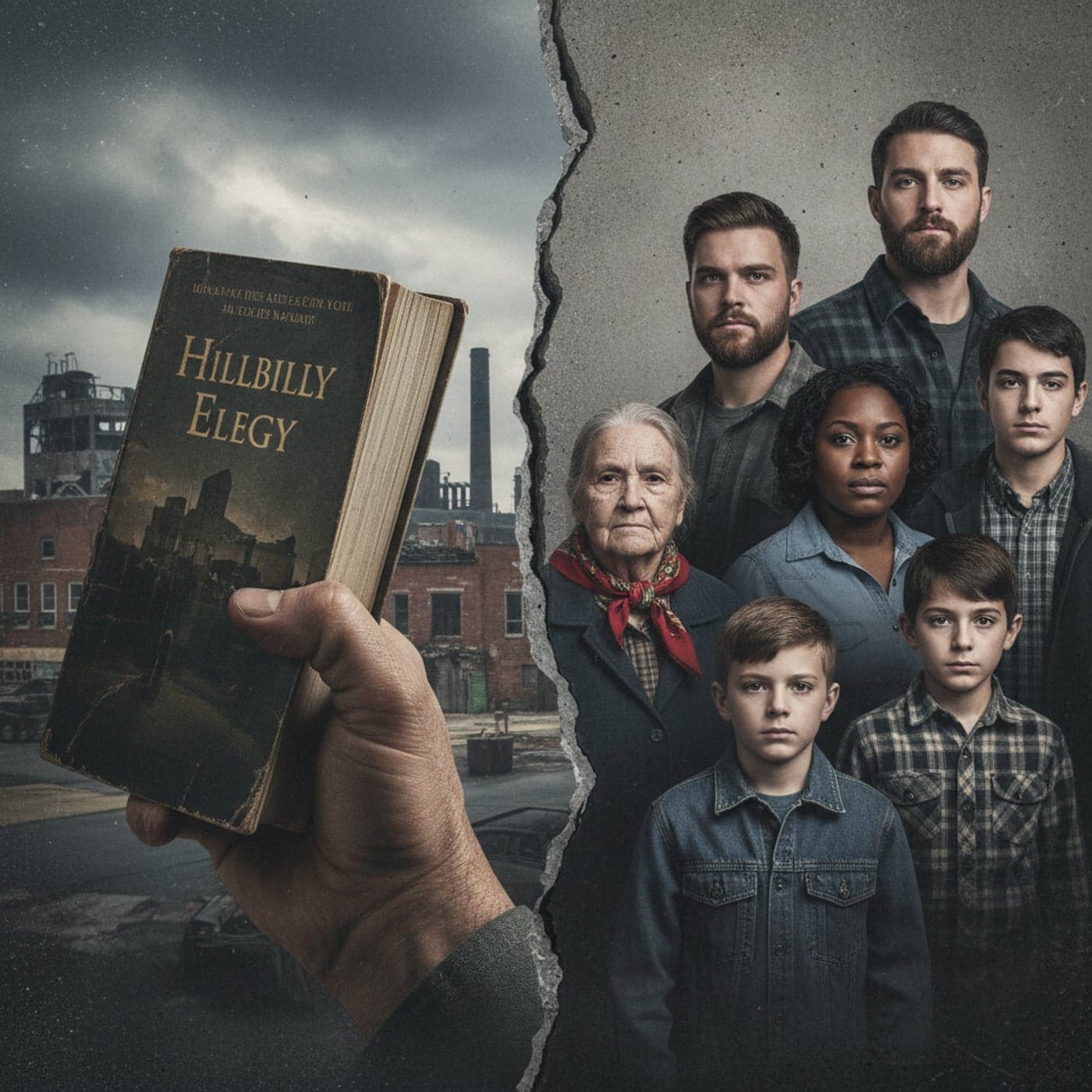
A memoir meant to explain the white working class's political leanings became a lightning rod for cultural debate, sparking a wave of counter-narratives from the very community it sought to represent.
From the Hillbilly Elegy Wikipedia page. The hosts are synthetic voices.
Read the script
Hillbilly Elegy. The title alone conjures images, right? Images of a specific kind of American struggle, a particular kind of poverty, a deeply felt cultural identity. And when J.D. Vance’s memoir came out in 2016, it seemed to tap directly into a national nerve. It was hailed as an explanation, a Rosetta Stone for understanding the white working class, and crucially, for understanding the seismic political shifts happening in America, particularly the rise of Donald Trump. We were told this was the key. This was the personal story that illuminated a national phenomenon. Vance, a Yale Law graduate returning to his roots, offered a raw, unflinching look at his family’s tumultuous journey from the hollers of Kentucky to the industrial towns of Ohio. He spoke of loyalty, of country, but also of addiction, of violence, of a culture in crisis. And for many, this narrative provided the missing piece, the explanation for why so many felt left behind, why they were drawn to a political outsider. But here’s the turn. The book that promised to explain a community, to give voice to the voiceless, ended up sparking a powerful counter-narrative. Because the very people Vance sought to represent, the people of Appalachia and its diaspora, began to speak back. And they said, ‘That’s not the whole story.’ Vance’s memoir, while lauded for its candor, was also criticized for what many saw as oversimplification. The argument went something like this: Vance blamed cultural traits – a lack of work ethic, a certain fatalism – for the deep-seated economic and social problems plaguing the region. He focused on personal choices, on ingrained habits, on a culture in crisis. And in doing so, some felt he was letting the larger, systemic forces off the hook. The historical exploitation of the region, the decline of industry, the lack of investment – these were often overshadowed by the focus on individual and cultural failings. And the response was significant. It wasn’t just a few dissenting voices. It was a chorus. Authors, academics, and activists from Appalachia pushed back, arguing that Vance’s narrative, while compelling, was a generalization. It was a single story, and as we know, a single story can be dangerous. It can lead to stereotyping, to pigeonholing an entire group of people based on one person’s experience, however vivid that experience may be. Think about it. Vance’s book became a bestseller, influencing how millions of Americans understood a significant portion of their fellow citizens. But then came books like Elizabeth Catte’s ‘What You Are Getting Wrong About Appalachia.’ She argued that Vance’s portrayal was part of a long tradition of stereotyping Appalachia, a way to justify certain political and economic decisions by painting the region as inherently flawed. It was a familiar script, and Vance’s memoir, unintentionally or not, played right into it. Then there was the anthology, ‘Appalachian Reckoning: A Region Responds to Hillbilly Elegy.’ This wasn’t just a critique; it was a collection of voices, a deliberate effort to offer a more diverse and nuanced picture of Appalachian life. The editors themselves stated it was born out of frustration, a desire to complicate the understanding that had settled in after Vance’s book. They wanted to push back against those who felt they understood Appalachia simply because they had read one memoir. And it didn’t stop there. Writers like Barbara Kingsolver, who went on to write the Pulitzer Prize-winning ‘Demon Copperhead,’ felt a duty to offer a different portrayal. She criticized Vance’s narrative as a ‘hero story’ that blamed victims, that suggested people were stuck because they lacked ambition or brains. She felt Vance, in her words, wasn’t from Appalachia and didn’t understand the community. This wave of responses highlighted a crucial point about representation. When a narrative becomes dominant, especially one that purports to explain a complex social and political phenomenon, it’s vital to question who is telling the story and whose voices are being amplified. Vance’s story was powerful, and it resonated. But it wasn't the only story. And the pushback from within the Appalachian community itself demonstrated a rich diversity of experiences, perspectives, and political viewpoints that were being flattened by the singular narrative of ‘Hillbilly Elegy.’ This is based on the Wikipedia article titled ‘Hillbilly Elegy,’ available under Creative Commons. The hosts are synthetic voices.