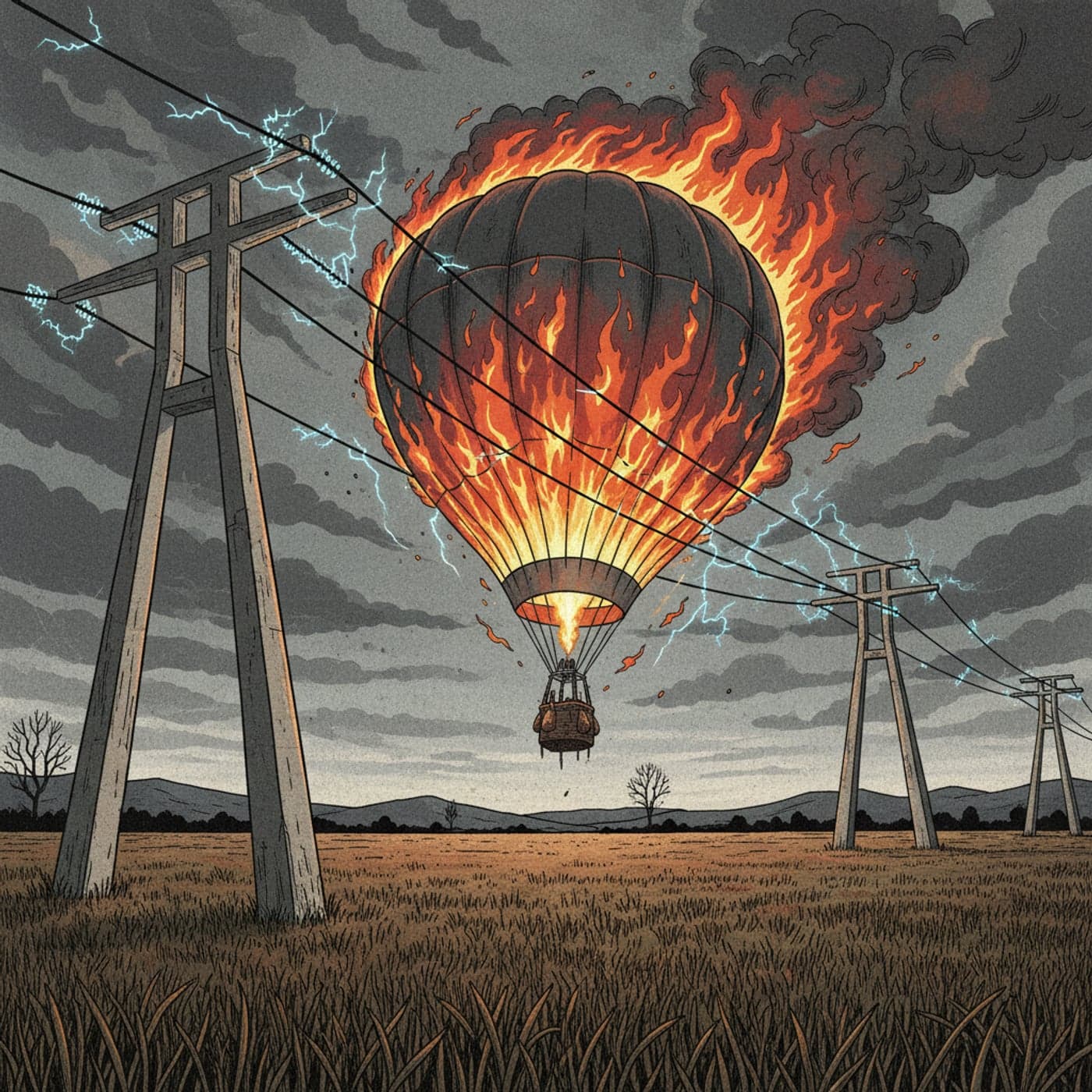
A hot air balloon, carrying ten passengers and its pilot, ignited and disintegrated mid-air after colliding with power lines, plunging all eleven people aboard to their deaths.
From the 2012 Carterton hot air balloon crash Wikipedia page. The hosts are synthetic voices.
Read the script
It was a clear January morning. The sky above Carterton, New Zealand, was a perfect blue. A hot air balloon, named 'Mr Big,' lifted off, carrying ten passengers and its pilot. It was meant to be a scenic flight, a gentle drift over the countryside. But the beauty of the morning would soon turn to horror. As the balloon began its descent, something went terribly wrong. The basket, carrying its precious cargo, drifted too close to a high-voltage power line. The pilot, Lance Hopping, was experienced. He had over 10,000 hours of flying time. He was also the safety officer for the local balloon festival. Yet, in that critical moment, he made a decision that sealed their fate. Instead of using the emergency system to rapidly lower the balloon, he attempted to climb over the power lines. It was a fatal miscalculation. The balloon snagged the wire. Then came the spark. Electrical arcing ignited the balloon's envelope and its fuel tanks. Fire erupted, a terrifying spectacle against the morning sky. Two passengers, in a desperate act of self-preservation, jumped from the burning basket. They fell, a tragic plummet of 20 meters, to their deaths. The fire intensified, consuming the balloon. The fabric, the very thing that held them aloft, disintegrated in the air. All eleven souls on board perished. The wreckage fell to earth in a field just north of Carterton. Investigations that followed unearthed a disturbing picture. The pilot, Lance Hopping, had tested positive for THC, the active compound in cannabis. This suggested he may have been under the influence at the time of the crash. It wasn't just the pilot's judgment. The investigation also revealed systemic failures. The balloon's maintenance records were found to be riddled with anomalies. Crucial inspections were incomplete or incorrectly documented. The pilot's medical certificate had expired weeks before the flight, meaning he shouldn't have been flying commercially at all. The rapid descent systems, vital for emergencies, had not been deployed, and passengers hadn't been briefed on their use. The Transport Accident Investigation Commission highlighted a broader issue. This was not an isolated incident. The crash was the sixth transport accident in ten years they had investigated where key personnel tested positive for drugs or alcohol. They called for stricter measures, for a serious look at drug and alcohol use across aviation, marine, and rail industries. The coroner described the accident as 'entirely preventable.' He noted that while direct proof of cannabis use before the flight was absent, the pilot was a regular user, and the long-term effects could have impacted his perception and decision-making. The crash became the deadliest ballooning disaster in New Zealand's history. It was a stark reminder of the fragility of life and the devastating consequences of error, whether human or systemic. This is based on the Wikipedia article titled '2012 Carterton hot air balloon crash,' available under Creative Commons. The hosts are synthetic voices.