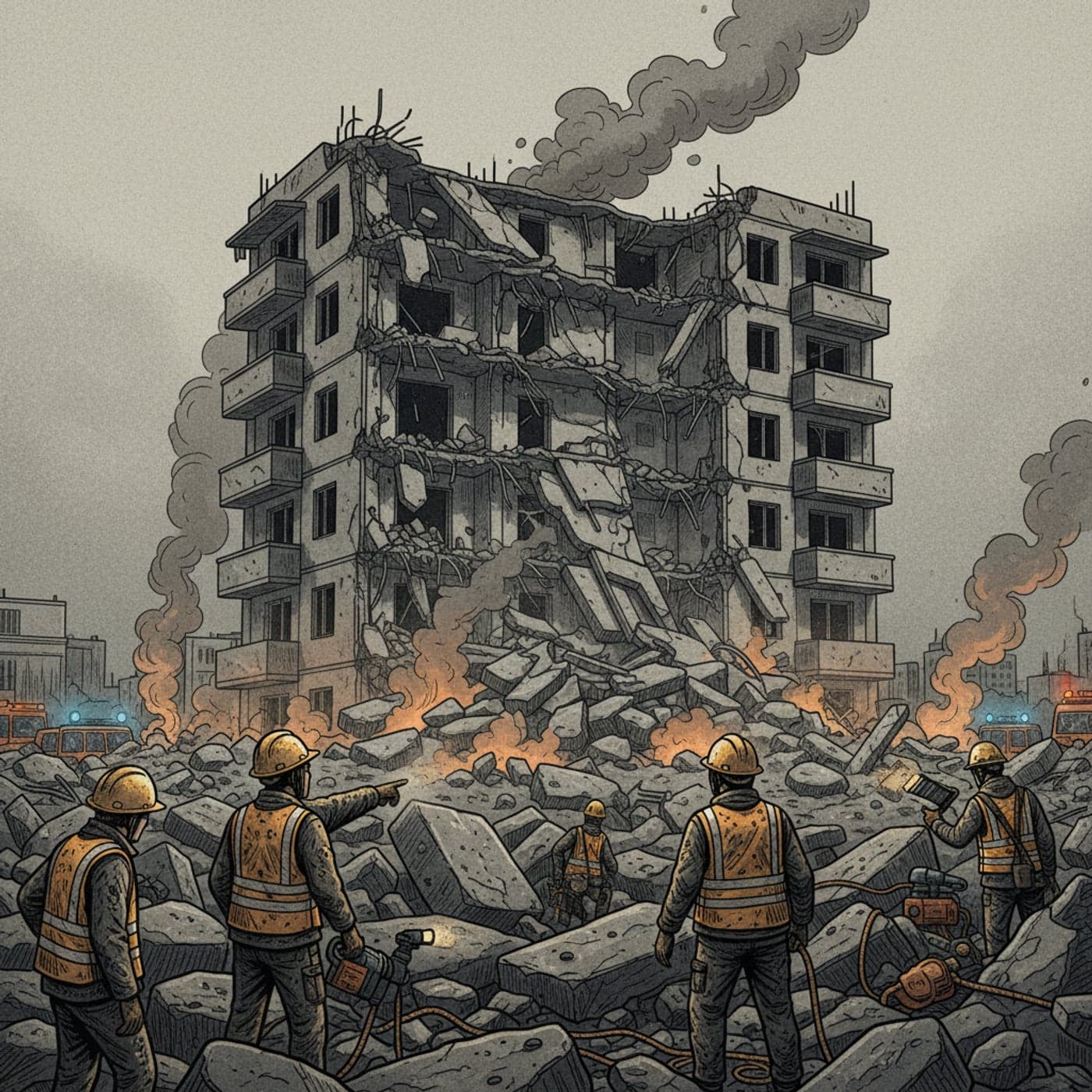
In the eastern Ukrainian city of Chasiv Yar, the evening of July 9th, 2022, was shattered by a sudden and devastating missile strike.
From the July 2022 Chasiv Yar missile strike Wikipedia page. The hosts are synthetic voices.
Read the script
In the eastern Ukrainian city of Chasiv Yar, the evening of July 9th, 2022, was shattered by a sudden and devastating missile strike. This wasn't a strike on a military base, or a strategic stronghold. It was a strike on homes. On ordinary lives caught in the crossfire. Chasiv Yar, a city of about 12,000 people, sits about 20 kilometers southeast of Kramatorsk. It’s a place where the lines between civilian life and military presence blurred tragically in the rubble, revealing the brutal impact of war on ordinary homes. On that July evening, at 21:17 local time, the Russian army unleashed what Ukrainian officials described as a powerful Uragan rocket launcher. The target: two residential buildings. The strike tore into a five-story building, completely destroying two entrances and causing a partial collapse. It was an attack that would unfold over days, not just in the initial moments of destruction, but in the agonizing aftermath. Rescue and search operations began immediately. Hundreds of emergency workers, armed with heavy equipment, descended upon the scene. For days, they painstakingly sifted through the debris, an estimated 525 tons of it. They were looking for survivors, for answers, for the lost. Initially, there were conflicting reports about who was in the buildings. The Russian Defense Ministry claimed they had targeted a temporary deployment point for a Ukrainian territorial defense unit. But the reality on the ground, as pieced together from witness accounts and later reports, was more complex. A local resident told The New York Times that 10 elderly civilians had been in the buildings. Members of the military, he said, had arrived to lodge there just two days prior, possibly after their shifts. These soldiers, some of them off-duty, sleeping in the building, became victims. Early reports indicated at least eleven soldiers from Ternopil Oblast were among the dead. Later, the numbers grew, with sources reporting at least 37 military victims, the majority from Ternopil. The final military death toll was put at 40. But they weren't the only ones. Civilians, including those elderly residents, were also killed. By July 13th, 48 bodies had been recovered from the rubble. Nine people had been rescued alive by July 12th. The scale of the loss was immense, a stark illustration of how the war in Ukraine had infiltrated the most intimate spaces of daily life. Reactions were swift and sharp. Andriy Yermak, the chief of staff to Ukraine's president, condemned the strike as another 'terrorist attack,' calling for Russia to be designated a 'state sponsor of terrorism.' Russia, through its military spokesman, claimed to have killed 'over 300 nationalists,' though it was unclear if this referred to the Chasiv Yar strike or an earlier incident. The strike on Chasiv Yar serves as a somber reminder of the devastating human cost of conflict, where the boundaries between combatant and civilian can be tragically erased. The search for truth and accountability continues, even as the city slowly grapples with its loss. This report is based on the Wikipedia article titled July 2022 Chasiv Yar missile strike, available under Creative Commons. The hosts are synthetic voices.