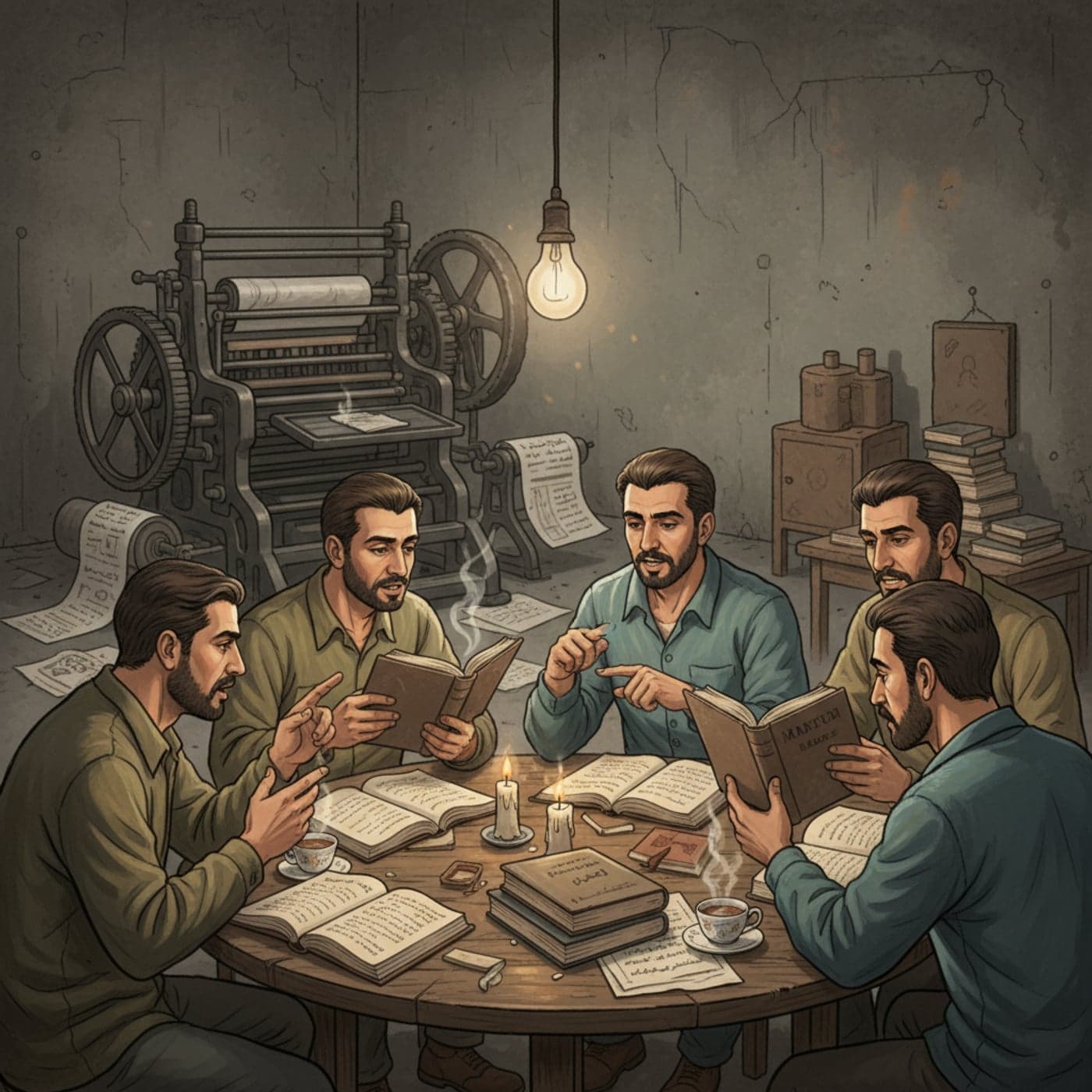
For nearly a century, one political party in Iraq has consistently championed the rights of the working class and advocated for social justice, often at great personal cost to its members.
From the Iraqi Communist Party Wikipedia page. The hosts are synthetic voices.
Read the script
For nearly a century, one political party in Iraq has consistently championed the rights of the working class and advocated for social justice, often at great personal cost to its members. The Iraqi Communist Party's surprising through-line is its unwavering commitment to social justice and national sovereignty, enduring brutal repression and shifting political alliances, from clandestine study circles to participating in government, yet consistently prioritizing the welfare of ordinary Iraqis over ideological purity or foreign influence. Born from a Marxist study circle in 1924 Baghdad, the Iraqi Communist Party, or ICP, quickly became a prominent force. It advocated for workers' rights, for women's equality, and for an end to feudal practices. Despite facing constant suppression, including public executions of its leaders and a near decimation of its ranks under regimes like the Ba'ath Party and Saddam Hussein, the ICP persistently organized and fought for change. It navigated complex geopolitical landscapes, at times aligning with the Soviet Union, at others opposing British occupation, and even participating in governments. From leading national uprisings and organizing labor unions to opposing the 2003 US invasion, the party's history is a testament to its resilience and its enduring, albeit often difficult, quest for a 'free homeland and a happy people' in Iraq. Its story begins not with a party, but with a single individual. Husain al-Rahhal, a student at the Baghdad School of Law, formed what is now seen as the first Marxist study circle in Iraq in 1924. These young intellectuals met in Baghdad's Haidarkhanah Mosque, discussing the 'new ideas' of the day. They published a small newspaper, Al-Sahifah, which detailed a decidedly Marxist ideology. Its contributors included influential figures like Mustafa Ali, who would later become Minister of Justice, and Mahmoud Ahmad Al-Sayyid, considered Iraq's first novelist. Al-Rahhal, a gifted polyglot, translated articles from European communist and Marxist newspapers, introducing many new ideals into Iraqi intellectual society. The paper, though lacking a definite agenda, focused on the need to break down tradition, advocating for equal rights for women and the abolition of feudal practices. After six issues and several government crackdowns, the paper published its final issue in 1927. Al-Rahhal continued to exert influence through the youth organization Nadi Al-Tadamun, inspiring Iraq's first student demonstrations. In 1929, a sharp decline in international commodity prices led to a national economic depression and massive wage reductions for Iraqi workers. Communist circles began to grow, particularly in Basra and Nasiriyyah, and also in Baghdad, among young men who had met during the earlier student demonstrations. These groups eventually came together through the boycott of the British-owned Baghdad Electric Light Company in 1933. On March 8th, 1935, Jamiyyat Dudd Al-Istimar, The Association Against Colonialism, was founded. Three days later, a manifesto was issued, calling for the unification of all workers and peasants, demanding debt cancellation, land redistribution, and an eight-hour workday. The organization published Iraq's first underground paper, Kifah Al-Shab, 'The Struggle of the People', and attacked the prime minister, resulting in swift arrests. By December 1935, the paper ceased to exist. After a coup in 1936, communist leaders and organizers who had eluded imprisonment helped lead peaceful demonstrations. The party found supporters in a Committee for National and Progressive Reform and even secured two seats in parliament. However, the coup leader, Bakr Sidqi, quickly attacked the party, leading to labor strikes and further crackdowns. Many reformers fled. Despite Sidqi's assassination in 1937, the party's leadership was left in the hands of Zaki Khairi, who sought new support among the lower ranks of the military. Throughout this period, the Iraqi Communist Party stood firmly against antisemitism and was wary of fascist trends. World War II presented a difficult predicament. The ICP looked to the Soviet Union for guidance but vehemently opposed supporting the British Empire, whose occupation of Iraq was partially to keep supply lines open to the Soviets. After Nazi Germany invaded the Soviet Union in 1941, the ICP hesitated to support either side. Eventually, in May 1942, the party decided to support the Allies, which temporarily aligned them with the Iraqi monarchy and landowners. In 1941, Yusuf Salman Yusuf became secretary-general. He revamped the organization, expanding membership among the working classes and laying the basis for the mass party of later years. Under his leadership, the party became a considerable force among Iraqi workers and a major focus for protest against British involvement. However, decisions made in 1942 led to a split into several factions. In 1944, the party launched a clandestine campaign to organize industrial workers, leading to a party conference in 1944 and its first congress in 1945. Anti-British sentiment returned to the forefront in April 1945 as the cost of living grew. The party attacked the Iraqi government after protestors were killed in June and July 1946. Fahd, a key leader, was arrested and sentenced to death, later commuted to life in prison. Between 1944 and 1946, significant percentages of oil, railway, and port workers were unionized, with ICP members as leaders. This resulted in massive strikes between 1945 and 1947, demanding wage increases and union legalization. The government granted increases but then dismantled the unions and arrested leaders, contributing to Al-Wathbah, a period of urban unrest in Baghdad, beginning in January 1948. Another major issue was the Palestinian Question. Despite earlier support for Palestinian self-determination, in July 1948 the party aligned with Moscow's position of supporting a Zionist state. This cost the party many supporters. This period brought organizational victories but also a devastating government response. Fahd and two other ICP members were publicly hanged in 1949, accused of organizing agitation from prison. The party was nearly decimated. After the devastations of the late 1940s, the party underwent serious changes. The weakened organization was carried through the early 50s by growing Kurdish support. For a period, the party was led from Kurdistan. Most of the old, Baghdadi leadership was imprisoned. Kurdish members filled the void. Jewish membership dropped drastically, linked to the mass exodus of Iraqi Jews. Between 1952 and 1954, uprisings led to martial law, the outlawing of political parties, and arrests. The ICP, always illegal, adopted a new national charter in 1953, accepting possible secession of the Kurdish people. Riots over prison conditions in 1953 resulted in deaths of communist prisoners, causing a national outcry and winning sympathizers. At its second congress in 1956, the party officially adopted a pan-Arabist stance, inspired by the arms agreement between Egypt and the USSR and Egypt's nationalization of the Suez Canal. This pro-Nasserist stance would later become a point of conflict. In 1958, the party supported the revolution and the new government of Abdul-Karim Qasim. The relationship between the party and Qasim was positive. After the monarchy was overthrown, Naziha al-Dulaimi, an ICP member, was appointed Minister of Municipalities in 1959, the first woman minister in modern Iraqi history and the first woman cabinet minister in the Arab world. Qasim, who had lifted a ban on the ICP, relied on its support. The Ba'athist coup of February 8th, 1963, was met with street fighting as communist activists resisted. When the Ba'ath consolidated power, the ICP suffered an unprecedented campaign of suppression. Leading figures were killed, though the total number remains unknown, it was in the dozens. In the mid-1960s, the US State Department estimated party membership at about 15,000. In 1967, Aziz al-Hajj split from the ICP, establishing a rival organization. In 1973, ICP secretary Aziz Muhammad signed a National Action Pact with President Ahmed Hassan al-Bakr, forming a National Progressive Front with the Ba'ath Party. The ICP was permitted to operate legally. However, this was coupled with repression. By the autumn of 1974, the party sought to increase its security through a more clandestine mode of operation. In 1978, Saddam Hussein unleashed a renewed campaign of repression, including the execution of large numbers of party members. In 1979, the party broke ties with the government. At its fifth national conference in 1993, the party voted to abandon democratic centralism, revolutionary socialism, and Marxism-Leninism, opting instead for reformism and identifying as Marxist. In 1993, the Kurdish branch became a semi-autonomous party. Following the American occupation of Iraq in 2003, the Iraqi Communist Party opposed the invasion but decided to work within the new political institutions. Its secretary, Hamid Majid Mousa, accepted a position on the Iraqi Governing Council. The party was a principal component of the People's Union list in the 2005 elections, and later joined the Iraqi National List. For the 2018 general election, the Communist Party joined the Alliance Towards Reforms, which made significant gains. A communist woman representing the alliance, Suhad al-Khateeb, was elected to represent the city of Najaf. Upon her victory, al-Khateeb stated, 'the Communist party have a long history of honesty – we were not agents for foreign occupations. We want social justice, citizenship, and are against sectarianism, and this is also what Iraqis want.' The party was supportive of the 2019-2021 Iraqi protests. It boycotted the 2021 Iraqi parliamentary elections, citing the deepening political and social crisis, corruption, assassinations, kidnappings, intimidation, and the deterioration of living conditions. In May 2025, the Iraqi Communist Party was one of thirteen political groups that formed a new electoral alliance, The Alternative Alliance, aiming to introduce a civil and reform-driven platform. The party newspaper is Tariq ash-Shaab, meaning Path of the People. It also publishes the magazine Al-Thakafa Al-Jedida, The New Culture. The motto of the party is 'a free homeland and a happy people'. This portrait is based on the Wikipedia article titled Iraqi Communist Party, available under Creative Commons. The hosts are synthetic voices.