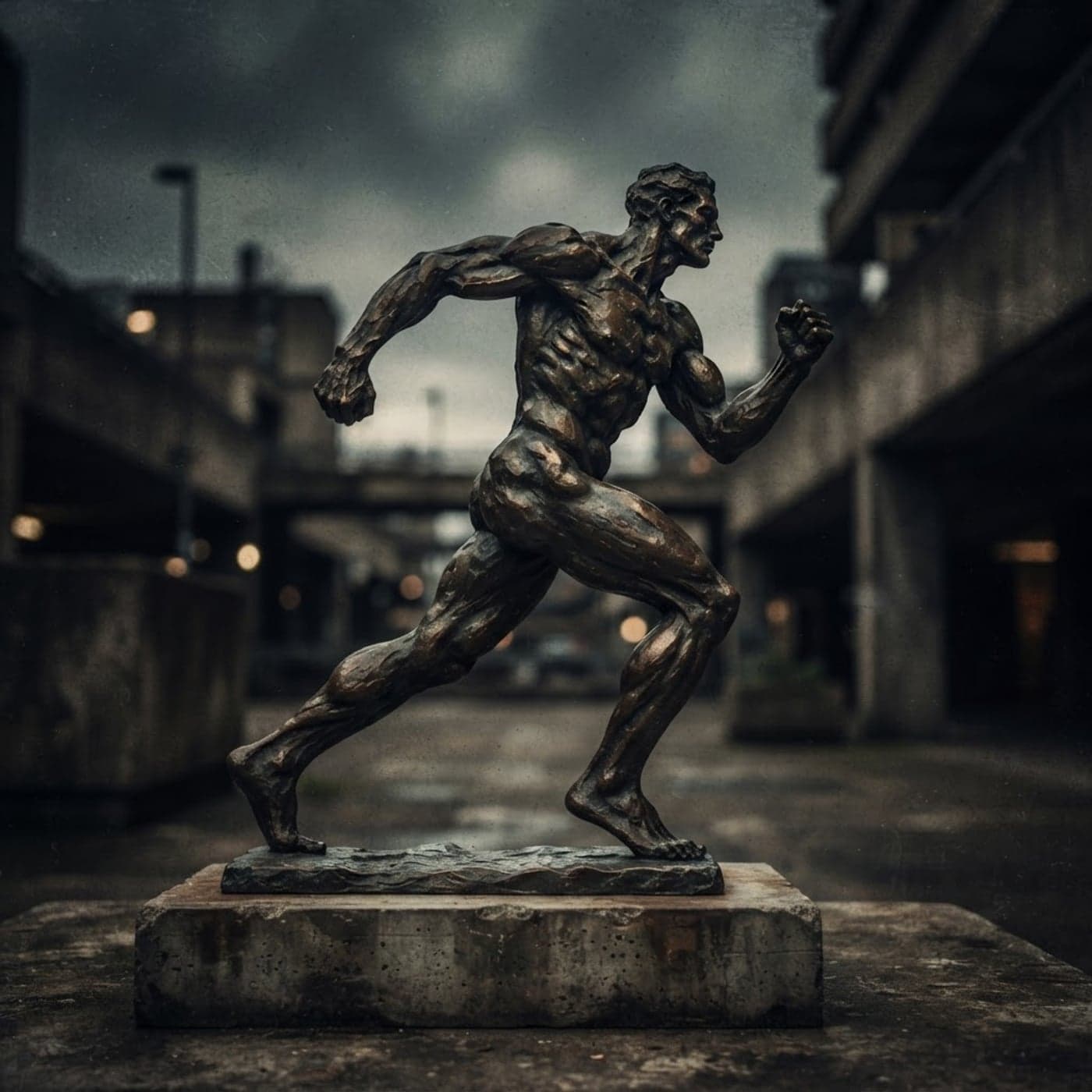
A horse, a building, and pure energy are synthesized into a single, dynamic form, but the artist's most famous sculpture only existed as a plaster cast before its destruction.
From the Umberto Boccioni Wikipedia page. The hosts are synthetic voices.
Read the script
Imagine a horse, a building, and pure energy, all synthesized into a single, dynamic form. That was the ambition of Umberto Boccioni, an artist whose most famous sculpture, designed to capture this very essence, only existed as a plaster cast before its destruction. It's a story of vision, loss, and the enduring power of an idea. Umberto Boccioni was born in Reggio Calabria, Italy, in 1882. His father, a government employee, moved the family frequently, exposing Boccioni to different parts of Italy from an early age. His artistic journey began in Rome, where he studied at the Scuola Libera del Nudo and under the poster artist Giovanni Mataloni. It was there he met Gino Severini, another budding artist, and together they explored philosophy, rebellion, and art. Their shared interest led them to Giacomo Balla, a master of Divisionism—a technique that broke down color into stippled dots and stripes rather than mixing them on the palette. Boccioni absorbed these lessons, but his restless spirit pushed him further. He briefly studied Impressionism and Post-Impressionism in Paris, then traveled to Russia, witnessing the societal upheaval that would undoubtedly fuel his later artistic philosophy. By 1907, Boccioni settled in Milan. The city, bustling with industrialization, offered a canvas for his evolving vision. It was here, in 1910, that he encountered Filippo Tommaso Marinetti, the founder of Futurism. Marinetti had already published his "Manifesto of Futurism," a bold declaration that celebrated speed, technology, youth, and violence, and rejected the past. Boccioni, along with Balla, Carlo Carrà, Luigi Russolo, and Severini, enthusiastically signed the "Manifesto of Futurist Painters." This moment marked a pivotal turn. Boccioni became a central theorist of the movement, believing that art should not depict a single, fleeting moment, but rather the synthesized experience of time, place, and form. He articulated this in 1914, stating, "While the impressionists paint a picture to give one particular moment and subordinate the life of the picture to its resemblance to this moment, we synthesize every moment (time, place, form, color-tone) and thus paint the picture." His early work, like "The Morning" (1909) and "Three Women" (1909–10), still showed traces of Divisionism, but his breakthrough came with "The City Rises" (1910). This monumental painting, depicting a dynamic scene of construction and horses, became a Futurist emblem. Boccioni described it as "a great synthesis of labor, light and movement." It captured the raw energy of urban transformation, a theme he would continue to explore. In 1911, he created "The Laugh," his first truly Futurist work, shedding the last vestiges of Divisionism. He then embarked on a trilogy of paintings titled "States of Mind"—"The Farewells," "Those Who Go," and "Those Who Stay"—each capturing the emotional and physical flux of a railroad station. His dynamism paintings, such as "Elasticity" (1912), depicted the pure energy of a horse with intense chromaticism, further solidifying his commitment to capturing motion and force. Boccioni's ambition soon extended beyond painting. After visiting the studios of avant-garde sculptors in Paris in 1912, he decided to embrace sculpture. In 1912, he published his "Technical Manifesto of Futurist Sculpture," outlining his vision for a new form of three-dimensional art that would express the synthetic continuity of motion, rather than a static, analytical representation. He began working in sculpture the previous year, driven by this new theoretical approach. By the end of 1913, he completed his masterpiece, "Unique Forms of Continuity in Space." This work aimed to express a synthetic continuity of motion, a figure striding forward, its form dissolving and reforming with each step, a powerful embodiment of the Futurist ideal. During his lifetime, however, this iconic sculpture existed only as a plaster cast. It was not cast in bronze until 1931, years after his death, and later, in 1998, it was chosen to be engraved on the Italian 20-cent euro coin. The outbreak of the First World War irrevocably altered Boccioni's path. In May 1915, Italy declared war on the Austro-Hungarian Empire, and Boccioni, a fervent nationalist, joined the military. He was assigned to an artillery regiment near Verona. Tragically, on August 16, 1916, at the age of thirty-three, he was thrown from his horse during a cavalry training exercise and trampled. He died the following day. His untimely death left a void, and a significant portion of his experimental sculptures from 1912 to 1913 were lost. After a memorial exhibition in Milan, his family entrusted his works to a fellow sculptor, Piero da Verona. What happened next is a matter of debate, but the outcome was devastating: many of his plaster sculptures were destroyed. Marinetti recounted that they were deliberately discarded or broken by workmen, perhaps at the behest of an "envious passéist narrow-minded sculptor." Today, many of these groundbreaking works are known only through photographs and later reconstructions. Umberto Boccioni's short life was a blaze of artistic innovation. His pursuit of dynamism, his synthesis of time and space, and his efforts to capture the very essence of modern life continue to resonate. His work, despite the losses, irrevocably shaped the course of modern art. This is based on the Wikipedia article titled Umberto Boccioni, available under Creative Commons. The hosts are synthetic voices.