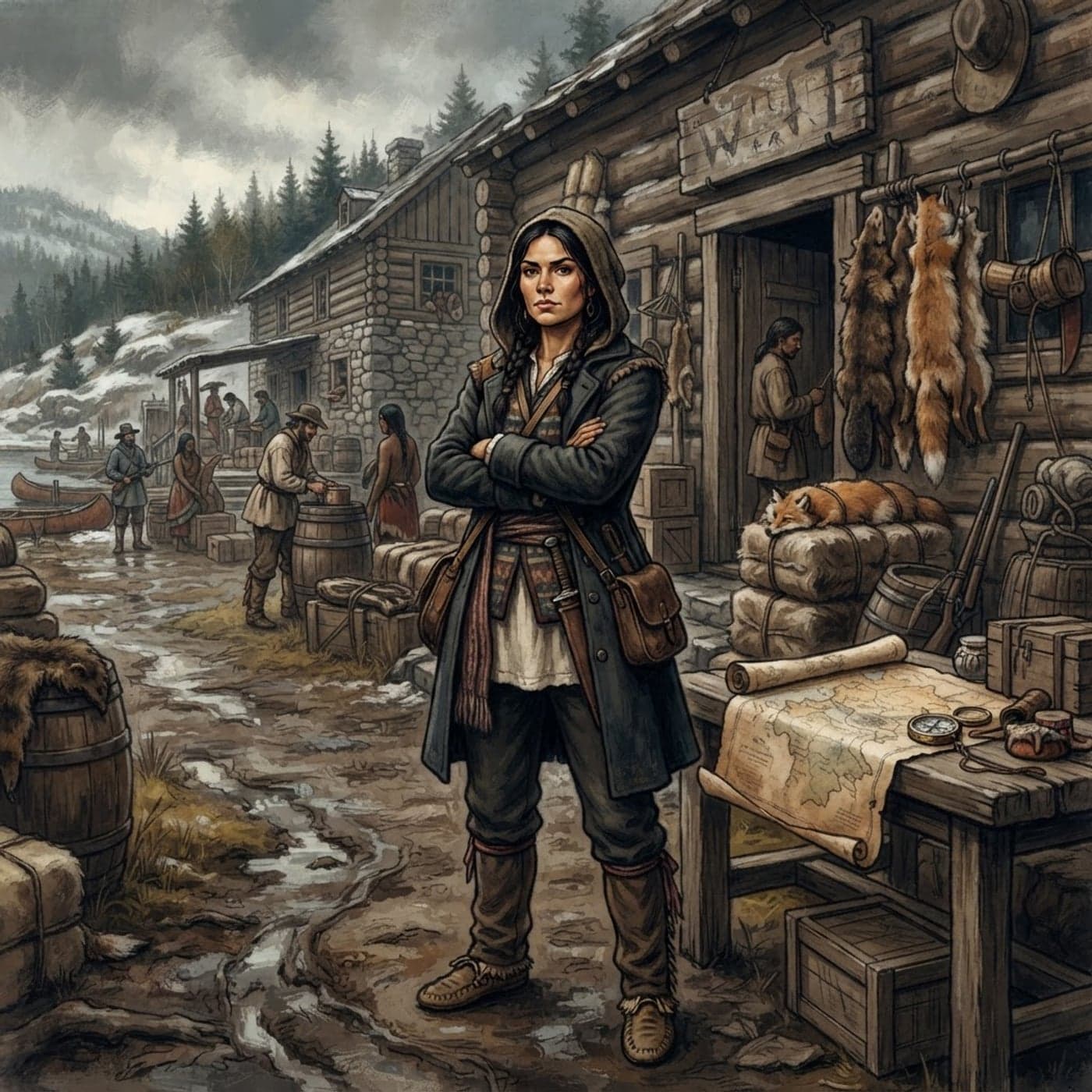
She was a multilingual, mixed-race fur trader who built a business empire in 19th-century Michigan, even outmaneuvering John Jacob Astor.
From the Magdelaine Laframboise Wikipedia page. The hosts are synthetic voices.
Read the script
Magdelaine Laframboise was a force of nature in 19th-century Michigan. A multilingual, mixed-race fur trader, she didn't just build a business empire; she outmaneuvered giants like John Jacob Astor and left a legacy that shaped her community. Her life was a masterclass in resilience and adaptability, a journey from a daughter of the fur trade to a formidable businesswoman, navigating loss, fierce competition, and profound cultural shifts. Born Marguerite-Magdelaine Marcot in 1781, near what we now call Niles, Michigan, her heritage was rich and complex. Her father was a French fur trader, a chief agent for the Northwest Fur Company. Her mother, Marie Nekesh, was Odawa, and her maternal grandfather was Chief Kewinoquot. This mixed heritage, this blend of worlds, would define Magdelaine’s extraordinary path. Tragedy struck early. Her father was killed when she was just two. Money became tight, and unlike her older siblings, Magdelaine and her younger sister Therese weren't sent to Montreal for French schooling. Instead, they were raised deeply within their mother’s Odawa culture, moving to Mackinac Island after the British ceded Fort St. Joseph to the newly independent United States. It was here, in this vibrant, bustling hub, that Magdelaine truly came into her own. She became fluent in not one, not two, but four languages: Odawa, French, English, and Ojibwe. This linguistic prowess, combined with her deep understanding of Native American cultures and her family’s extensive network, would become invaluable. In 1794, she married Joseph La Framboise. Together, they built a thriving fur trade business in the Grand River Valley. Every fall, they’d load their trade goods from Mackinac Island and journey to the Odawa territories, establishing trading posts, including the first permanent mercantile building in west Michigan, at what’s now Fallasburg. Each spring, they’d return to Mackinac Island, laden with the season’s furs. But in 1806, tragedy struck again. Joseph was fatally stabbed, leaving Magdelaine a widow with two young children. Many might have crumbled, but Magdelaine Laframboise was not many. She took the reins of their business, not just maintaining it, but expanding it across the western and northern parts of Michigan’s lower peninsula. She managed multiple trading posts, even as she raised her children, Josette and Joseph, ensuring they received the formal education she hadn’t, sending them to French schools in Montreal. The fur trade was lucrative, and Magdelaine was exceptionally good at it. While an experienced trader might earn a thousand dollars a year, Magdelaine was pulling in five to ten thousand, a fortune at the time. She was described as “a woman of a vast deal of energy and enterprise – of a tall and commanding figure, and most dignified deportment.” She didn’t just survive in a male-dominated world; she dominated it, even competing successfully against John Jacob Astor’s powerful American Fur Company. Her fluency in multiple languages and her strong ties within Native American communities gave her an undeniable edge. Around 1818, she affiliated with Astor’s company, and by 1822, at the age of 41, she sold her flourishing business and retired a very wealthy woman. Her retirement wasn’t a retreat from life; it was a pivot to community. She settled into a stately home on Mackinac Island, a home her son-in-law, Captain Benjamin Pierce, commandant of Fort Mackinac, had overseen the construction of. She taught herself to read and write in both French and English. Her passion for education led her to establish the first Catholic school for Native American children on the island, initially running it from her own home. She was a devout Catholic, teaching catechism at Sainte Anne Church and acting as a crucial figure in keeping the congregation together during years without a regular priest. When the church needed a new site, she donated the land next to her home, asking only to be buried beneath its altar. It was a request that would be honored. Her home became a social magnet, drawing prominent figures. French writer Alexis de Tocqueville, known for his observations on American democracy, visited her. So did Margaret Fuller, the renowned American intellectual, who described Laframboise in her book, *Summer on the Lakes*, as “an Indian by birth, and wearing the dress of her country. She spoke French fluently, and was very ladylike in her manners. She is a great character among them.” Fuller noted how people constantly sought Laframboise’s homage, aid, and advice, recognizing her as “a shrewd woman of business.” Magdelaine Laframboise passed away on April 4, 1846. Her request was honored, and she was interred beneath the altar of Sainte Anne Church. Though her remains, and those of her daughter Josette and infant granddaughter, were later moved during renovations, they found their final resting place in a crypt within the church itself in 2013, a testament to her enduring legacy. Her mansion still stands next to the church, now a charming inn, a constant reminder of the extraordinary woman who once lived there. In 1984, Magdelaine Laframboise was posthumously inducted into the Michigan Women's Hall of Fame, a fitting tribute to a pioneer businesswoman, a pillar of her community, and a woman who truly carved her own path. This portrait is based on the Wikipedia article titled Magdelaine Laframboise, available under Creative Commons. The hosts are synthetic voices.