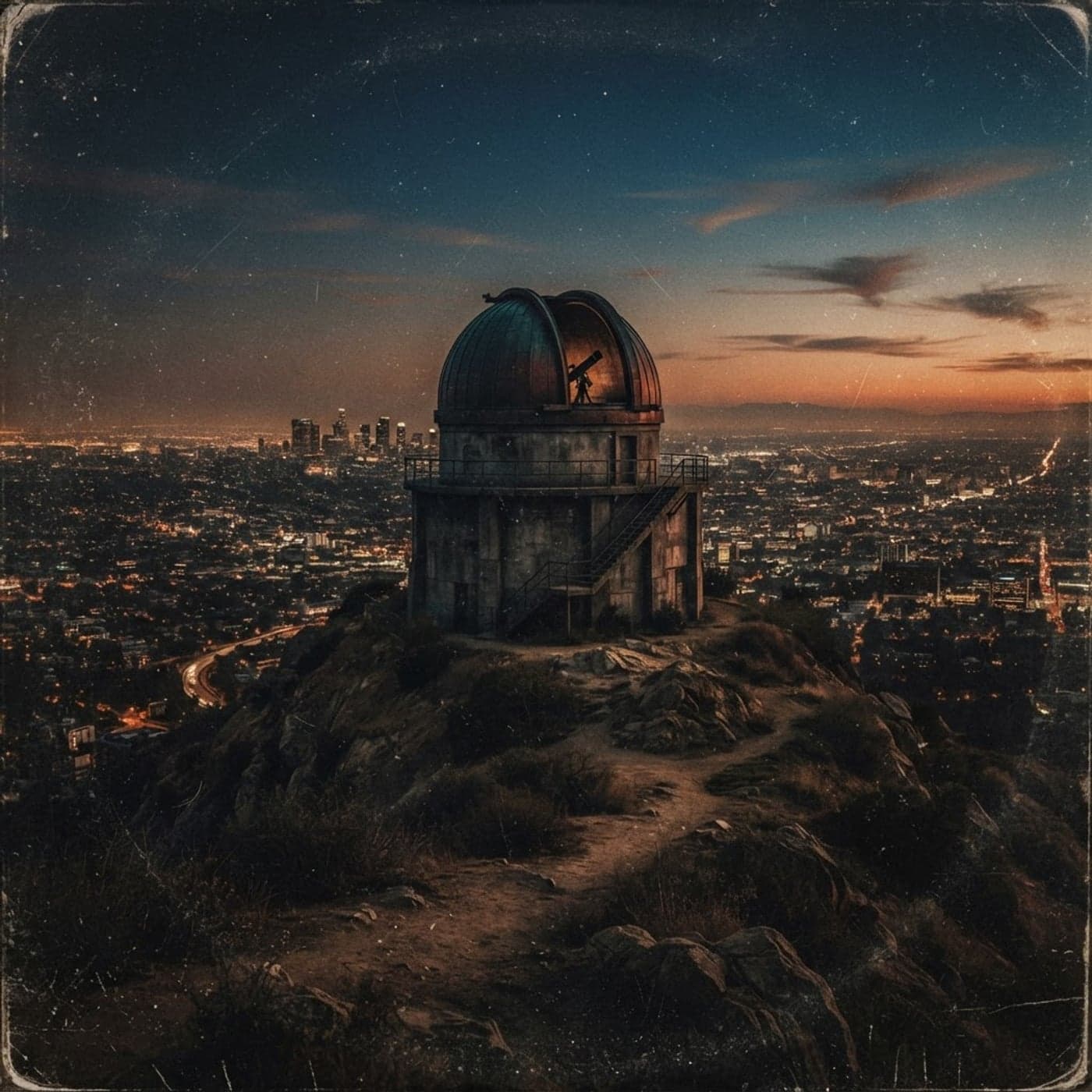
A Chilean hill became a crucial outpost for understanding the Sun's journey through the cosmos, overcoming broken mirrors and riotous strikes.
From the Manuel Foster Observatory Wikipedia page. The hosts are synthetic voices.
Read the script
A Chilean hill, Cerro San Cristóbal, overlooking Santiago. Today, it’s a place of parks and public tours. But for a crucial period in the early 20th century, this was a vital outpost for understanding our place in the universe. It was a place that battled broken mirrors, leaky domes, and even riotous strikes. This is the story of the Manuel Foster Observatory. It began with a philanthropic dream. Darius Ogden Mills, a wealthy American banker, wanted to map the unseen motions of the stars. Specifically, he funded an ambitious project based at the Lick Observatory in California, aiming to determine the Sun's motion through space. This required looking not just at the Northern Hemisphere, but the Southern Hemisphere too. And so, in 1903, an offshoot of the Lick Observatory was established on this very hill. Originally known as the D. O. Mills Observatory, its primary mission was to collect spectrograms – essentially fingerprints of starlight – from southern stars. These would then be compared with data from the north, allowing astronomers to calculate our solar system’s journey through the cosmos. The man tasked with leading this southern expedition was William H. Wright, an assistant to the project’s visionary, W. W. Campbell. Campbell himself, however, was severely injured before the expedition could even set sail. The journey to Chile was fraught with challenges from the start. A crucial mirror, intended for the telescope, broke during transit. Then, when the equipment finally arrived in Valparaíso, a riotous strike in the port caused another significant delay. Even after reaching Santiago, the chosen site on Cerro San Cristóbal presented its own issues. The custom-built dome, a steel frame covered in canvas, proved stubbornly un-waterproof, leading to leaks that threatened the sensitive instruments. And the mirror, after being re-shaped, was delivered with the wrong specifications, needing yet another correction. Despite these setbacks, operations began in late 1903. William H. Wright and his assistant, Harold K. Palmer, soldiered on. They were housed in the city, requiring a nightly climb to the observatory. Early observations revealed issues with the telescope’s focus as it cooled, and the silvered mirror’s reflectivity declined rapidly in the humid climate, necessitating longer exposure times. Yet, by October 1905, they had collected 800 spectrograms. This initial phase, funded for just two years, proved successful enough for Darius Ogden Mills to agree to continued financing. Under new leadership, Heber D. Curtis took over in 1906. The observatory received much-needed improvements. A machine shop and new living quarters were added. The leaky canvas dome was replaced with galvanized iron, and a refrigeration unit was installed to help keep the dome cool. New spectrographs were built to study fainter stars, and the mirror was re-silvered regularly. The astronomers continued to collect data, observing some 725 stars and producing over 3,600 plates by the end of 1909. Over the years, the funding continued, passed from Darius Ogden Mills to his son, Ogden Mills, and eventually supplemented by friends of the observatory. Astronomers like Joseph H. Moore, Ralph E. Wilson, and Ferdinand J. Neubauer led the station through different phases. They studied not only stars but also nebulae, even observing Comet Morehouse and later, Halley's Comet. By 1928, when the observatory’s operations under Lick control finally concluded, over 10,000 spectrograms had been produced. This vast collection of data allowed W. W. Campbell to finally complete his study on the Sun's motion through space in 1926. The results, combined with data from the Northern Hemisphere, helped refine humanity's understanding of our solar system’s place in the galaxy. In 1928, a significant transition occurred. The observatory was purchased by Chilean lawyer Manuel Foster Recabarren, who then generously donated it to the Universidad Católica de Chile. It was renamed the Manuel Foster Observatory and became the largest operational telescope in the southern hemisphere at the time. It continued to be used for astronomical research, with astronomers like Erich P. Heilmeier studying variable stars in the 1940s. However, the growing city of Santiago brought increasing light pollution, and the observatory faced further challenges, including fires and accidents. By 1948, technical and economic problems led to its closure. Yet, the story didn’t end there. Restoration began in the 1980s, and the observatory was used again for research and public outreach, observing phenomena like Supernova 1987A. But the relentless march of urban growth eventually degraded observation quality beyond repair. In 1995, the Manuel Foster Observatory ceased operations altogether. In 2010, it was declared a national monument. Today, Cerro San Cristóbal remains a beloved landmark, and the Manuel Foster Observatory, though silent astronomically, serves as a reminder of a time when a small hill in Chile played a crucial role in charting the vastness of the cosmos. This has been based on the Wikipedia article titled Manuel Foster Observatory, available under Creative Commons. The hosts are synthetic voices.