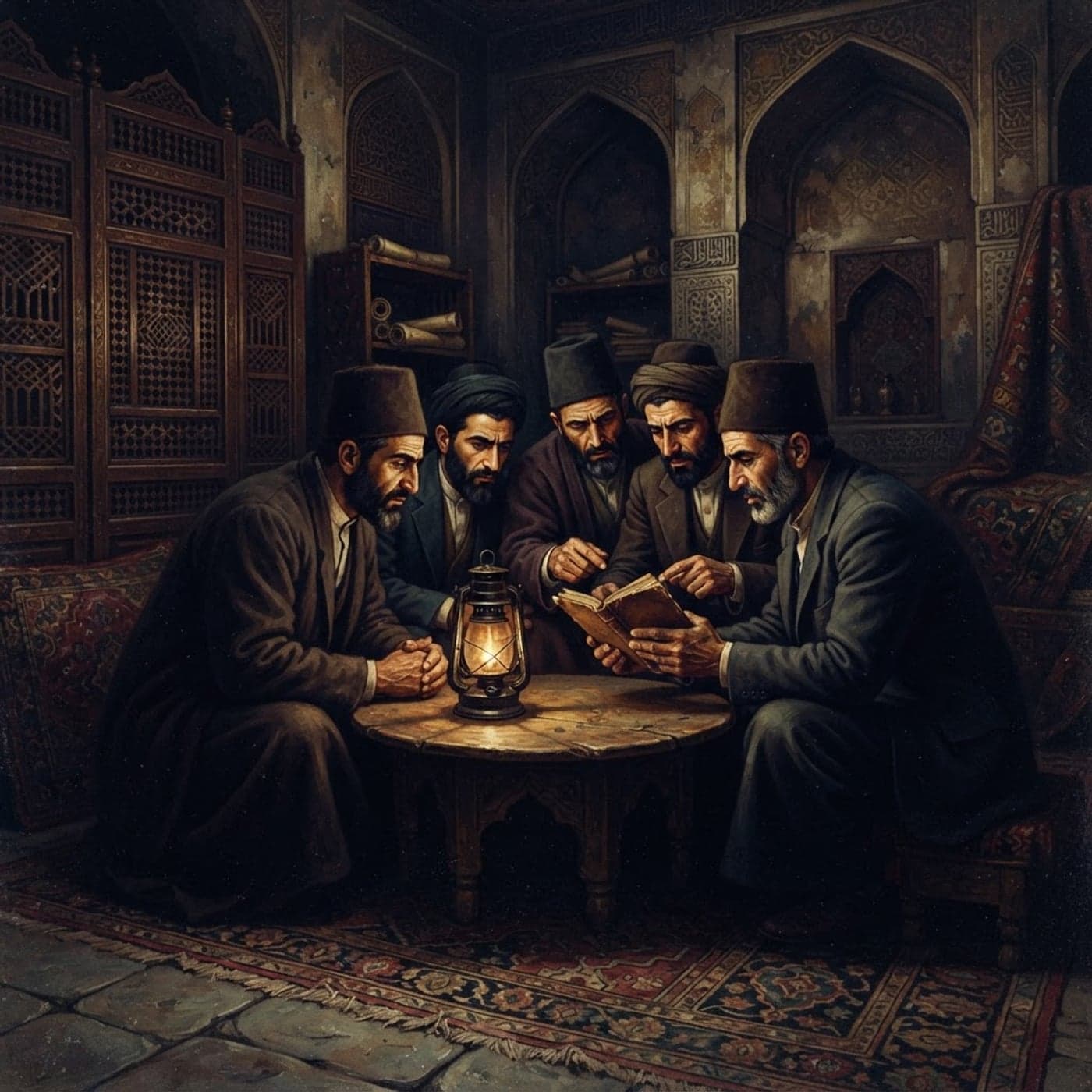
In the mid-19th century, Iran's educated elite, shaken by military defeats and economic collapse, began a secret revolution of ideas, inspired by French thinkers and disseminated through clandestine societies.
From the Iranian Enlightenment Wikipedia page. The hosts are synthetic voices.
Read the script
Imagine a country, shaken to its core. Defeated in war, its economy crumbling. This was Iran in the mid-19th century. And into this crisis, a quiet revolution began. Not with armies, but with ideas. A revolution of the mind, sparked by thinkers who looked to Europe, especially France, for inspiration. This was the Iranian Enlightenment. A period, roughly from the mid-1800s to the early 1900s, where Iran's educated elite started a secret, intellectual movement to modernize their nation. They were grappling with what they saw as Iran's backwardness, its vulnerability in a rapidly changing world. Think of it like this: the Qajar era in Iran. The country had suffered a significant defeat in a war with Russia in the 1820s. This military loss, coupled with economic instability, laid bare a perceived weakness. It was a wake-up call for the educated class. They began to question the status quo. And where did they find new ideas? Many looked westward. France, in particular, became a sort of intellectual beacon. It wasn't directly involved in Iran's colonial struggles, unlike Britain, and it was a center of new philosophies. French became the language of the educated elite, replacing Arabic in some ways, as translations of Western literature, philosophy, and history flowed into Iran, often through French. This intellectual ferment didn't happen in public squares. It was clandestine. Secret societies and associations sprang up. One famous example was Mirza Malkam Khan's Faramosh Khaneh, which, the article notes, was based on Masonic lodges. These groups weren't just meeting to chat. They were distributing leaflets and newspapers, spreading their radical ideas far and wide. What were these ideas? At their heart, they were about reform. They called for modernizing the land and administrative systems. They wanted to curb the influence of the clergy, which they saw as intertwined with superstition and what they termed intellectual prejudice. And they advocated for limiting the absolute power of the rulers, bringing them under the framework of law. These were secular thinkers, directly challenging the established religious order. Their goal was to drag Iran into the modern age. They looked at the economic situation, for instance. The Qajar economy was largely feudal, and increasingly, foreign companies like the East India Company were gaining influence, leading to what the article describes as a complete economic collapse for many. While a governor might earn a fortune through corruption, a simple worker earned a pittance. This disparity fueled the desire for change. These intellectuals, like Mirza Fatali Akhundov, Mirza Abdul'Rahim Talibov, and later figures like Seyyed Hassan Taghizadeh, expressed their thoughts in ways that resonated with people. They used poetry, fiction, simple stories, and parables. This accessibility was key to spreading the message beyond a small circle of scholars. And their influence didn't stay within Iran's borders. These ideas spread to neighboring countries like Afghanistan and across the Arab world, influencing places like Egypt. Thinkers like Jamal al-Din al-Afghani collaborated with many of these Iranian intellectuals. Some efforts at reform were more direct. Amir Kabir, who became Prime Minister in 1848, attempted a series of reforms. He established Dar al-Fonun, Iran's first modern university, bringing in foreign professors who introduced Western science and culture. He also started a modern newspaper, Vaqaye-e Ettefaqiyeh, which published world news and had different sections, even for children. But Amir Kabir faced significant opposition, particularly from the clergy and some members of the royal court, and was eventually assassinated. The educational system itself began to change. Haji-Mirza Hassan Roshdieh, known as the father of modern Iranian education, established new schools that were open to ordinary people, not just the aristocracy. He introduced new teaching methods and books for children. Though he faced opposition, with some of his schools being destroyed by clerics, his efforts contributed to a shift in the educational landscape. Later, the Constitutional Revolution in 1906 brought about a period of relative freedom of expression. A parliament was formed, laws were passed, and newspapers could be published with less censorship. The ideas that had been circulating in secret societies for decades began to manifest in the social and political reality of Iran. Concepts like secularism, modernism, and nationalism gained traction. This period saw the formation of the first modern political parties, like the Social Democratic Party, which advocated for these modernist ideas. The intellectuals were no longer just whispering in secret; their ideas were shaping the nation's future. It was a long, complex process, a fundamental shift in how a nation thought about itself and its place in the world. This was the Iranian Enlightenment, a quiet revolution of ideas that profoundly altered Iran's intellectual landscape and laid the groundwork for future political change. This is based on the Wikipedia article titled "Iranian Enlightenment," available under Creative Commons.