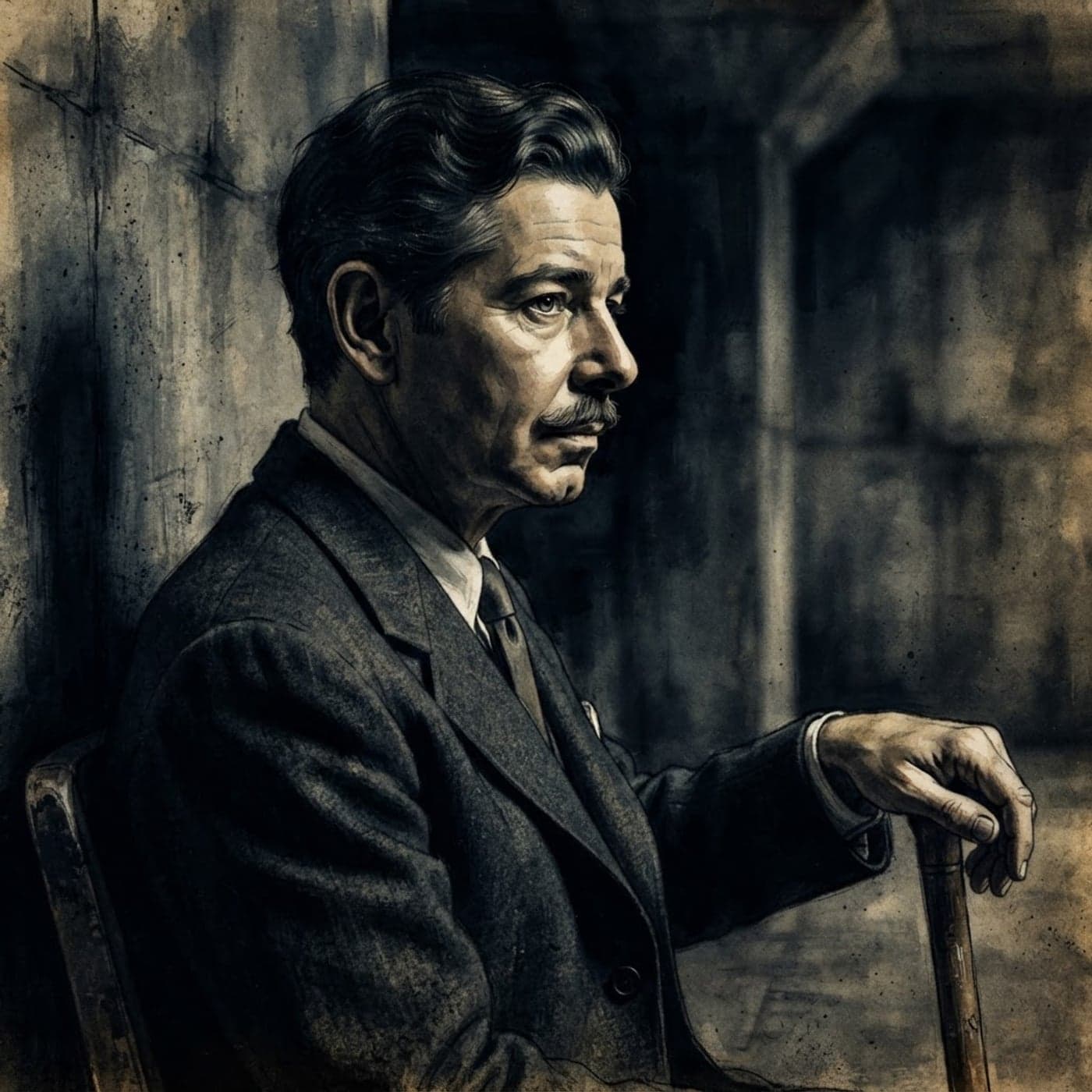
He was buried alive by a shell explosion, wounded in battle, and found his voice so captivating it was later referenced in Ralph Ellison's 'Invisible Man.'
From the Ronald Colman Wikipedia page. The hosts are synthetic voices.
Read the script
He was buried alive by a shell explosion, wounded in battle, and found his voice so captivating it was later referenced in Ralph Ellison's 'Invisible Man.' Ronald Colman’s life unfolded like a classic Hollywood script, a journey from a shy English lad who dreamed of engineering, to a distinguished voice on the silver screen. It was a testament to finding one's true calling, embracing transformation, and proving that a dignified presence could bridge the silent era and the dawn of sound. Born Ronald Charles Colman in Richmond, Surrey, in 1891, his early life was shaped by a sudden shift in fortune. His father, a silk merchant, died when Ronald was just 16, making his dream of studying engineering at Cambridge financially impossible. He’d already discovered a love for acting at Hadleigh House School, despite his natural shyness, but now he needed to work, taking a clerical job in London. Then came the First World War. Colman joined the London Scottish Regiment in 1909 and, at the outbreak of war, immediately rejoined. As Private No. 2148, he was soon plunged into the brutal realities of the Western Front. At Ypres, on October 30, 1914, he endured the terrifying experience of being buried alive by a shell explosion. He was dug out, unharmed, but the next day, during the Battle of Messines, he was seriously wounded in the right ankle. This injury would stay with him, causing a limp he would subtly try to conceal throughout his acting career. Declared no longer fit for war service, Colman was discharged in 1915, awarded the Victory Medal, the British War Medal, and the 1914 Star. His military character was noted as “Very good. Honest, sober and trustworthy.” With his engineering dreams behind him, and a lingering injury, Colman turned to the stage. He had already been active in Ealing’s performing community before the war, playing banjo solos, joining Pierrot troupes, and forming his own groups like the Mad Medicos. He performed character sketches from Dickens, recited poems, and even wrote short pieces for the stage. After his discharge, he continued his theatrical work, appearing in London plays before making a pivotal move across the Atlantic. In 1920, five days after marrying Thelma Raye, Ronald Colman sailed to New York City. He found work quickly, though not without its challenges. He had walk-on parts, was replaced in productions, and faced spells of unemployment. But then, a turning point. While performing in a play called La Tendresse, director Henry King saw him and cast him as the leading man opposite Lillian Gish in the 1923 film, ‘The White Sister.’ It was an immediate success. Colman virtually abandoned the stage for film, rapidly becoming a hugely popular silent film star. With his dark hair and eyes, and his athletic ability—he did most of his own stunts—he was often cast in romantic and adventure roles, sometimes even compared to Rudolph Valentino. He starred in films like ‘Beau Geste’ and ‘The Winning of Barbara Worth,’ becoming a top box-office draw. But it was the advent of sound pictures that truly unleashed Ronald Colman’s greatest asset: his voice. “Beautifully modulated and cultured,” “a bewitching, finely modulated, resonant voice”—these were some of the descriptions. He was often seen as the epitome of a suave English gentleman, his voice embodying chivalry and dignity. English film critic David Shipman called him “the dream lover – calm, dignified, trustworthy.” His first major talkie success came in 1930, earning him an Academy Award nomination for his performances in ‘Bulldog Drummond’ and ‘Condemned.’ He went on to star in classics like ‘A Tale of Two Cities,’ ‘Lost Horizon,’ and ‘The Prisoner of Zenda.’ His career culminated in an Academy Award win for Best Actor in 1948 for his intense portrayal in ‘A Double Life,’ where he played an actor who identifies too strongly with his character, Othello. Ronald Colman’s distinctive voice wasn’t just for the big screen. He lent his vocal talents to radio, hosting the anthology series ‘Favorite Story’ and making numerous guest appearances with his second wife, Benita Hume, on ‘The Jack Benny Program.’ Their comedic chemistry as Benny’s exasperated next-door neighbors led to their own popular radio comedy, ‘The Halls of Ivy,’ where Colman played a college president. He even wrote episodes for the show, including ‘The Goya Bequest,’ demonstrating a lifelong engagement with storytelling beyond acting. His voice was so memorable that it was immortalized in literature. In Ralph Ellison's ‘Invisible Man,’ the main character expresses a wish to have a voice like Colman’s, describing it as charming and befitting a gentleman. It was a voice that resonated with audiences, a voice that carried him from the trenches of war to the pinnacle of Hollywood stardom. Ronald Colman passed away in 1958, at the age of 67, from acute emphysema. He left behind a legacy of iconic performances and a voice that defined an era. He has two stars on the Hollywood Walk of Fame, one for motion pictures and one for television. This portrait is based on the Wikipedia article titled Ronald Colman, available under Creative Commons. The hosts are synthetic voices.