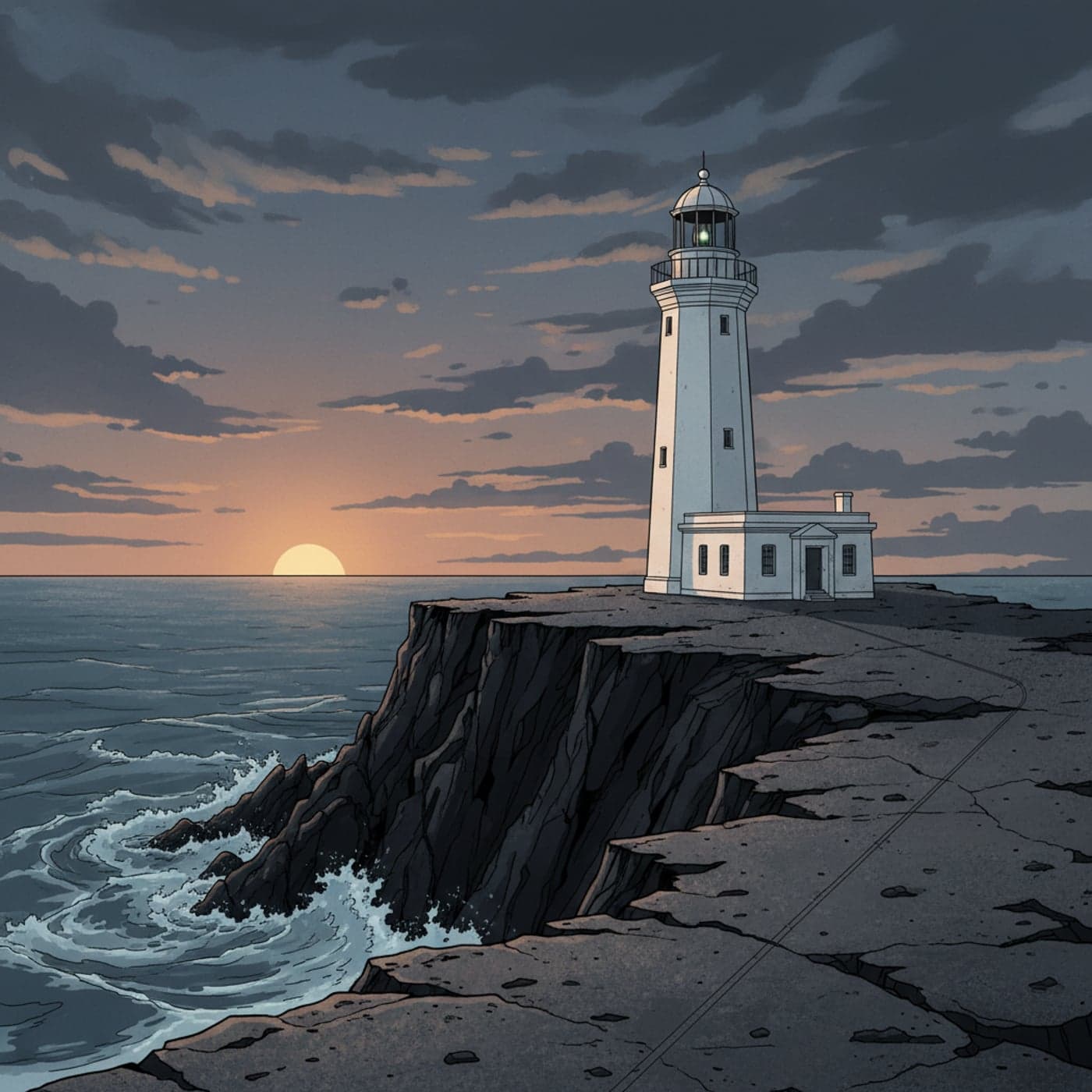
At the western fringe of the Canary Islands, a lone lighthouse still sweeps the Atlantic with a beam that once guided sailors off the edge of the known world.
From the Punta Orchilla Lighthouse Wikipedia page. The hosts are synthetic voices.
Read the script
You are driving along a road that keeps narrowing, the asphalt giving way to gravel, then to bare rock. The ocean is somewhere to your left, a low roar you feel more than hear. Ahead, the land simply stops. This is the southwestern tip of El Hierro, the smallest of the Canary Islands, and you are heading for a lighthouse that has been called the most remote in Spain. It is called Punta Orchilla, and its story begins long before the concrete tower was poured. Early mapmakers did not have satellites. They needed a fixed line to measure east from, a zero point for longitude. For centuries, that line ran right through this headland. They called it the Ferro Meridian, named after the island's old name, Ferro. It marked the western edge of the known world. If you stood here in the fifteenth century, you were standing at the end of the map. Ships would set their charts by this rock. The name Orchilla itself comes from a lichen, orchil, that clings to the lava slopes and was once harvested for purple dye. So the place was known for two things: a line on a map and a stain on the rocks. The lighthouse came much later. The second maritime lighting plan for the Canaries identified the need for a light here, but it took until 1933 for the beam to sweep the Atlantic for the first time. The design follows the Canarian tradition: a single‑storey keeper’s house, whitewashed against the sun, with dark volcanic stone framing the windows and corners. From the seaward side of the house rises an octagonal tower, twenty‑five metres tall, built from the same black basalt. It carries twin galleries and a lantern dome that holds a first‑order Fresnel lens. That lens is the heart of the light. It sits one hundred and thirty‑two metres above sea level, and its flash can be seen twenty‑four nautical miles out. That is a long reach for a beam that starts on a cliff where the road runs out. Getting here is half the story. From the village of Sabinosa you drive twenty‑five kilometres. The first stretch is paved, then the surface breaks into loose stone, then it becomes a track that rattles your suspension and tests your patience. The article describes it as "unmade and uneven." There is no gate, no ticket booth, no gift shop. The site is accessible, but the tower and the house are closed. You can walk up to the base, feel the wind off the Atlantic, and look up at the lantern room knowing no one has climbed those stairs in years. The keepers left long ago; the light is automated now, maintained by the port authority in Santa Cruz de Tenerife. Despite the isolation, the lighthouse has travelled farther than most. In 2008 the Spanish postal service, Correos, issued a set of six commemorative stamps honouring the archipelago’s lighthouses. Punta Orchilla was one of them. A tiny rectangle of paper carried its image into letterboxes across Spain and beyond. Collectors who have never smelled the salt air here can hold a piece of this headland. It is a quiet irony: a beacon built to guide ships across an empty ocean becomes a symbol that travels the world in an envelope. There is a meridian memorial nearby, a stone marker that reminds you of the Ferro Meridian. Standing beside it, you can look west and see nothing but water until the Americas. The mapmakers’ line has moved — Greenwich won that argument — but the rock remains. The lighthouse still flashes, a white pulse every few seconds, cutting through fog and darkness. It is an active aid to navigation, logged in the admiralty lists, watched by satellites that also know its coordinates to the centimetre. You might wonder why keep a light here at all. Modern ships carry GPS, radar, electronic charts. But the sea does not care about electronics. A light is a promise: someone knows this coast, someone has measured the danger, someone has built a tower that says "land here." The Fresnel lens does not need a satellite; it needs only oil, or now electricity, and the geometry of glass prisms. It turns that energy into a beam that reaches twenty‑four miles. That is a language older than radio, older than Morse, older than the stamps that carried its picture. The keeper’s house is empty. The volcanic stone walls have weathered eighty‑odd winters. The whitewash flakes in places. The track that brought you here will eventually be reclaimed by the same lava that forms the cliffs. But the light continues. It flashes over water that has seen caravels, steamers, submarines, container ships, and now the occasional research vessel. Each flash is a stitch in a line that runs from the Ferro Meridian to the GPS satellite, from the lichen gatherers to the stamp collectors. When you turn the car around and start the long bounce back to Sabinosa, the beam is still there behind you, sweeping the horizon. You carry the memory of a place where the world once ended, and where a tower still says it has not. This is based on the Wikipedia article titled Punta Orchilla Lighthouse, available under Creative Commons.