In 1966, a single basketball game shattered racial stereotypes and irrevocably altered college sports.
From the 1966 NCAA University Division basketball championship game Wikipedia page. The hosts are synthetic voices.
Read the script
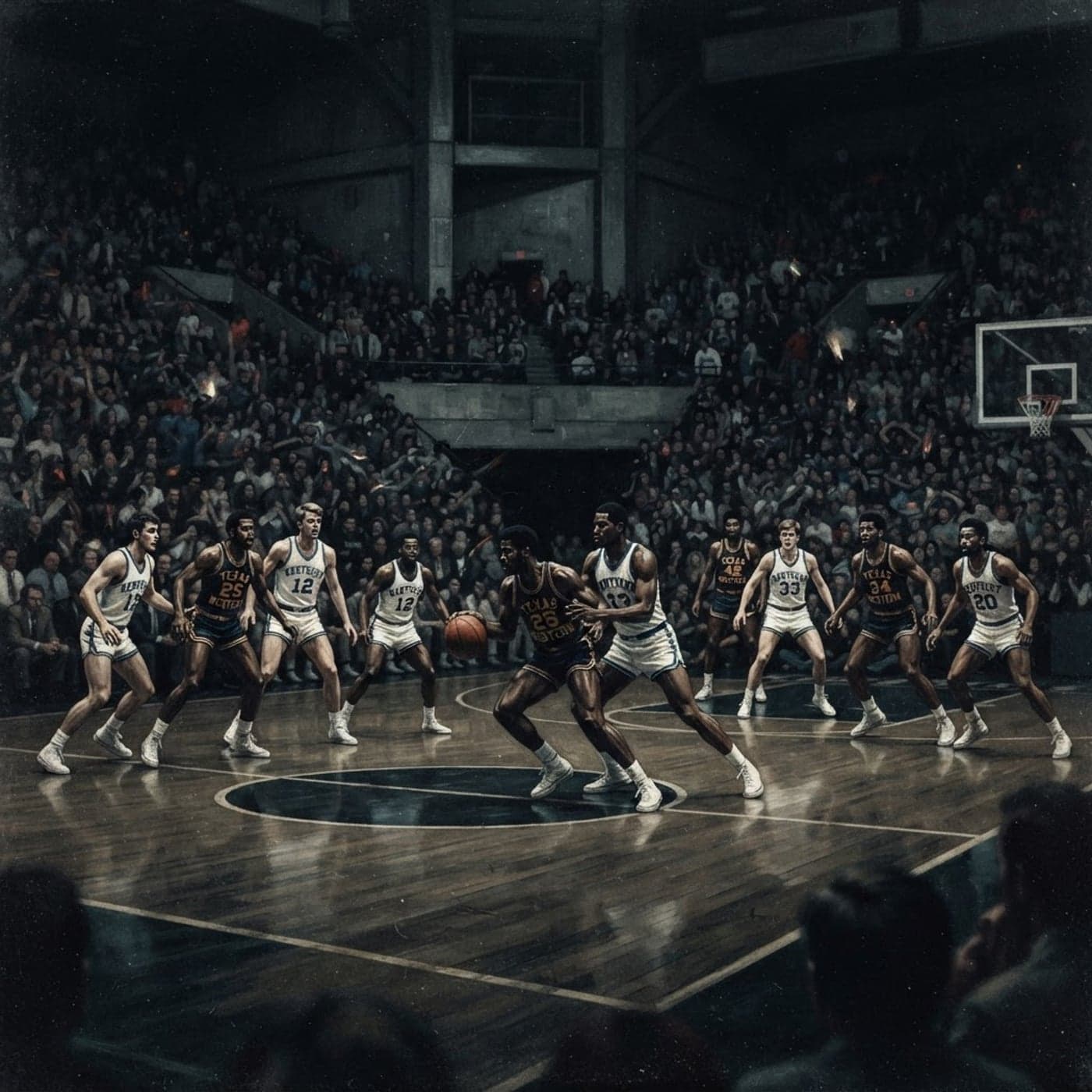
In 1966, a single basketball game shattered racial stereotypes and irrevocably altered college sports. That's the conventional wisdom, anyway. The story goes that the NCAA Championship game between the all-white Kentucky Wildcats and the all-black Texas Western Miners was more than just a contest for a national title. It was a watershed moment, directly challenging prevailing racist assumptions about athletic ability and discipline, and forcing major programs to confront their biases and accelerate the integration of Black athletes. A powerful narrative. But like many powerful narratives, it might be a bit too neat. Let's set the scene. March 19, 1966. Cole Field House in College Park, Maryland. On one side, the number one ranked Kentucky Wildcats, coached by the legendary Adolph Rupp. An all-white team. On the other, the third-ranked Texas Western Miners, coached by Don Haskins. And they started five African American players. This was the first time an all-Black lineup had ever appeared in an NCAA title game. The expectations were clear, fueled by the pervasive stereotypes of the time. Black players, it was thought, lacked discipline, couldn't be coached, and played an undisciplined, flashy game. Kentucky, with its clean-cut, white players, was seen as the embodiment of controlled, intelligent basketball. The Miners, however, played a different game. They executed with precision, with strategy, often outplaying the favored Wildcats. Don Haskins famously stated he played his best players, who happened to be Black. And he motivated them with a story, a supposed promise from Rupp that his white team would not lose to an all-Black squad. Texas Western won, 72-65. Their first national championship. And the narrative of change began. But what if the impact wasn't quite as immediate, or as widespread, as we've been led to believe? What if the real story is a little more nuanced, a little less of a triumphant march towards equality and a bit more of a slow, grinding shift? The article I'm drawing from today is the Wikipedia article titled '1966 NCAA University Division basketball championship game.' The hosts, as you know, are synthetic voices. Let's look at the immediate aftermath. Yes, Texas Western's victory was historic. It challenged stereotypes. But the article points out that Don Haskins received racist letters after the game. Some even accused him of exploiting his Black players. Death threats were made against the Miners before a game against SMU the following season. This doesn't sound like a society that overnight embraced racial equality in sports. Kentucky, meanwhile, had a rough year after the loss. Their star player, Pat Riley, suffered an injury. Adolph Rupp coached for five more seasons, making the tournament each time, but never reaching the Final Four again. Texas Western, now the University of Texas at El Paso, remained a strong program, but it took them three seasons to return to the NCAA Tournament. The article states that in the first season after the game, all conferences in the Southern U.S. featured at least one Black men's basketball player. This was a change from the previous season, when many Southern conferences, like the SEC and ACC, had not yet integrated. And yes, large college programs began to recruit African Americans more actively, removing unofficial quotas. By 1985, the number of Black players in Division I more than doubled. These are significant changes. But the timeline is key. The article doesn't suggest that integration happened instantly. It suggests a *process*. A process that was undoubtedly accelerated by this game, but not completed by it. The idea that this one game irrevocably altered college sports, while true in spirit, might oversimplify the reality. It wasn't a switch flipped; it was a door creaked open, and then slowly, deliberately, pushed further. The victory itself was a powerful symbol. But symbols, while potent, don't always translate into immediate, sweeping change. The ingrained biases of the era didn't vanish in the locker room glow of a championship trophy. They were chipped away, slowly, game by game, recruitment by recruitment. The narrative of the 1966 game is a crucial one. It's a story of triumph, of defying expectations, of a moment when sports reflected, and perhaps even nudged, the broader societal shifts happening in America. But the full story, the one that accounts for the lingering racism, the gradual integration, and the slow dismantling of deeply entrenched stereotypes, is perhaps even more compelling. It reminds us that progress, even when marked by dramatic events, is often a marathon, not a sprint. And that the most profound changes are rarely the most instantaneous.