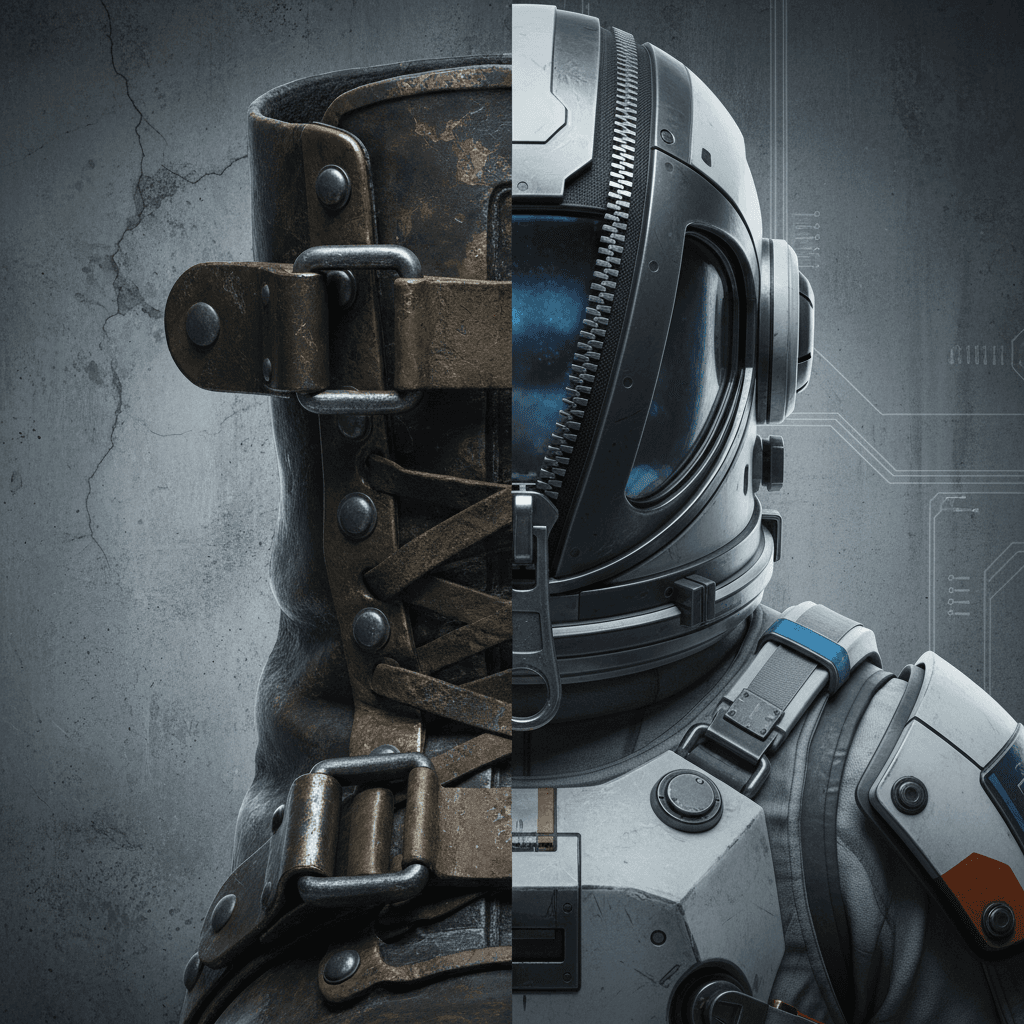
How did a simple device designed to fasten boots end up in space suits and become the most ubiquitous fastener in the world?
From the Zipper Wikipedia page. The hosts are synthetic voices.
Read the script
Host A: How did a simple device, originally designed to fasten boots, end up in space suits and become the most ubiquitous fastener in the world? Host B: That's a great question. Today, we're talking about the zipper. It's something we use every single day, probably without even thinking about it. But its journey from a clunky, unreliable boot fastener to a space-age necessity is a fascinating story of persistent innovation, overcoming mechanical failures, and a surprising name change. Host A: It really is. The story starts, as many do, with an inventor with a big idea. In 1893, an American inventor named Whitcomb Judson patented what he called a 'clasp locker.' His goal was to create an alternative to boot laces. Host B: And it was a pretty ambitious idea for the time. Judson envisioned a device that could quickly and easily fasten boots. He even partnered with a businessman named Colonel Lewis Walker and launched the Universal Fastener Company to manufacture it. Host A: But the early 'clasp locker' had some serious issues. It was mechanical, and prone to jamming. It wasn't exactly the seamless experience we associate with zippers today. They even debuted it at the 1893 Chicago World's Fair, but it didn't exactly set the world on fire. It met with very little commercial success. Host B: It sounds like it was a good concept, but the execution just wasn't there yet. And it wasn't really used in clothing at this stage, right? It was mostly for boots and things like tobacco pouches. Host A: Exactly. The real breakthrough, the evolution to the modern zipper, came from a Swedish-American electrical engineer named Gideon Sundbäck. He was hired by the company that eventually became Talon, Inc. Host B: And Sundbäck really got to work improving Judson's design. He significantly increased the number of interlocking teeth on each side, going from about four per inch to ten or eleven. He also developed a way for the slider to mesh these teeth together more effectively. Host A: Crucially, he also created a special manufacturing machine. This machine could produce a continuous chain of these fasteners, which was essential for mass production. This allowed the 'separable fastener,' as it was then known, to finally go on sale in 1913. Host B: So, Sundbäck is really the father of the modern zipper. But even then, it still didn't have its famous name. That came a bit later. Host A: It did. In 1923, the B.F. Goodrich Company was looking for a way to fasten their new rubber boots, or galoshes. They started using Sundbäck's fastener on these boots, and they found that you could fasten them with a single 'zip' of the hand. They began calling them 'zippers,' and the name just stuck. Host B: That's brilliant! An onomatopoeic name that perfectly describes the action. It's amazing how a catchy name can make such a difference in popularizing a product. Before that, it was just called a 'hookless fastener' or 'clasp locker.' Host A: Right. And once it had a name and a more reliable design, the zipper started to find its way into more and more applications. In the 1930s, there was even a sales campaign for children's clothing featuring zippers, promoting them as a way to help kids dress themselves and foster independence. Host B: And then came the 'Battle of the Fly' in 1937. French fashion designers started raving about zippers in men's trousers, and it officially beat the button as the preferred fastener for flies. Advertisements even touted its ability to prevent 'unintentional and embarrassing disarray.' [laughs] Host A: [laughs] A very practical, if slightly awkward, selling point. But the zipper's utility wasn't just limited to everyday clothing. It found a critical role in some rather extreme environments. Host B: You're talking about space, aren't you? NASA needed a way to maintain air pressure inside their suits, especially for high-altitude flights and then, of course, for space itself. Host A: Exactly. They developed airtight zippers by adding a waterproof sheeting around the teeth that created a double seal when closed. These zippers are incredibly important for retaining air pressure, which is obviously vital when you're in the vacuum of space. Host B: It's incredible to think that this simple fastener, born out of a need to close boots, is now a critical component of life support systems for astronauts. The article mentions they're also used in scuba diving dry suits and hazmat suits where airtight or watertight seals are essential. Host A: The design has evolved a lot over the years, too. We have coil zippers made of polyester, invisible zippers hidden behind the fabric, and metal zippers, often found in jeans. There are even plastic-molded ones, and specialized ones like water-resistant or magnetic zippers. Host B: And the manufacturing side is pretty interesting too. While early on it was Judson and Sundbäck, and then B.F. Goodrich popularizing the name, companies like YKK in Japan became massive players in the industry through efficient manufacturing and quality control. Host A: It's a testament to the power of incremental innovation. Taking a basic idea, refining it, making it reliable, and then finding new applications. This whole story is based on the Wikipedia article titled 'Zipper,' available under Creative Commons.