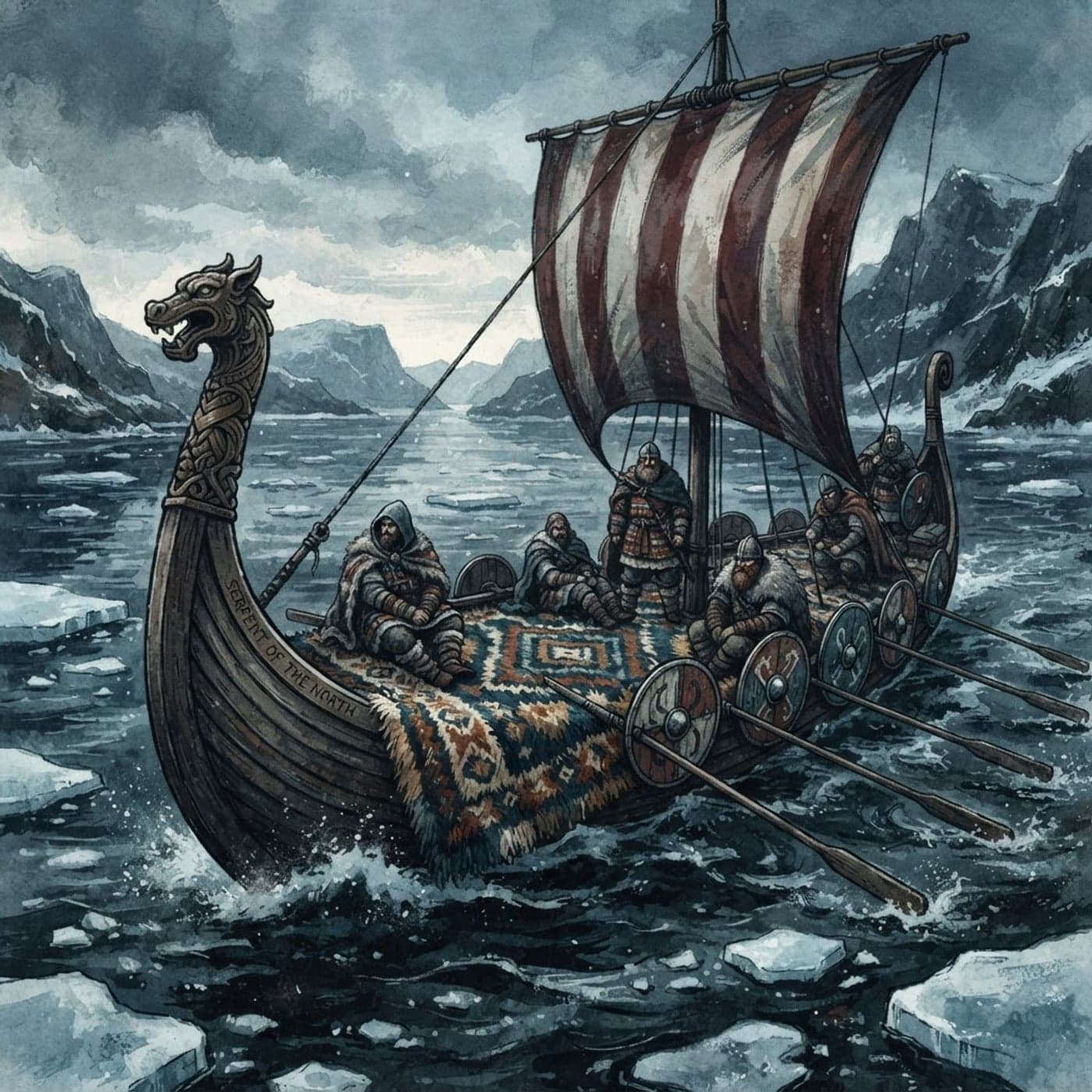
For centuries, the biting winds of Scandinavia were met not with furs alone, but with intricately woven stories underfoot.
From the Scandinavian rugs Wikipedia page. The hosts are synthetic voices.
Read the script
For centuries, the biting winds of Scandinavia were met not with furs alone, but with intricately woven stories underfoot. These textiles were more than just decoration. They were warmth. They were history. They were, in many ways, the very soul of a home. The story of these rugs doesn't begin in Scandinavia, not with local hands. It begins with the exotic allure of the East. The Vikings, known for their far-reaching voyages, were also keen traders. And among the goods they brought back from the Byzantine Empire, from Constantinople itself, were rugs. These were not the thick, shaggy creations we might picture today. These were fine, expertly crafted textiles, prized for their beauty and their ability to insulate against the harsh Northern climate. For a long time, this was the arrangement. Oriental rugs, imported from the East, dominated the homes of Scandinavia. They were hung on walls for warmth, and spread out as luxurious blankets for noblemen. But centuries of exposure to these beautiful, intricate patterns began to seep into the Scandinavian consciousness. A desire grew to create something similar, yet distinctly their own. By the 14th century, that desire had taken form. The Scandinavians developed what became known as the Rya, or Ryijy. Unlike the fine weaves of the East, the Rya was designed for comfort and deep warmth. Its defining feature was a thick, shaggy, long pile. These rugs were built to withstand the cold, to provide a soft, yielding surface against the unforgiving winters. Ryas quickly became common, replacing not only the imported Oriental rugs but also cloaks and blankets. Archaeological finds in old Viking settlements, even in York, England, have unearthed examples of this distinctive weave. They were a practical necessity, a testament to the ingenuity of a people living in a challenging environment. But the Rya was more than just practical. It evolved to carry deeper meaning. In medieval Scandinavia, these shaggy rugs became a part of wedding ceremonies. Ryas woven for these unions were often adorned with the initials of the bride and groom, the date of their marriage, intertwined hearts, and symbols representing their families. These wedding Ryas were important, perhaps the most distinct development in Scandinavian rug-making, weaving together love, family, and tradition into a tangible form. As the centuries passed, the influence of Oriental motifs, like the elegant Tree of Life, found its way into Scandinavian designs. The Scandinavians adapted this symbol, often reinterpreting it to represent family trees and the enduring ties that bound them together. By the late 1800s, traditional Scandinavian rugs, especially the Ryas, were popular across Northern Europe. Around this time, Sweden also developed another distinctive style: the Rollakan. These were different from the shaggy Ryas. Rollakans were flat-woven rugs, often featuring elaborate tapestry art. They offered a different aesthetic, yet served similar purposes of warmth and decoration. For a time, the Rya rug fell out of favor with the aristocracy, relegated to the realm of folk art. But then, in the middle of the 20th century, something remarkable happened. The Rya rug experienced a resurgence in popularity, catching the eye of a new generation of designers. These modernist designers, with their clean lines and often starker aesthetic, found something captivating in the shaggy, colorful Ryas. The abstract, geometric designs, and the sheer tactile warmth of the pile, offered a perfect counterpoint to the hard woods, metals, and straight lines of mid-century modern interiors. A Rya rug could bring a sense of hominess, a splash of color and softness, that balanced the more austere elements of contemporary design. Designers as influential as Ray Eames, Le Corbusier, and Frank Lloyd Wright were known to appreciate the effect of these traditional Scandinavian rugs. They understood how a well-placed textile could transform a space. At the forefront of this revival, and indeed of Scandinavian rug design for much of the 20th century, was Märta Måås-Fjetterström. Working from 1919 until her death in 1941, she brought a modernist sensibility to the ancient craft. Måås-Fjetterström focused on capturing the intimacy of the natural world through her designs, using abstract lines and geometric figures. Her work was not just about decoration; it was about communicating a feeling, a connection to nature, rendered in wool. Upon her death, Märta Måås-Fjetterström left behind a remarkable legacy: over 700 designs and detailed instructions for their creation. This body of work, and the studio she established in Båstad, continued to inspire. Artists like Ann-Mari Forsberg, Barbro Nilsson, and Marianne Richter, working in her tradition, created rugs that are still highly sought after today. Their rugs, and the tradition they represent, continued to complement the clean, geometric aesthetics of mid-century design, earning global acclaim. The attention to detail, the sophisticated use of color, the masterful approach to line and geometry – these qualities made Scandinavian rugs, especially those influenced by Måås-Fjetterström, indispensable elements in the homes of design icons. This story, of imported luxury inspiring local innovation, of practical necessity evolving into artistic expression, and of ancient traditions finding new life in modern design, is all found within the humble Scandinavian rug. This has been based on the Wikipedia article titled Scandinavian rugs, available under Creative Commons.