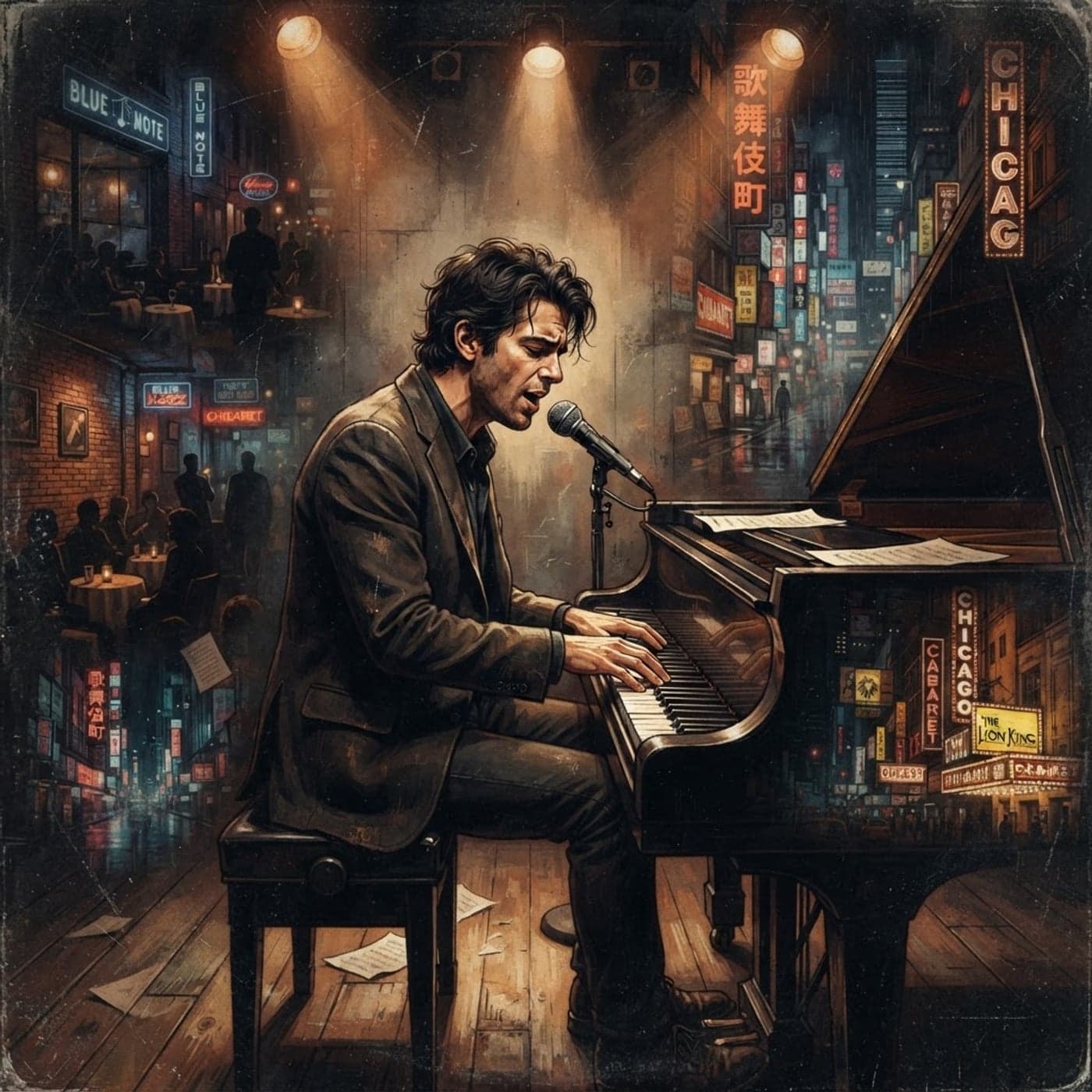
From Carnegie-Mellon's art halls to the global stages of pop and Broadway, this songwriter found her voice in the spaces between cultures and languages.
From the Roxanne Seeman Wikipedia page. The hosts are synthetic voices.
Read the script
From the hallowed halls of Carnegie-Mellon to the vibrant global stages of pop and Broadway, Roxanne Seeman has charted a remarkable course. Her journey isn't just about writing songs, it’s about building bridges, weaving together diverse musical traditions from American jazz and pop to Chinese Canto-jazz and fado, translating emotions across continents and into hit songs that resonate with millions. Born in New York, Roxanne’s early life was steeped in a rich cultural tapestry. Her father, a scholar and World War II veteran, and her mother, active in preserving heritage, laid a foundation for her expansive worldview. At just ten, she began piano lessons, later picking up the violin and guitar. But it was at Carnegie-Mellon, initially pursuing art, that a deeper passion for music began to blossom. She found a classical piano teacher in the practice rooms and immersed herself in jazz theory under the tutelage of Dr. Nathan Davis. Her curiosity, however, stretched beyond music. A class in Chinese calligraphy sparked a desire to learn the language, leading her to transfer to Columbia University, where she earned a degree in Oriental Studies, delving into Chinese arts and language. New York City in the 70s was a crucible for Roxanne. By night, she frequented jazz clubs, soaking in the vibrant scene. By day, she worked as a temporary secretary at Atlantic Records and Warner Communications. It was during this time, lying on a dock overlooking the Long Island Sound, that inspiration struck: she began writing lyrics for jazz instrumentals, translating the intricate nuances of the music into poignant words. A pivotal meeting with David Lasley, a songwriter and session singer for James Taylor, helped bring her lyrical visions to life through demo recordings. Her move to Los Angeles in 1977 marked a new chapter. She quickly found herself collaborating with music legends. Her lyrical version of Ramsey Lewis’s “Tequila Mockingbird” led to a collaboration with Philip Bailey of Earth, Wind & Fire, culminating in “Sailaway” for their album, Faces. She also worked with Carmine Coppola, transforming his film scores into songs, lending her words to themes from films like The Black Stallion and The Outsiders. A significant turning point arrived with her partnership with Billie Hughes. Together, they penned “Walking On The Chinese Wall,” a song that, initially deemed “too unusual” by her publisher, became a pop hit and the title track for Philip Bailey’s solo album. Their collaboration also produced the Emmy-nominated “Welcome To The Edge,” a number one single in Japan that sold over half a million copies, and another Emmy nomination for “Dreamlove.” Roxanne’s unique ability to bridge cultures truly shone in Asia. She became instrumental in shaping the sound of Canto-jazz, a style coined by the legendary Jacky Cheung, for whom she wrote five songs for his “Private Corner” album. Her song “Everyday Is Christmas,” co-written with Philipp Steinke, became a global Christmas hit, making Cheung the only Chinese-language singer in Nokia’s top ten most downloaded Christmas songs worldwide in 2010. Her work extended to K-pop and Mandopop, writing for artists like Rainie Yang and contributing to productions by esteemed figures like Zhang Yadong and Gao Xiaosong. Beyond songwriting, Roxanne has also made her mark on Broadway, co-producing acclaimed shows like “To Kill a Mockingbird” and “The Waverly Gallery,” both of which garnered multiple Tony nominations. Her career is a testament to her versatility, her deep understanding of musical and cultural landscapes, and her unwavering commitment to connecting people through song. This portrait is based on the Wikipedia article titled Roxanne Seeman, available under Creative Commons. The hosts are synthetic voices.