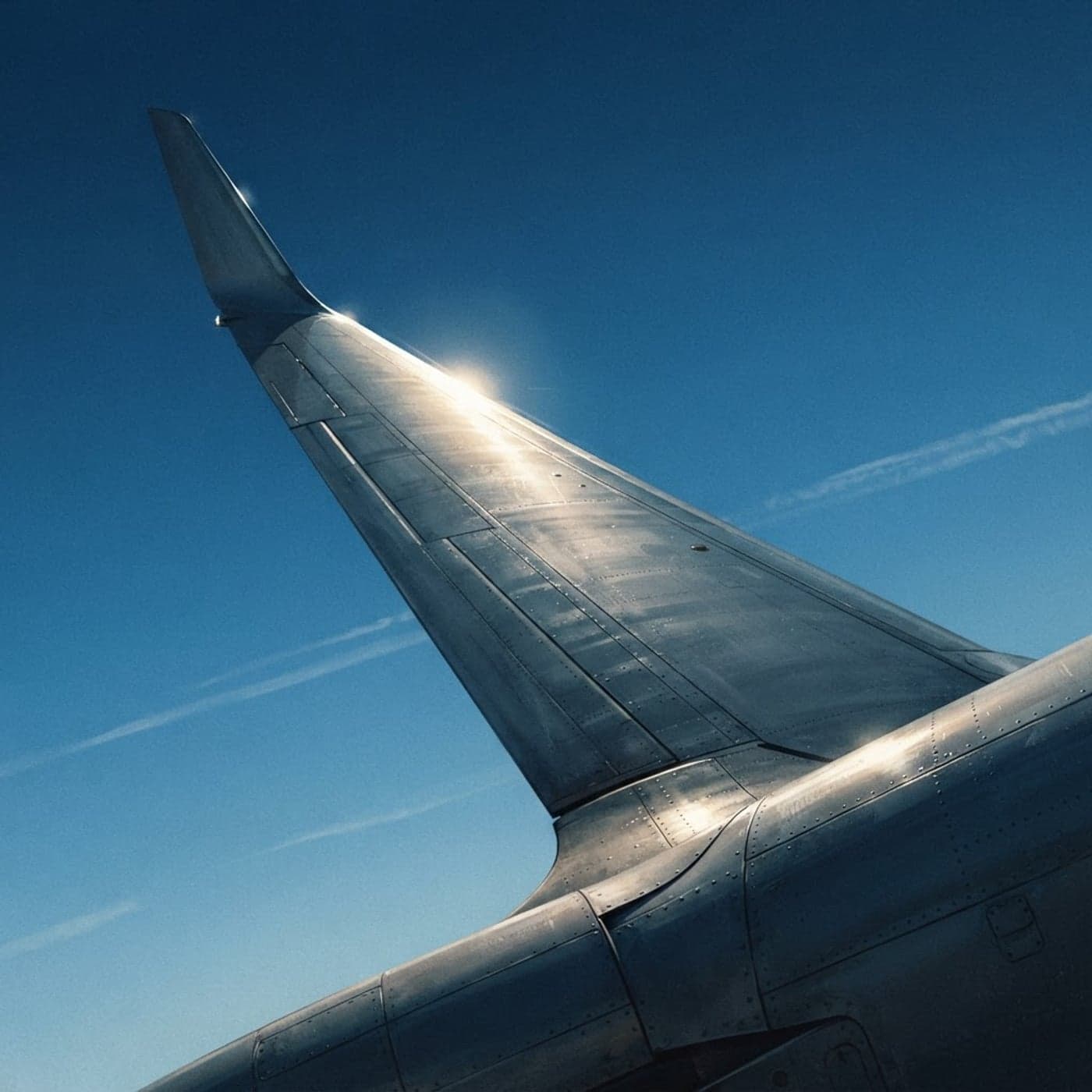
The subtle upward angle of an airplane's wings, often just a few degrees, is the unsung hero of flight stability, preventing catastrophic rolls.
From the Dihedral (aeronautics) Wikipedia page. The hosts are synthetic voices.
Read the script
You know that subtle upward slant on an airplane's wings? Often just a few degrees. It's not just for looks. That angle is the unsung hero of flight stability, quietly preventing what could be catastrophic rolls. It's called dihedral. And it’s a surprisingly simple geometric concept with a powerful effect on how an aircraft flies. Dihedral, at its core, is just the upward angle of an aircraft's wings from horizontal. But its impact, what engineers call 'dihedral effect,' is crucial. This effect is a rolling moment – a force that wants to roll the plane – that’s produced in proportion to how much the plane is slipping sideways through the air. And that's key to keeping an aircraft stable in the roll axis. So, how does this work? Imagine an airplane is flying along, wings level. Then, a gust of wind, or perhaps a slight control input, causes it to roll a bit, say, to the left. As the plane rolls, it also starts to slip sideways through the air, moving a little bit towards the lower wing. This is called sideslip. Now, because of that upward dihedral angle, the wing that is now lower (the left wing in our example) presents itself to the oncoming air at a slightly greater angle than the higher wing. Think of it like this: the lower wing is now catching more air head-on, while the higher wing is catching less. What happens when a wing catches more air at a greater angle? It generates more lift. So, the lower wing, experiencing a greater angle of attack due to the sideslip, creates more lift than the higher wing. This difference in lift between the two wings creates a restoring force – a rolling moment – that pushes the aircraft back towards a level position. It's like the wings are constantly trying to right themselves. Aircraft designers can fine-tune this dihedral angle to achieve just the right amount of dihedral effect. But it’s not the only factor. Other elements also play a significant role. For instance, how much the wings sweep back from the fuselage, the vertical position of the aircraft's center of gravity, and even whether the wing is mounted high or low on the fuselage – all of these influence the overall dihedral effect. For example, if an aircraft has wings that sweep back a lot, like many modern jetliners, that sweep itself provides a good deal of dihedral effect. So much so, that designers might actually reduce the physical dihedral angle or even introduce what's called 'anhedral.' Anhedral is the opposite of dihedral – the wings angle *downward* from the fuselage. This reduces the stabilizing effect, which can be desirable in certain aircraft. Fighter jets, for instance, often use anhedral. Why? Because while stability is good for comfortable passenger flights, fighter pilots need maximum maneuverability. Reducing that inherent stability allows the aircraft to roll more easily, making it more agile in combat. Another interesting factor is the vertical position of the center of gravity. If the center of gravity is lower than the wings, it creates a 'pendulum effect,' adding to the dihedral effect. This is why high-wing aircraft, where the wings are mounted above the fuselage, often have less dihedral angle, or even anhedral, compared to low-wing aircraft. The high wing position naturally provides a lot of dihedral effect, so less physical dihedral angle is needed to achieve the desired stability. Sometimes, you’ll see wings that aren't just a simple upward or downward angle, but have multiple bends along their span. These are called polyhedral wings. Gliders often use polyhedral designs, with the wingtips angling upwards, to enhance stability. Even some fighter jets, like the McDonnell Douglas F-4 Phantom II, ended up with polyhedral wingtips. This was a post-prototype design change to correct an unexpected stability issue – angling just the tips was a more practical fix than redesigning the entire wing. So, that subtle upward angle of an airplane's wings, often just a few degrees, is doing a lot of work. It’s a key part of an intricate dance of forces and geometry that keeps planes stable and flying true. This is based on the Wikipedia article titled "Dihedral (aeronautics)", available under Creative Commons. The hosts are synthetic voices.