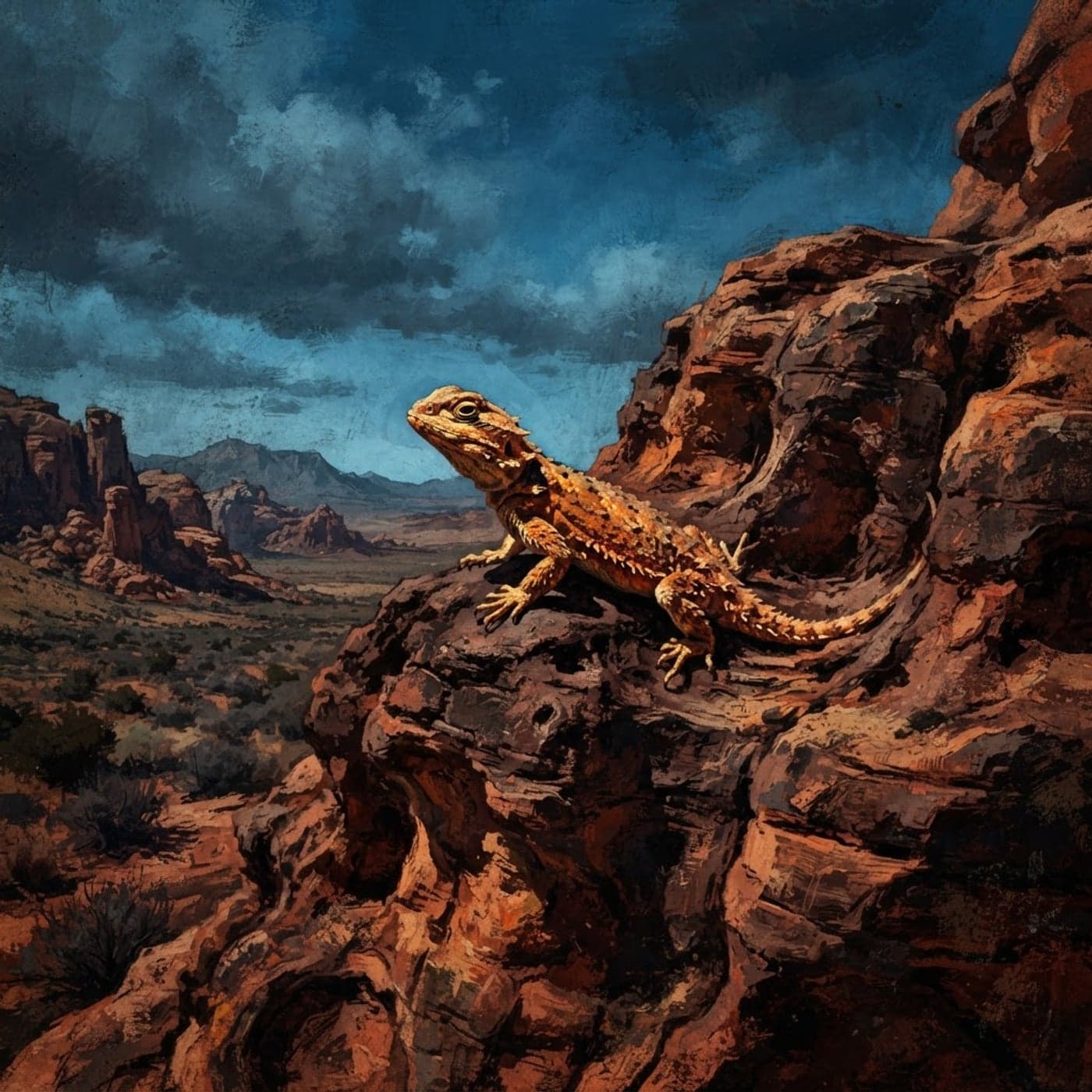
Imagine a tiny dragon, no bigger than your hand, painted with the very ochre of the ancient Australian earth.
From the Ctenophorus tjantjalka Wikipedia page. The hosts are synthetic voices.
Read the script
Imagine a tiny dragon, no bigger than your hand. Its scales are the color of the ancient Australian earth. Ochre. This is the ochre dragon, Ctenophorus tjantjalka. It lives on weathered, stony hills. Places where the land has crumbled over millennia. Arid South Australia. This is a robust lizard, built for this landscape. Its body is low and flat, like it’s pressed against the ground. Its forelimbs are large, strong, ready to grip rock. The tail, unlike many of its relatives, is plain. No bands, just a sweep of color. Males are a striking blue. Their flanks are salmon-pink. A flash of color against the muted tones of the desert. Females are different. They carry pale spots, a subtler pattern. Their world is one of sparse resources. Survival here means specializing. And the ochre dragon has done just that. Its diet is overwhelmingly ants. Tiny, industrious ants, forming the bulk of its meals. But it’s not exclusively ants. It will take what it can find: a scattering of other insects, a stray spider. A small hunter in a vast, dry land. This miniature dragon navigates a world of constant threat. The sky above is patrolled by predators. Brown falcons. Australian kestrels. Birds of prey that see everything from a great height. On the ground, bustards stalk. Large snakes move silently. And the ever-present monitor lizards. Each a danger, a reason for the dragon to stay low, to stay hidden. It’s a life lived on the edge. A testament to adaptation. A tiny life, painted with the ochre of the earth, surviving in one of the world’s harshest environments. This has been based on the Wikipedia article titled Ctenophorus tjantjalka, available under Creative Commons.