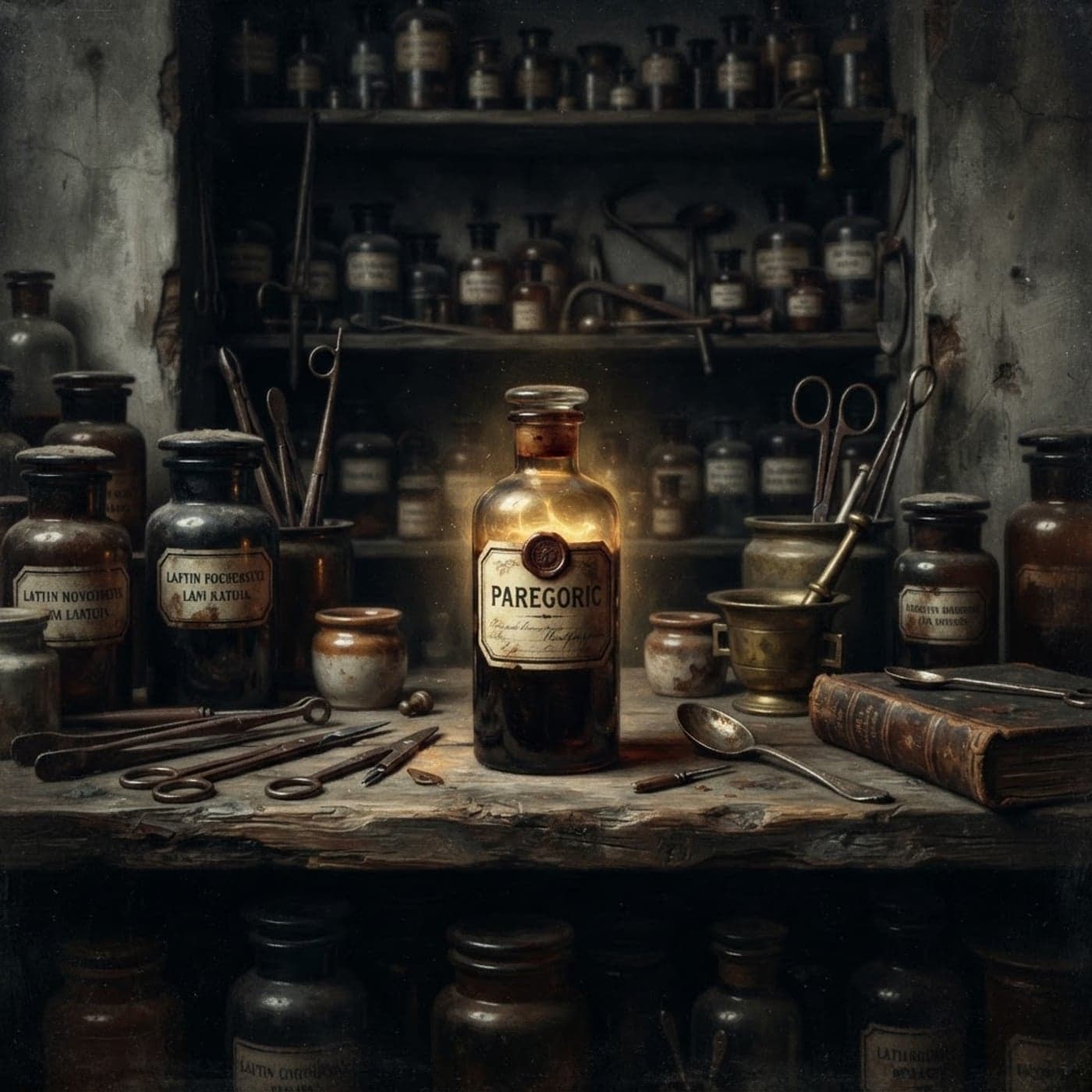
Before modern medicine, a potent elixir containing opium, camphor, and anise was the go-to remedy for everything from a child's cough to a colicky infant's distress.
From the Paregoric Wikipedia page. The hosts are synthetic voices.
Read the script
Before the advent of modern medicine, there was a potent elixir, a comforting concoction that promised relief for a vast array of ailments. Imagine a liquid containing opium, camphor, and anise, a go-to remedy for everything from a child's persistent cough to the colicky distress of an infant. This was paregoric. Its story begins in the early 18th century. A professor of chemistry at Leiden University, Jakob Le Mort, developed an 'asthmatic elixir.' He called it 'paregoric,' a name derived from the Greek word 'parēgorikós,' meaning soothing. And soothing it was intended to be. Le Mort’s original recipe was a complex blend, featuring honey, licorice, and opium, alongside camphor, anise oil, and spirit of wine. It was even included in the London Pharmacopoeia of 1721, reflecting its early acceptance. For centuries, paregoric remained a household staple, a bridge between traditional folk remedies and the burgeoning field of regulated medicine. Its very name whispered of comfort, even as its opiate base would eventually necessitate increasing control. It was widely used to manage diarrhea in both adults and children, to calm fretful babies, and even to ease the pain of teething. One woman, recalling life in Mississippi after the American Civil War, remembered her father’s medicine chest, filled with paregoric and other remedies, dispensed freely to combat the frequent stomach and intestinal troubles of the time. Recipes from the 19th century illustrate its commonality. Dr. Chase's Recipes from 1865 offered a formula involving opium, benzoic acid, oil of anise, honey, camphor, and alcohol. Another, from a 1827 medical companion, described an elixir of purified opium, benzoin, camphor, and anise seed, steeped in brandy. But as the 20th century dawned, so did a greater understanding of the addictive properties of opium. Governments began to regulate these potent remedies. In the United States, the Pure Food and Drug Act of 1906 mandated ingredient disclosure. Previously, many patent medicines had relied on secret formulas or misleading labels. While this law didn't ban such drugs, it meant that ingredients like opium had to be declared. Sales of patent medicines containing opiates reportedly decreased significantly after this labeling requirement. Laws in Britain and Canada followed suit, requiring ingredient disclosure and limiting narcotic content. The Harrison Narcotics Tax Act in the U.S. in 1914 further restricted the manufacture and distribution of opiates. Paregoric, however, was often classified as an 'Exempt Narcotic' due to its relatively low concentration of opium. Until 1970, paregoric could still be purchased over-the-counter in American pharmacies, though with some limitations. Purchasers typically had to sign a register, and there were limits on the quantity dispensed within a 48-hour period. Some states imposed even stricter controls. Even where legally permitted, individual pharmacists often exercised discretion over its sale. Then, in 1970, the landscape shifted again. Paregoric was classified as a Schedule III drug under the Controlled Substances Act. Certain formulations, like those combining paregoric with kaolin and pectin, were initially classified as Schedule V drugs and remained available over-the-counter for a few more years. However, by the early 1990s, these combinations also faced restrictions. Today, paregoric is available in the United States only by prescription. Its manufacture was even temporarily discontinued in late 2011, though production resumed in 2012. While its use has largely been supplanted by modern, less psychoactive cough suppressants and non-addictive antidiarrheals, paregoric remains a potent symbol of a past era of medicine. It represents a complex blend of comfort and caution, a liquid that once brought solace to countless households, its soothing promise now tempered by the recognition of its potent origins. This spoken portrait is based on the Wikipedia article titled Paregoric, available under Creative Commons. The hosts are synthetic voices.