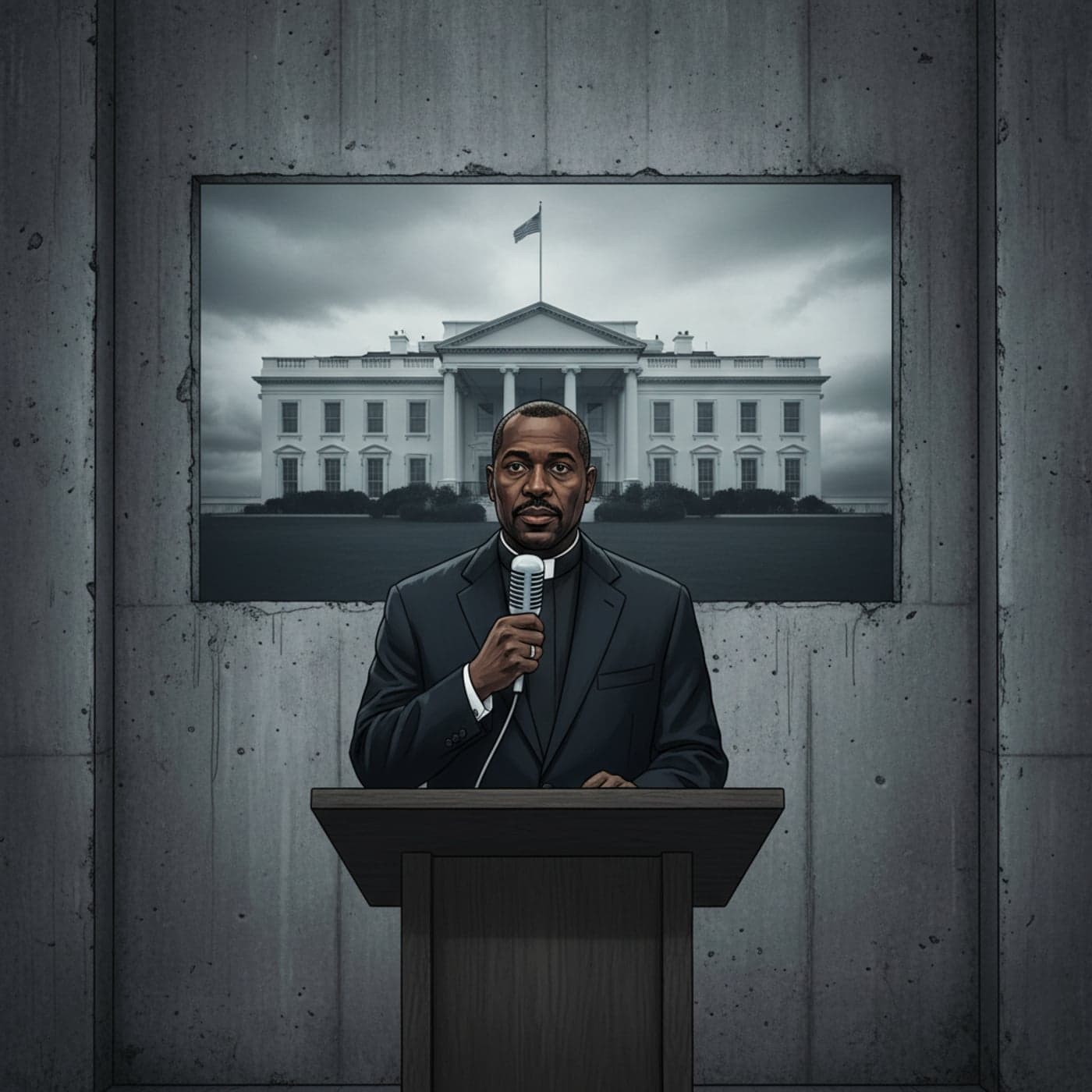
He cared for President Lyndon B. Johnson after surgery, but later his own words ignited a firestorm during a presidential campaign.
From the Jeremiah Wright Wikipedia page. The hosts are synthetic voices.
Read the script
Jeremiah Wright. He cared for President Lyndon B. Johnson after surgery. He was a promising young man, a respected member of his high school class, ready with a kind word. But later, his own words ignited a firestorm during a presidential campaign. It’s a story about how context matters, about how a career built on faith and community can be dismantled by a few selectively aired soundbites. Jeremiah Wright spent 36 years as the pastor of Trinity United Church of Christ in Chicago. He took a congregation that was barely a hundred people strong and grew it into a community of over 8,000. He wasn't just a local preacher; he was a national figure. He mentored seminarians, he taught at theological schools, he served on university boards. His influence was such that a phrase from one of his sermons, "the audacity to hope," became the title of Barack Obama's bestselling book. But then came 2008. And as Obama’s presidential campaign gained momentum, snippets of Wright's sermons began to surface. These weren't just any snippets; they were the most incendiary parts. Sermons that spoke of America's sins, of government dishonesty, of racial injustice. And they were played, and replayed, often out of context, during the campaign. The message was clear: this was the man who had mentored the candidate. This was the man who had baptized his children. This was the man who had married him and Michelle. Obama found himself in an impossible position. He couldn't simply ignore the controversy, but he also couldn't disown a man who had been such a significant figure in his life. He delivered a speech, "A More Perfect Union," attempting to explain his relationship with Wright and to distance himself from some of his more extreme statements, without entirely repudiating the man. But the controversy didn't die. Wright continued to make public appearances, and in one interview, he made remarks about Jewish influence on politics that were widely condemned. This led to his eventual resignation from the church and a public rift with Obama. It’s easy to see this as a simple story of a candidate distancing himself from a controversial pastor. But what’s lost in that narrative is the depth of Wright's work and the context of his ministry. He was a Black liberation theologian, speaking to a Black congregation about the realities of American history and policy from their perspective. His words, while sometimes harsh, were often a response to what he saw as systemic injustice. He was tending to a flock, offering spiritual guidance, and yes, sometimes prophetic critique. His sermon about the 9/11 attacks, for example, was framed within a broader critique of American foreign policy. The infamous phrase, "God damn America," was part of a longer discourse, not a simple condemnation of the nation. This is based on the Wikipedia article titled Jeremiah Wright, available under Creative Commons. The hosts are synthetic voices.