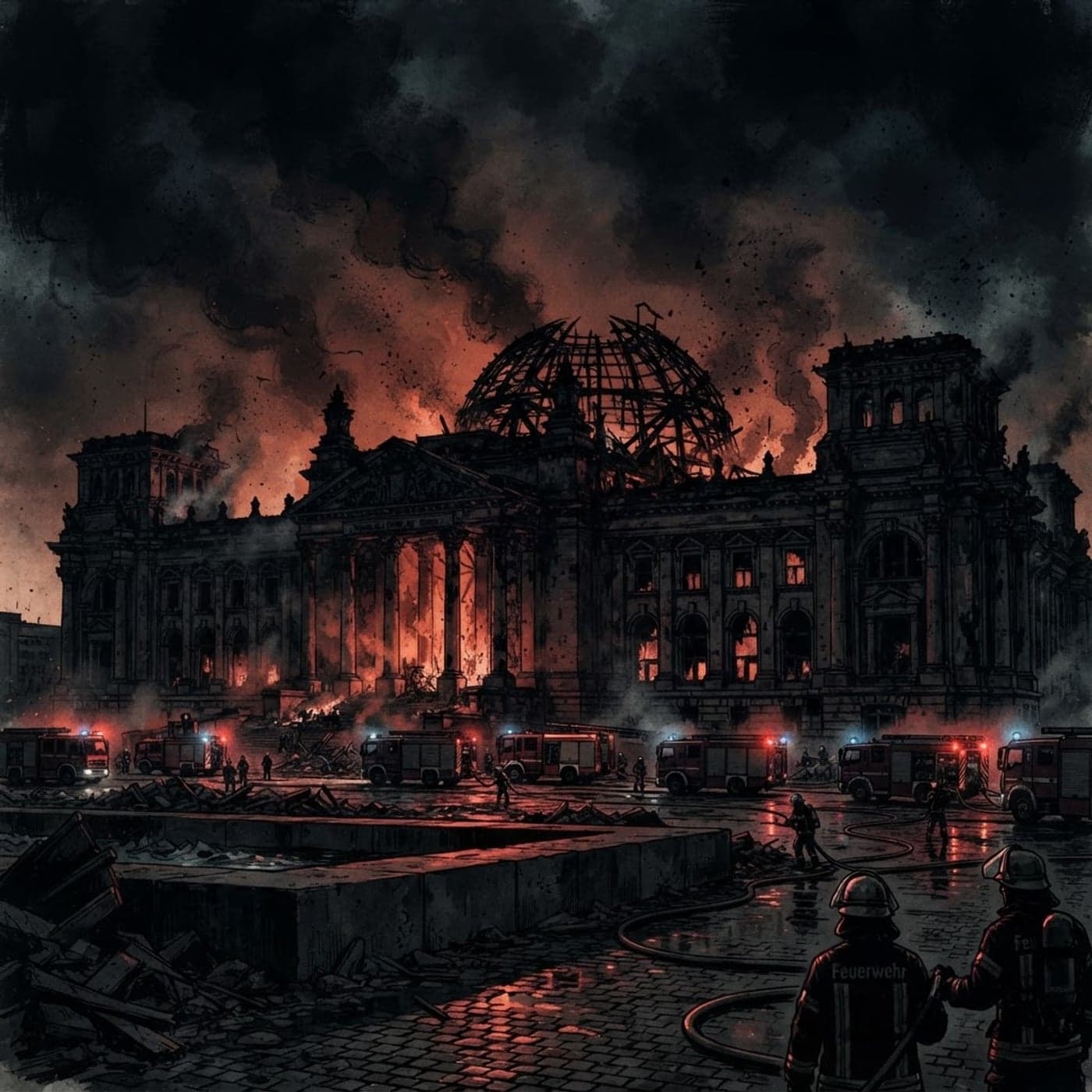
A single act of arson, four weeks after Hitler became Chancellor, plunged Germany into chaos and paved the way for Nazi totalitarianism.
From the Reichstag fire Wikipedia page. The hosts are synthetic voices.
Read the script
On the night of February 27th, 1933, the German parliament building, the Reichstag, went up in flames. This wasn't just any fire. This was the fire that, in the words of one historian, 'paved the way for Nazi totalitarianism.' It happened just four weeks after Adolf Hitler became Chancellor. The official story, the one that quickly took hold, was simple: a lone Dutch communist named Marinus van der Lubbe was the sole culprit. He was found at the scene, and the Nazis, eager for a narrative, immediately declared it proof of a communist plot to overthrow the government. But what if that story, the one that led directly to the suspension of civil liberties and the consolidation of Nazi power, wasn't the whole truth? What if the fire itself, and the man found in it, are more complicated than we've been led to believe? The Reichstag fire is a pivotal moment in history. It’s the event that allowed Hitler to convince President Hindenburg to issue the infamous Reichstag Fire Decree. This decree, enacted under Article 48 of the Weimar Constitution, suspended fundamental civil liberties – freedom of speech, freedom of the press, the right to assemble. Suddenly, the government had the power to arrest anyone, to silence any opposition. And who was the primary target of these arrests? Communists. Thousands were rounded up, including all communist members of the Reichstag. This crackdown had a direct impact on the March 5th elections. With the Communist Party effectively neutered, the Nazis, who had previously held only a plurality, saw their vote share increase. This, combined with their allies, gave them a majority in the Reichstag. And with that majority, they were able to pass the Enabling Act, effectively handing Hitler dictatorial powers. The fire, in essence, was the spark that ignited the Nazi dictatorship. Now, Marinus van der Lubbe was convicted of starting the fire and was executed in January 1934. For years, he was portrayed as the sole perpetrator, a radical communist acting alone. But even at the time, questions lingered. Was he truly acting alone? Or was he a pawn in a much larger game? Consider the trial. Van der Lubbe was convicted, but the four other communists charged alongside him – Georgi Dimitrov, Vasil Tanev, Blagoy Popov, and Ernst Torgler – were acquitted due to insufficient evidence. The judge explicitly stated that while he believed there was a communist conspiracy, he couldn't connect the others to the fire. And then there's the testimony of Georgi Dimitrov himself. During the trial, Dimitrov, who was a prominent Comintern operative, directly confronted Hermann Göring, the Prussian Interior Minister and a key Nazi figure. Dimitrov systematically dismantled the Nazi narrative, questioning the very evidence presented. He pointed out inconsistencies in reports about what was found on van der Lubbe, and challenged Göring on the lack of investigation into van der Lubbe's alleged accomplices. Göring, in response, became increasingly agitated, resorting to personal attacks rather than addressing the substance of Dimitrov's questions. Historians have long debated van der Lubbe's role. Some, like the British reporter Sefton Delmer, believed van der Lubbe acted alone, but that the Nazis exaggerated his role to create a broader conspiracy. Others, including writers like William Shirer, have argued that van der Lubbe was a 'dupe,' encouraged by the Nazis to start a fire, but that the main blaze was set by stormtroopers. Shirer pointed to the quantity of accelerants used, suggesting one man couldn't have carried them or started so many fires so quickly. Fritz Tobias, a German public servant and historian, published extensive research in the 1960s arguing that van der Lubbe was indeed a pyromaniac who acted alone. He presented evidence of van der Lubbe's prior arson attempts. However, even Tobias acknowledged that van der Lubbe's actions were used by the Nazis to their advantage. What is clear is that the Nazis seized upon the fire with astonishing speed and ferocity. Hitler himself called it a 'sign from God' and the beginning of a 'communist revolt.' This narrative of an imminent communist uprising was precisely what they needed to justify extraordinary measures. So, while the consensus among historians is that van der Lubbe did set the fire, the question of whether he acted alone, or was manipulated, or if the Nazis themselves played a role in igniting the blaze, remains a subject of intense debate. The crucial point is that regardless of the exact mechanics of the fire, the Nazi regime used it as the perfect pretext. The fire provided them with the justification to dismantle democratic freedoms and consolidate their power. It’s a stark reminder of how a single event, amplified and exploited, can dramatically alter the course of history. The story of the Reichstag fire, and Marinus van der Lubbe, is based on the Wikipedia article titled Reichstag fire, available under Creative Commons. The hosts are synthetic voices.